- About
- Visiting
- What’s On
- Venue hire
- Catalogues
- Collections
- 101 Treasures of Chetham’s
- Digital Resources
- The Flowers of Histories
- A Book of Hours from France
- The Manchester Scrapbook
- Thomas Barritt of Manchester
- Art Treasures Examiner of 1857
- Manchester Association for Constitutional Order
- The North Western Museum of Science and Industry: Some Reminiscences by Richard Hills
- Criminal Manchester
- The Cup of Destiny
- Athenaeum Souvenir
- Middle English Manuscripts
- Manchester and Liverpool of Today
- Hollingworth’s Mancuniensis
- Memoir of Cecil Wray
- William Seward’s Diary
- The Anti-Monopolist
- Fishwick’s History of Rochdale
- Knyvett’s Defence of this Realm
- Tractatus de Nigromantia
- Axon Ballads
- Printed Books & Ephemera
- Archives & Manuscripts
- Prints and Photographs
- Blog
- Support us
Shakespeare’s Third Folio (1664)
Although Chetham’s Library is not lucky enough to possess a copy of Shakespeare’s First Folio (1623), it does have a copy of the even rarer Third Folio (1664). The First Folio, published seven years after Shakespeare’s death, collected together thirty-six of his plays, eighteen of which had never been published before. The Third Folio added a further seven plays, although only one of these is now recognised as being by Shakespeare. The new play, Pericles, Prince of Tyre (1607), is now thought to have been a co-authored work.
The Third Folio’s publication date of 1664 is significant for two reasons. First, following the Restoration of Charles II to the throne in 1660 and the re-opening of the theatres, there was a new appetite for drama and public entertainment. The theatres had been closed during the Puritan Republic, and public performances of plays had been illegal. The re-opening of the theatres also saw, for the first time, public performances by women. Shakespeare’s heroines, such as Juliet, Ophelia, Desdemona and Lady Macbeth, had previously been played by boy actors, but the new popularity of actresses with the theatre-going public was so great that many plays were re-written to include more female parts. A revived interest in drama no doubt contributed to the commercial viability of the Third Folio. Second, the publication date of 1664 might explain the scarcity of copies of the Third Folio: the seventeenth-century London book trade was centred on the area around St Paul’s Cathedral, and it is likely that any unsold copies of the Third Folio were destroyed in the Great Fire of London in 1666.
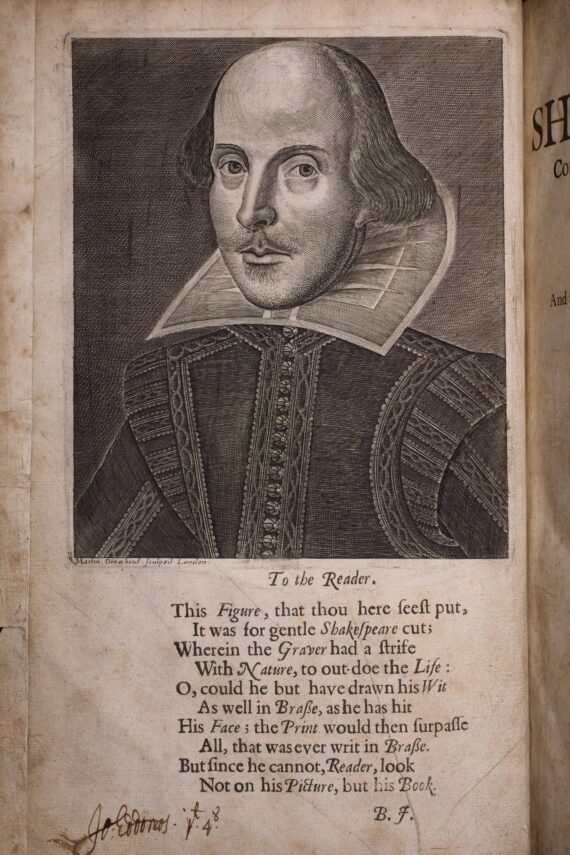
In Chetham’s Library’s copy of the Third Folio (Chetham’s Library, Mun. 7.B.1.2), the inscription ‘Jo: Eddowes’ appears on the page featuring the famous Droeshout engraving of Shakespeare and Ben Jonson’s poem ‘To the Reader’. It is possible that Jo(hn?) Eddowes was the first owner of Chetham’s Library’s copy of the Third Folio. A bookplate indicates that by the early eighteenth century, it was the property of Frances, Viscountess Scudamore (1684–1729). Chetham’s Library probably acquired the volume in the late eighteenth or early nineteenth century.
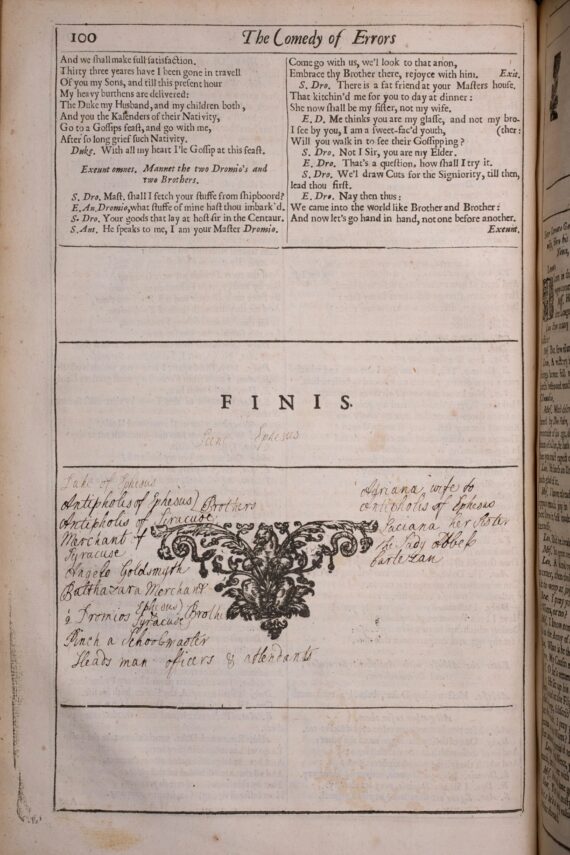
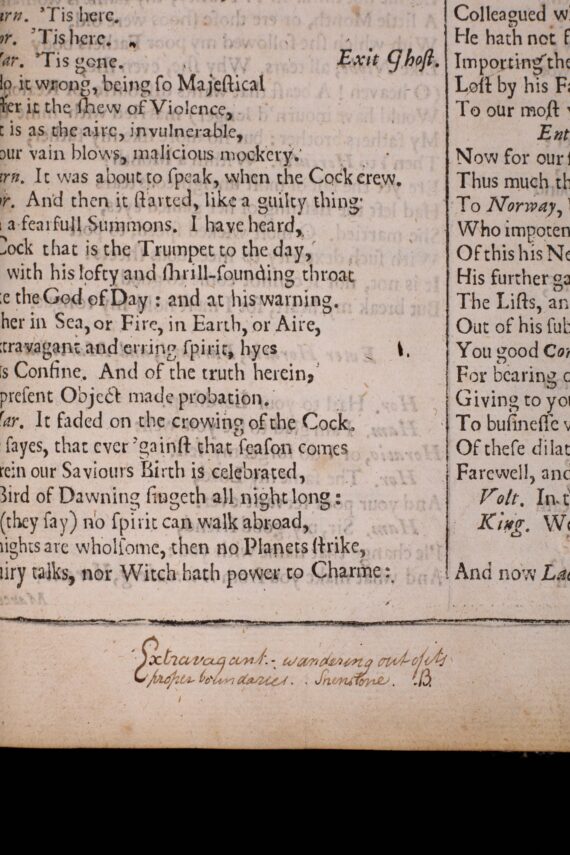
Chetham’s Library’s copy of the Third Folio had attentive early readers who added marginalia. Extra stage directions were written by hand in The Tempest, and five of the comedies feature handwritten character lists at their conclusions. The text of Hamlet also contains marginalia: one reader glossed the word ‘extravagant’ as meaning ‘wandering out of its proper bounds’, based on its Latin etymology. The word describes the Ghost of Hamlet’s Father, who has left purgatory to walk the earth and reveal his murderer. By the eighteenth century, this earlier meaning needed explaining, since ‘extravagant’ had primarily come to have connotations of recklessness, particularly financial, a meaning that has endured to the present day. A classically-educated reader also noted a similarity between Hamlet and the Greek tragedy Persae by Aeschylus.
Like the previous two editions of Shakespeare’s plays, the Third Folio contains a dedication written by the editors, Heminge and Condell, who were colleagues of Shakespeare and first collected his plays together for publication in a single volume. The work was dedicated to two aristocratic brothers, William Herbert, Earl of Pembroke, and Philip Herbert, Earl of Montgomery, and the dedicatory letter is written in the usual seventeenth-century style of extreme flattery of aristocratic patrons. Heminge and Condell’s sycophantic language almost appears to belittle the plays they supposedly recommend, referring to them as ‘these trifles’. In Chetham’s Library’s copy of the Third Folio, a later reader wrote a single word, ‘blasphemy’, above ‘trifles’. The reader’s judgement is a strikingly literal example of what came to be known as Bardolatry. Shakespeare’s reputation from the later eighteenth century grew to such an extent that his writings came to be regarded almost as a sacred text. The reader, offended by Heminge and Condell’s apparent disparagement of the plays, expressed their sense of outrage on the book itself, possibly even after it had been acquired by Chetham’s Library.