On 8 September 1597, the famed Renaissance polymath John Dee wrote to his friend, Sir Edward Dyer, to complain about the ‘tymes of very great dearth here … I can not see how my household of eighteen could live on the daily stipend of 4s … so hard & thinne a dyet, never in all my life, did I, nay was I forced, so long, to taste.’ At the beginning of the previous year, Dee had arrived in the town to take up the wardenship of its collegiate church, then known as Christ’s College, to which he had been appointed by Elizabeth I. Educated at Cambridge University, Dee had originally pursued a career at the changeable royal court, becoming Elizabeth’s astrological and scientific advisor, but when his proposals for calendar reform were rejected in 1583, he travelled to the continent and stayed at the courts of Europe. Upon his return in 1589, he discovered that his home of Mortlake had been ransacked and his cherished library sold to pay off his debts in his absence. He consequently sought financial compensation for his losses from Elizabeth, in whose gift the wardenship of Manchester’s college lay.
Chetham’s Library’s latest exhibition focuses on John Dee’s life and his connection to our buildings and the library’s collections. Although Dee hoped that the wardenship of the college would provide him with a consistent income and the chance to pursue his scientific studies uninterrupted, he found neither financial stability nor peaceful study during his tenure. Instead, he was continuously hindered by financial struggles, tensions with the college’s fellows, land disputes, and a persistent reputation for occult practices that followed him from the royal court to Manchester. He lost his wife Jane and potentially his three youngest daughters when the plague visited Manchester in 1604, and the following year, he quit Manchester and returned to his home at Mortlake (although he remained warden until his death in late 1608 or early 1609). Despite all of this, however, Dee was reasonably diligent in the exercise of his office, and was one of the last great wardens of the college before its seventeenth-century decline. Over the coming months, we look forward to exploring Dee’s life and experiences of Tudor Manchester with you.
On Friday 21 November, join us for an immersive after-hours event based on John Dee’s wardenship. Step into the college as Dee knew it, walk in his footsteps, and marvel at the books that he owned that are now part of the library’s collections (which are displayed together for the first time for one night only). You can find out more about the event and book tickets here.
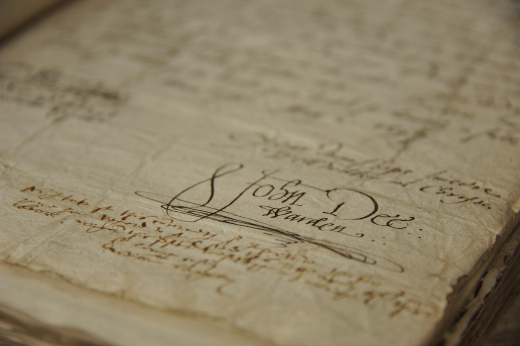
John Dee’s signature on a letter to William Langley, rector of Prestwich, dated 2 May 1597, concerning the bounds of the parish of Manchester (Chetham’s Library, Raines C.6.63, vol. 32, p. 9).
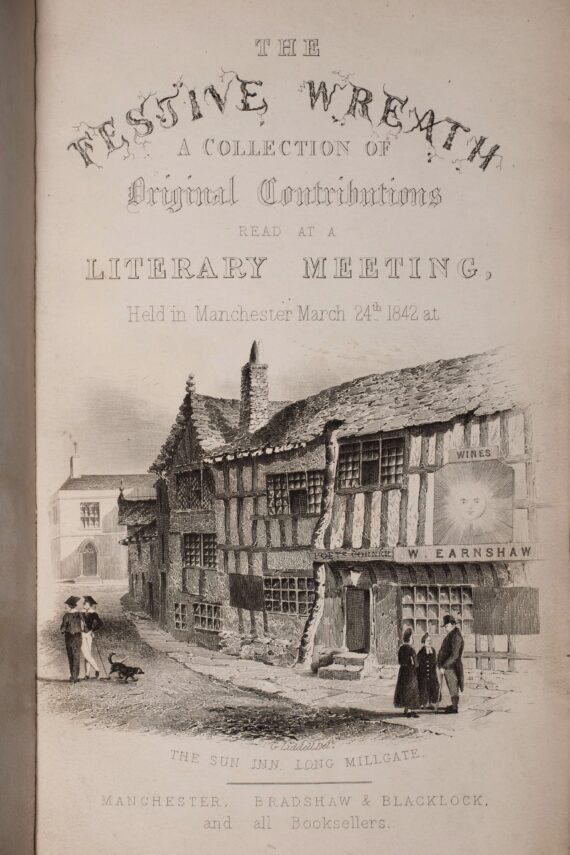
Grey and bustling, Manchester emerged during the eighteenth and nineteenth centuries as the first industrial city, churning out cotton through its steam mills and the toil of the labouring class to the great profit of the wealthy. Consequently, although it was cotton-rich, the city was seen to be culturally poor, since its inhabitants were more interested in generating capital than producing art. At the Sun Inn on Long Millgate, however, one could find Poet’s Corner and the Sun Inn Group, whose poetry challenged this perception of Manchester.
The Sun Inn Group, composed mainly of labouring-class poets, gathered in this public house to share ideas and their writings. One of its members, John Critchley Prince, was a reed maker, becoming an apprentice to his father at the age of nine to help provide for his family; other members were barbers (Richard Wright Prochter) and weavers (Samuel Bamford), who worked alongside their writing to support themselves and their families. The act of creativity, and especially the writing of poetry, can be understood as a radical act in the midst of the conditions of the poor, challenging perceptions about the Mancunian labouring-class mind. Labouring class professions were monotonous, requiring long hours for meagre wages, and factories were equalled in their cramped, poor conditions by the inhospitable homes to which factory workers returned. As a result of this inequality, Manchester was known for being politically-influential, leading the Chartist movement, which was concerned with the rights of the working class, working for better conditions and reforming attitudes towards the working class. The growing class consciousness and a desire for better amongst the labouring class that this movement reflected is also reflected in the poetry of the Sun Inn Group.
Figure 1: The title page of The Festive Wreath (Chetham’s Library, 8.J.5.70).
Poetry as an art form can have an emancipatory effect, both on readers and the poets themselves: both are offered a glimpse into a new world and new way of communicating in the poetic style, expanding the world outside of the confines of everyday life. The modern activist idea that ‘the personal is political’ encapsulates how everyday occurrences amount to the way society treats you and the life you lead. The poetical can be included here. Not only can the content of a poem be personal—and therefore political—or vice versa, but in writing poetry, the labouring class poet used their personal time for not just a creative but a political way, harnessing their free time to personal creation rather than creation to boost the economy. The disbelief that Mancunians could produce anything other than cotton—expressed by individuals such as John Stanley Gregson in his Gimcrackiana (1833), of which we have a copy in our collection—encapsulates the political agency that poetry represented as a means to imagine Mancunians as something other than cogs in a machine.
Whether or not John Critchley Prince saw himself as a reformer, his poem ‘Buckton Castle’ grounded this tension between the personal, political and poetical. In lines 109-116, Prince wrote:
‘Ye who in crowded town, o’ertoiled, o’erspent, For bread’s sake cling to desk, forge, wheel, and loom, Come, when the law allows, and let the bent Of your imprisoned minds have health and room; So ye may gaze upon the free and fair, Receive fresh vigour from the mountain sod’
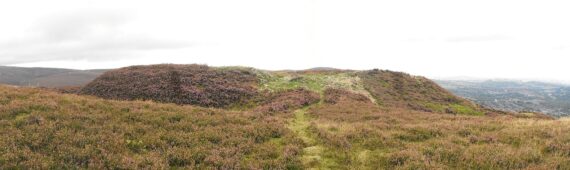
In this stanza, Prince explored the effects of city life on the labouring class. He evoked the Romantic view of the liberating quality of nature as a place for respite, encouraging the labouring class to escape the cramped city, breathe in the fresh air, and take a break. Like the act of writing poetry, this was time taken to express oneself and explore a different life. With his heavy workload, it is unlikely that Prince and other labourers would have much leisure time, but poems like such as these helped imagine a new future for the labouring class. Although much of the poem focused on the beauty of the area, the eponymous Buckton Castle is a medieval ruin, and its remnants may have reminded the reader that the great structures that signified wealth and power—like the factories that towered over the Sun Inn—could fall.
Figure 2: The view from Buckton Castle (photograph by Richard Nevell, 2009).
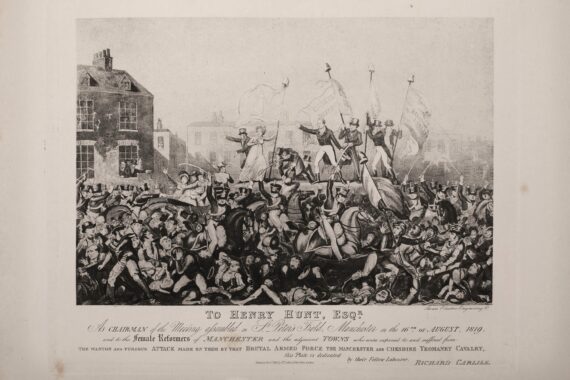
The influence of the Romantic movement is undeniable in the works of the Sun Inn poets. Romanticism promoted a return to nature, seeking the sublime, and detested the man-made and the industrialisation of society. Many Romantic poets, such as Shelley and Wordsworth, came from affluent backgrounds, and enjoyed lengthy educations and the leisure time to reflect and write poetry. As was mentioned in one of our recent blog posts, collections of Romantic poetry were more expensive and harder to come by in the north of England. Romantic writing was often concerned with the imprisonment of man’s mind, and called for liberation and equality, values that were shared with Chartism. Indeed, Shelley wrote ‘The Masque of Anarchy’ inspired by the Peterloo Massacre, at which Samuel Bamford (another member of the Sun Inn Group) was present. Prince wrote in his sonnet ‘On Receiving From a Friend the Poems of Keats’ that:
‘Oh! thou hast pleased me to my heart’s content, And set my jarring feelings all in tune. ‘Twere sweet to lie upon the lap of June, Half hidden in a galaxy of flowers, Beneath the shadow of impending bowers, And pore upon his page from morn till noon. ‘Twere sweet to slumber by some calm lagoon’
In this sonnet, Prince demonstrated the transformative effect of poetry, the that comfort it provided and the creative capability of the labouring classed in Manchester. In exploring the way that he found himself moved by Keat’s language, Prince felt that it ‘‘twere sweet to slumber by some calm lagoon’. In writing about being transported to this idyllic moment of rest and beauty, we see the importance of reading poetry within labouring class communities, which helped one dream of a better life.
The first wave of workers to flock to Manchester for job opportunities came from the fields, looking for regular employment rather than seasonal harvest work, and rural life and the natural world were frequently praised in poems by the Sun Inn Group. Like the Romantics, they looked back on what they saw as a simpler, ‘purer’ time and way of life, and mourned what they felt was being lost as factory work and machines came to define the working lives of the common man. On the other hand, poetry also reveals class divides and the struggles of labouring class poets; the Sun Inn Group were regionally known, but were restricted in their artistic success. Prince, for example, relied on the patronage of others in order to complete his work, and still laboured six days a week alongside his writing. Classist ideas and the time taken up working or facing persecution from the authorities were barriers to poetry’s emancipatory effect.
Figure 3: An engraving depicting the Peterloo Massacre (Chetham’s Library, 12.F.3.21, np).
The oral poetic tradition lent itself to the poetry of the labouring class, and the Sun Inn played an important role in the poetic scene of nineteenth century Manchester. As a public house, the Sun Inn functioned as a ‘third space’ for the labouring class to gather and share ideas and poetry, free from industrial obligations. In sharing their poems aloud, the Sun Inn Group exemplified the oral tradition as an accessible art form, since the need to be able to read was obviated. Although Chetham’s Library was something of an exception, most libraries were not open to all, and as the Peterloo Massacre of 1819 demonstrated, protests and ideals of Chartism were not welcomed by the authorities. The Sun Inn therefore played a crucial role in the expression of the labouring class, since their opinions and art found a home in this spaces. Charles Swain’s poem ‘Poor Man’s Song’ began:
‘Oh! better be poor and be merry, Than rich as a lord and be sad; For good beer laughs louder than sherry, Which never such happy friends had!’
Through this ballad-like poem, Swain demonstrated the community among the labouring class and the unifying nature of public houses, with the energy which he opened his poem with and the direct references to the rich versus the poor. Poetry could be a catalyst for pride in the labouring classes, since it was through poetry that Swain found a way to express this. Just as the Chartist movement helped to create pride and a sense of identity for the labouring class, poems such as ‘Poor Man’s Song’ contributed to a growing collection of literature that reflected the lived experiences and traditions of the working class.
In looking at the economic, political and artistic background to the Sun Inn Group’s lives and work, poetry can be understood as a crucial creative element in the expression of class struggle, raising awareness of the conditions of the working class and the effects of industrialisation on the mind. Although poetry was unable to lift the labouring class out of poverty or vanquish classism, the creative output of the labouring class could help unify the masses, provide an outlet for workers, and put Manchester on the map for artists.
Maisie, our placement student, recently completed a project to finish cataloguing the Cass Collection, which originally arrived at Chetham’s Library in 2016:
Between January and April, I spent 20 days working on the Cass Collection at Chetham’s Library as part of my Master’s degree in Library and Archive Studies at the University of Manchester. In the nineteenth century, Chetham’s Library began to specialise in the history and topography of the North West of England, collecting material related to Manchester and the surrounding regions. Donated to the library in 2016, the Cass Collection comprises works local to the North West, with an emphasis on dialect writing. The majority of the material dates to the nineteenth and twentieth century, and captures local and working-class voices of enduring appeal for readers in Manchester and beyond. You can read a previous blog post about this collection here.
The scholar and bibliophile Eddie Cass (1937-2014) pursued careers in banking and coal mining before turning to academia in later life to explore his penchant for folklore and Lancashire dialect writing. He amassed a considerable collection of works, over six hundred of which are now held by Chetham’s Library. Contained within the collection are books, pamphlets, essays, dictionaries, poetry collections, dialect literature, songbooks, biographies and more.
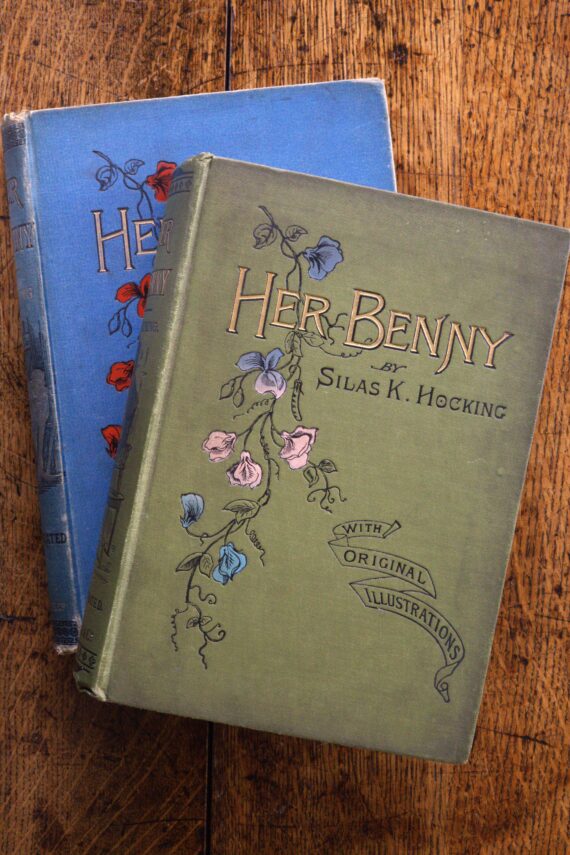
Figure 1: Copies of Her Benny, Lancashire fiction within the Cass Collection (Chetham’s Library, 12.F.7.11-12).
Cass was embedded in the cultural fabric of Manchester, and was a prominent voice at many literary and heritage institutions. President of the Manchester Literary and Philosophical Society, he was a trustee for the People’s History Museum, and chairman of the Portico Library between 1988 and 1990, where he supported various exhibitions. The foremost expert on the Lancashire pace-egg plays, Cass was also the president of the Folklore Society from 2008 to 2011, and donated a portion of his collection to the society, currently housed at the University of Sheffield.
Since its arrival in 2016, the Cass Collection has proved popular among readers, which was posing problems for the library in the lead-up to my placement. The library had made a start on cataloguing the collection, but the work was incomplete. Staff were finding it hard to locate material, and researchers were not privy to the full extent of the collection. Like most material at Chetham’s, the Cass Collection is closed access, meaning readers cannot browse the shelves for themselves. This means that any uncatalogued or unlisted titles are effectively invisible, making cataloguing a top priority.
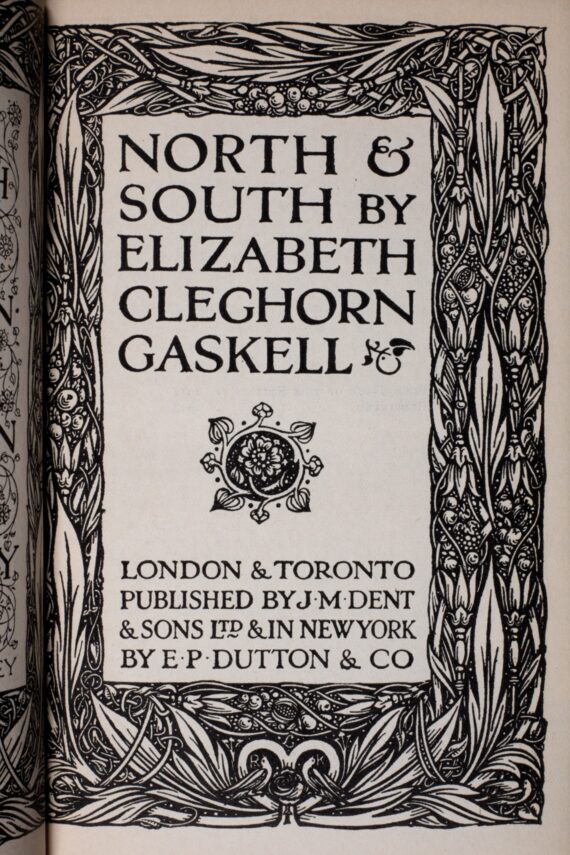
Figure 2: One of the library’s copies of Elizabeth Gaskell’s North and South (Chetham’s Library, 12.F.5.26, title page).
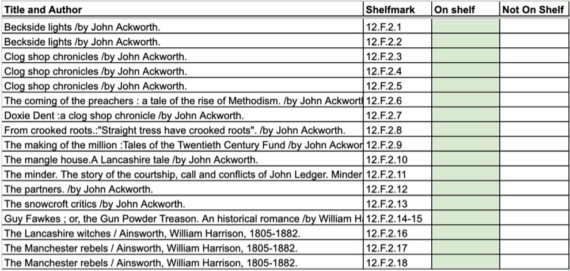
This is where my placement has come in. I was tasked with conducting a shelf check of the collection against the existing online catalogue, and creating records for uncatalogued items. I began by searching for the books by location using the online catalogue in order to create a list to compare against the shelves. I worked my way through the collection, coming across missing, misplaced, partially catalogued and uncatalogued works. I used these findings to create a second ‘to-do’ list of material that stood in need of cataloguing or updating. To avoid duplicating existing records, I cross-referenced my list with Chetham’s catalogue, to see if any of the books I’d identified were catalogued elsewhere in the library. I also made a note of any missing works, many of which I managed to find as the placement went on.
Figure 3: An example of the spreadsheet created by Maisie to help with cataloguing.
Once I finished taking stock of the shelves, I was ready to begin cataloguing. I was set up on Chetham’s test system to begin with, allowing me to practice working with the software while preventing me from accidentally deleting the existing records. I created my first records with the support of the Assistant Librarian, Laura Bryer, who took me through the main fields and the Resource Description and Access (RDA) cataloguing standard employed by the library. I also learned how to download and modify records from existing bibliographic databases.
Figure 4: The V-Smart cataloguing test software used by the library.
After cataloguing a few test records, I was added to the live system. I taught myself how to create a template record, filling in pre-set fields specific to the Cass Collection, and added all of the records I worked on to a designated save list for review. For each volume, I entered information about the author, title, place of publication, publisher, date, physical extent, format, acquisition, subject, genre and location. As I went along, I moved volumes around to save space and keep the collection together, and added shelfmarks on visible acid-free slips to facilitate future retrievals.
Figure 5: The completed project – books on shelf, fully catalogued and with acid free slips.
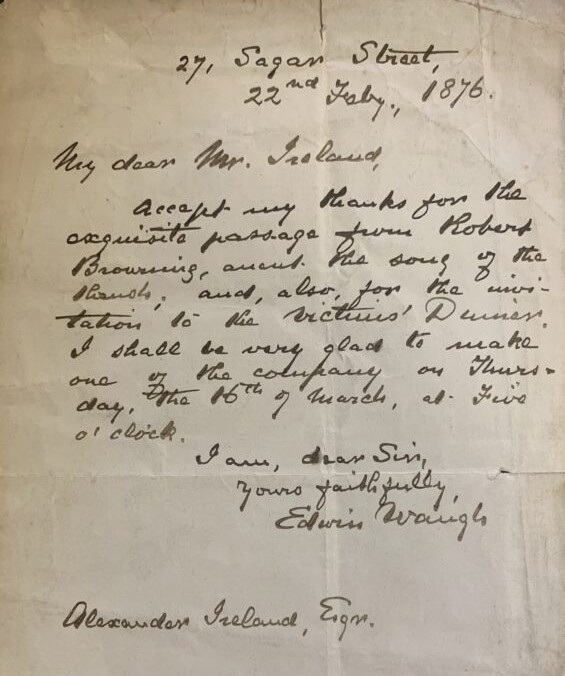
By the time I’d finished cataloguing, the ‘nearly three-hundred titles’ described in the first blog post about the collection had become 680 (including works split across multiple volumes). Accompanying the books is also a small amount of archival material, containing some of Cass’ research photographs, some sheet music, and a letter addressed to a Mr Ireland by Edwin Waugh.
Figure 6: One of the archival items within the Cass Collection, a letter from Edwin Waugh to a Mr Ireland (Chetham’s Library, no shelfmark).
I’m so pleased that I opted to do a placement as part of my degree, and couldn’t have asked for a better place to work than Chetham’s Library. I really enjoyed this project, and came away with first-hand experience of cataloguing and collection management, which I know will stand me in good stead as I progress into the wider world of libraries and archives. I now have a much deeper appreciation for the work that goes into making material accessible to readers, and I hope that the work that I have done will make it easier for readers to engage with this fantastic collection, which is now available to browse in its entirety on our online catalogue.
I want to extend a heartfelt thank you to the entire team at Chetham’s Library for their support and encouragement throughout my placement. I will really miss working, and lunching, with you all.
Blog post by Maisie Proctor
We use cookies to ensure that we give you the best experience on our website. If you continue to use this site we will assume that you are happy with it.