Author Archives: Emma Nelson

  1. John Dee, Re-animator of Corpses, and Humphrey Chetham, Rejected Young Lover: Fictional Versions of Real People in W. H. Ainsworth’s Guy Fawkes (1841)

    Leave a Comment

    William Harrison Ainsworth, the popular Victorian historical novelist, had a long association with Chetham’s Library. Born in King Street, Manchester, in 1805, Ainsworth attended Manchester Grammar School on the library’s doorstep, and as a teenager, became a solicitor’s clerk. Escaping the tedium of his job, he spent many hours reading in Chetham’s Library. His favourite poems were those of Byron, featuring tortured heroes, while the historical novels of Walter Scott and the Gothic romances of Ann Radcliffe and Matthew Lewis also inspired him. The atmosphere of Chetham’s Library also exerted a powerful effect on his imagination: although there is no historical evidence to suggest that Guy Fawkes had any direct association with Christ’s College, Manchester, or with John Dee, its warden at the time of the Gunpowder Plot, Ainsworth set several scenes in his novel Guy Fawkes, or The Gunpowder Treason: An Historical Romance (1841) in the buildings that later became Chetham’s Library and Hospital School. In this work, he mixed real historical characters, such as Guy Fawkes, John Dee and Humphrey Chetham, with romantic inventions such as the heroine Viviana Radcliffe, the young, beautiful Roman Catholic mistress of Ordsall Hall, who is also the love interest of both Fawkes and Chetham. Throughout the novel, Ainsworth characterised Chetham as an altruistic, rational and tolerant Protestant, in contrast with the more dashing, violent and impulsive Catholic Fawkes. It is, of course, Fawkes whom Viviana favours.

    The novel begins in late June 1605, when the Gunpowder Plot is already well advanced. Guy Fawkes is in Manchester, witnessing the gory executions of two Jesuit priests outside the Collegiate Church. The executions, although fictitious, were based by Ainsworth on real executions carried out in Lancaster, York and London during Elizabeth I’s reign. A local prophetess, Elizabeth Orton, intervenes dramatically but dies after attempting to escape from the soldiers pursuing her. Shortly afterwards, a young Humphrey Chetham and Guy Fawkes witness her body being exhumed from the section of the collegiate church’s graveyard reserved for criminals. It is Chetham who recognises the body snatchers: ‘the famous Doctor Dee … divine, mathematician, astrologer—and if report speaks truly, conjuror … and the other in the Polish cap is the no-less celebrated Edward Kelley, the doctor’s assistant, or, as he is ordinarily termed, his seer’.
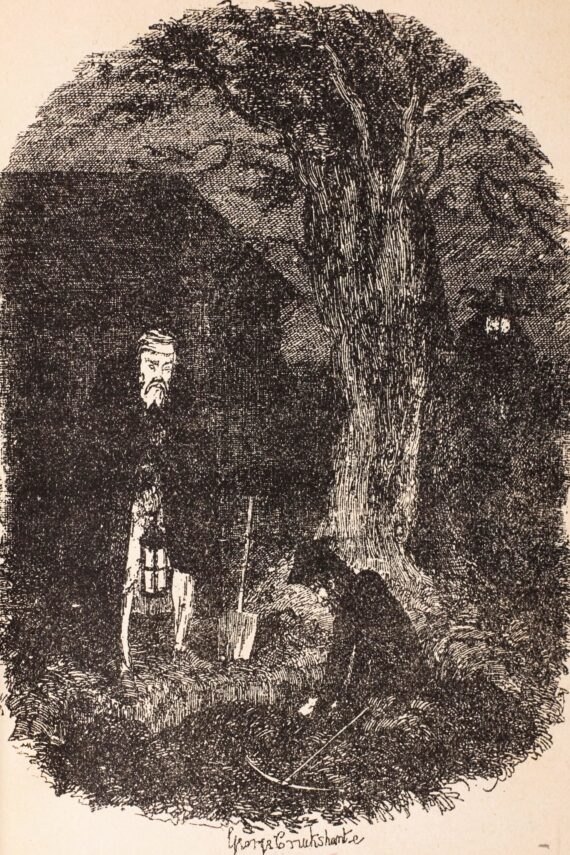
    An engraved print depicting a graveyard. A figure in black stands in an open grave with a pickaxe to the side, while another man in a black cloak and cap and holding a lantern watches over him. From behind a tree, a third figure wearing a conical hat with a brim and feather observes the scene.

    Figure 1: John Dee and Edward Kelley exhume the body of Elizabeth Orton, watched by Guy Fawkes (Chetham’s Library, 12.F.2.14, plate after p. 60).

    Disregarding the inconvenient facts that Kelley had died in 1597 and that Dee had left Manchester in November 1604, Ainsworth constructed a narrative in which Fawkes witnesses Dee and Kelley re-animate the corpse of Elizabeth Orton in order to hear more of her prophecies. In a scene of supernatural horror, Fawkes asks the corpse for information about the success of his scheme. The prophecy, however, is ambiguous: ‘”the end will be death,” replied the corpse’.

    Eager to learn more about his future fate, Fawkes is taken by Dee into ‘a large chamber, panelled with oak, and having a curiously moulded ceiling, ornamented with grotesque sculpture’, recognisable as the present Audit Room. From there, he is led through intricate passages to a chamber ‘which was evidently the magician’s sacred retreat’. In a recess behind a black curtain, Dee’s show-stone is placed on a table ‘covered with cabalistic characters and figures, referring to the celestial influences’. If Ainsworth was thinking here of the present Reading Room, the recess he describes may be the alcove in which Marx and Engels later came to study, or a small room known as the ‘scriptorium’. Ainsworth’s description of the ensuing ritual involves Dee and Kelley throwing gums and herbs onto a brasier, producing noxious and fragrant odours and multi-coloured flames, with accompanying incantations, howling, shrieking, music, laughter and silence: ‘“the spirits are at hand!” cried Dee. “Do not look behind you or they will tear you to pieces!”’. Fawkes is afforded three visions: one shows the conspirators taking their oath in the past; a second vision is of a gloomy vault filled with wood and barrels of gunpowder in the present; finally, in the future, Fawkes sees a crowd of skeletons pointing their bony fingers at ‘a figure resembling himself, stretched upon the wheel, and writhing in the agonies of torture’. Dee forewarns Fawkes of the failure of his plot and attempts to discourage him from proceeding further with it, to no avail.
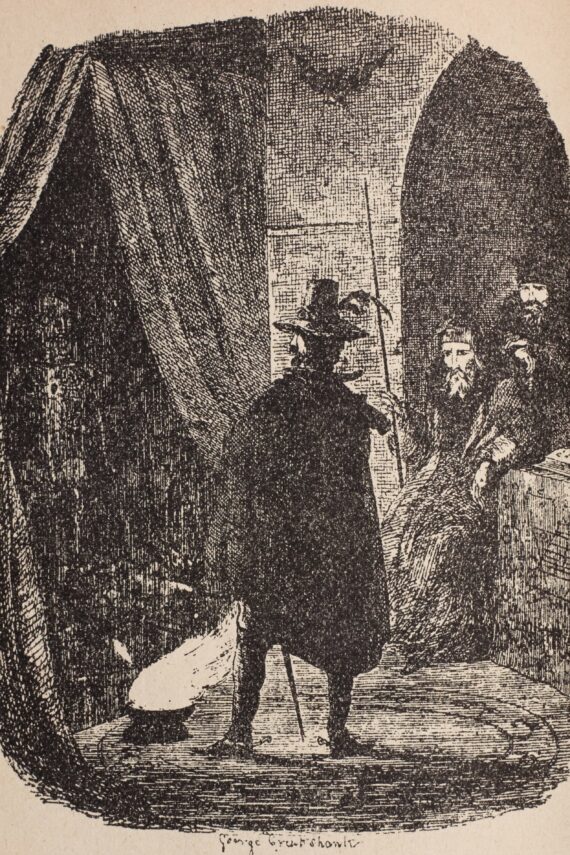
    An engraved print depicting a room. A man wearing a wearing a black cloak and a conical hat with a brim and feather stands in a circle drawn on the floor with a brazier in front of him. Two figures are seated to the right of him, and in front of him, a skeleton is visible behind a parted curtain.

    Figure 2: John Dee and Edward Kelley summon up a vision of Guy Fawkes’ future fate (Chetham’s Library, 8.E.1.27, plate before p. 61).

    Ainsworth was clearly not averse to embellishing the myth of Doctor Dee with all the paraphernalia of Gothic fiction at his disposal, including the re-animation of a corpse, elaborate conjuring and horrific prophetic visions. Later in the narrative, Dee appears as a more benevolent figure, saving the life of the injured Fawkes with the aid of his supernatural knowledge. He consults his show-stone and produces ‘an elixir of wonderful efficacy … a gourd-shaped bottle with a clear sparkling liquid’. He applies some of this to Fawkes’s temples and makes him drink three draughts of it. Dee, however, is in some doubt over whether this is the right thing to do: ‘I am debating within myself whether it is worthwhile reviving him for a more dreadful fate’. Dee is no doubt remembering the former vision of multiple skeletons pointing at Fawkes being tortured.

    Dee’s ministrations lead to Fawkes’ recovery, and he secretly marries the heroine, Viviana Radcliffe. After Fawkes’s arrest and imprisonment, Dee makes a further appearance, attempting to help Viviana. Despite her being Catholic, she had not supported Fawkes’ plot to blow up the king and the Houses of Parliament. She was, however, aware of the conspiracy, and was culpable in not having reported it. It was Dee who had revealed the plot to the Earl of Salisbury, and he therefore believes that he can arrange a merciful judgement on Viviana. He tries to persuade her that he can help her regain her mansion and estates, but that she must obey him by marrying Humphrey Chetham after Fawkes’s death. Although in love with Viviana, Chetham is aware that she does not love him, and is appalled by Dee’s attempts to bargain with her. He did not know of Dee’s intention in advance, and urges him ‘not to clog his proposal with conditions which cannot be fulfilled’. Viviana refuses to marry Humphrey Chetham, but requests that he escort her to London. She voluntarily surrenders herself to the authorities and pleads her case before the Earl of Salisbury and the king: ‘I was restrained from the disclosure [of the Gunpowder Plot] by a fatal passion!’ Her excuse does not impress her inquisitors, however, and she is imprisoned in the Tower of London. In a final meeting with Chetham, she regrets being unable to reciprocate his love, and expresses hope that he will ‘meet with someone worthy of [him]’. Chetham vows that he will never love again. She advises him to return to Manchester, and, as a cure for his unhappiness, to ‘devote [him]self to the business of life’ and ‘employ [him]self in [his] former occupations’. Shortly afterwards, Viviana dies before the conspirators come to trial.
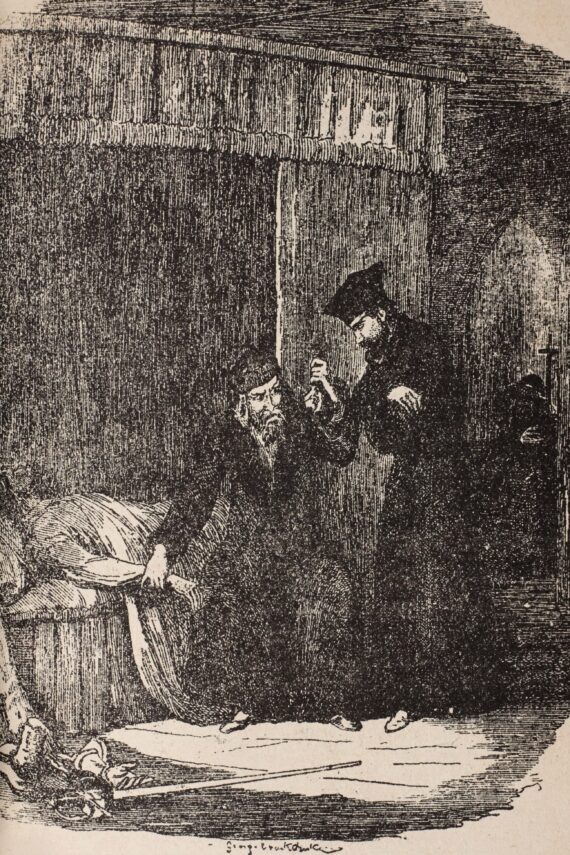
    An engraved print depicting a room. A man in a white shirt lies in a bed. A man wearing a long fur-lined robe and a cap crouches by him with a flask in hand, and converses with another man wearing a long black robe.

    Figure 3: John Dee and Edward Kelley revive the injured Guy Fawkes with a magical potion (Chetham’s Library, 8.E.1.27, plate after p. 140).

    Ainsworth portrays Humphrey Chetham as the unsuccessful lover who never recovers from his unrequited passion for Viviana. The trauma of rejection and the premature death of Viviana affect him for the rest of his life: he remains unmarried and channels his energies, as she had advised, into business, making money which he uses for philanthropic purposes. From the perspective of two centuries later, Ainsworth pays tribute to the founder of Chetham’s Library and Hospital School:

    ‘Obedient to Viviana’s last request, he quitted London … and, acting upon her advice, devoted himself on his return to Manchester to his mercantile pursuits. His perseverance and integrity were crowned with entire success, and he became in due season the wealthiest merchant of the town. But the blighting of his early affections tinged his whole life, and gave a melancholy to his thoughts and an austerity to his manner originally foreign to them. True to his promise, he died unmarried. His long and worthy career was marked by actions of the greatest benevolence. In proportion as his means increased, his charities were extended, and he truly became “a father to the fatherless and destitute”. To him the town of Manchester is indebted for the noble library and hospital bearing his name; and for these admirable institutions by which they so largely benefit, his memory must ever be held in veneration by its inhabitants’.

    Ainsworth’s sensationalist historical fiction has not found favour with later generations: the critical consensus has preferred the humour and social conscience of Dickens, the psychological depth of George Eliot, and the romantic passions of the Brontës. Novels such as Guy Fawkes give us an insight into early-Victorian popular taste, however: audiences then preferred simple characterisation, continuous rapid action, and fantastic and supernatural elements above historical accuracy. The teenage Ainsworth, escaping from the uncongenial work in his solicitor’s office, probably contemplated the portrait of Humphrey Chetham in the Reading Room, and twenty years later, he invented a psychological explanation of youthful romantic disappointment to reconcile the severity of Chetham’s later appearance in the portrait with the benevolence of his actions in devoting his wealth to the foundation of the Library and Hospital School, through a fictional association with the college’s most famous warden (for a more factual account of Dee’s time as warden, you can read a recent blog post on the topic).


    Blog post by John Cleary
  2. The Afterlives of John Dee’s Books

    1 Comment

    By the 1570s, John Dee had established at his home of Mortlake what has been described as the largest and most diverse library in Elizabethan England, containing—according to Dee—three thousand printed books and a thousand manuscripts. Before he departed for the continent in 1583, he selected eight hundred of his printed books and nearly a hundred manuscripts, requiring four coaches to transport these all around Europe. When he returned from the continent in 1589, however, he found that his home and much of his library at Mortlake had been plundered in his absence. From Dee’s once-fine collection, five books can now be found within Chetham’s Library’s collections, which have commonly been assumed to have remained in the college buildings between Dee’s departure and the library’s foundation in 1653, but their histories are actually much more interesting.

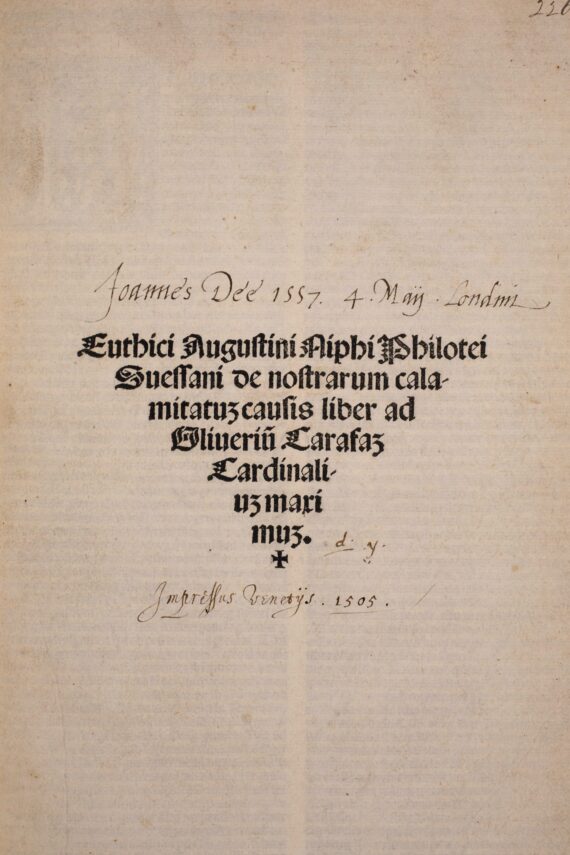
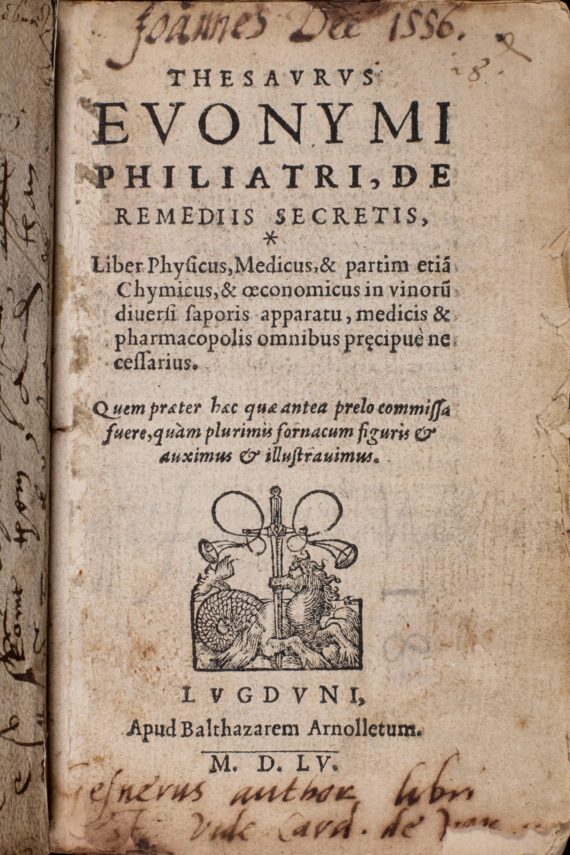
    Fortunately for us, Dee compiled two manuscript catalogues of his library in 1557 and 1583. Following his return from the continent, Dee annotated the latter catalogue, now in the library of Trinity College, Cambridge, and his notes provide an insight into the history of his books. This catalogue can be viewed online, also an edition of the catalogue was published by the Bibliographical Society in 1990. In its introduction, the editors suggest that Dee marked the books that he had taken with him with a ‘T’, and the books that he had left in the care of his brother-in-law Nicholas Fromond with an ‘Fr’. Two of Dee’s books now in Chetham’s Library’s collections—Konrad Gesner’s De remediis secretis (Chetham’s Library, Mun. 7.C.4.214) and Agostino Nifo’s Euthici Augustini (Chetham’s Library, Mun. A.6.42 (8))—were marked with a ‘T’, while three—Vitruvius’ De architectura (Chetham’s Library, P.8.23), Arrian’s Periplus euxeinou pontou (Chetham’s Library, Mun. 7.C.4.116) and Francesco Vimercati’s In quatuor libros Aristotelis meteorologicorum commentarii (Chetham’s Library, Dd.3.64(2))—were marked with an ‘Fr’.

    The title page of John Dee’s copy of Agostino Nifo’s Euthici Augustini. The title is printed in a gothic type in lines of decreasing length to form an inverted triangle shape, with a cross at the bottom. Above the title, the words ‘Joannes Dee 1557. 4. Maii. Londini’ have been written in a calligraphic hand in ink.

    Figure 1: The title page of John Dee’s copy of Agostino Nifo’s Euthici Augustini (Chetham’s Library, Mun. A.6.42 (8)).

    In some cases, we also know something of these books’ later provenance. Dee’s copy of Agostino Nifo’s Euthici Augustini, which was marked as taken, can be traced to the collection of the prominent Mancunian scholar and short-hand writer John Byrom (1692–1763). Byrom had close connections with Chetham’s Library: he had been offered and turned down the librarianship, but remained a close associate of one of Chetham’s Librarian Robert Thyer (1732–63), and regularly acted as an agent for the library, purchasing books at London auctions. Like Dee, Byrom was a noted bibliophile, whose large collection of printed books and manuscripts was donated to the library following the death of his descendant, Eleonora Atherton, in 1870.

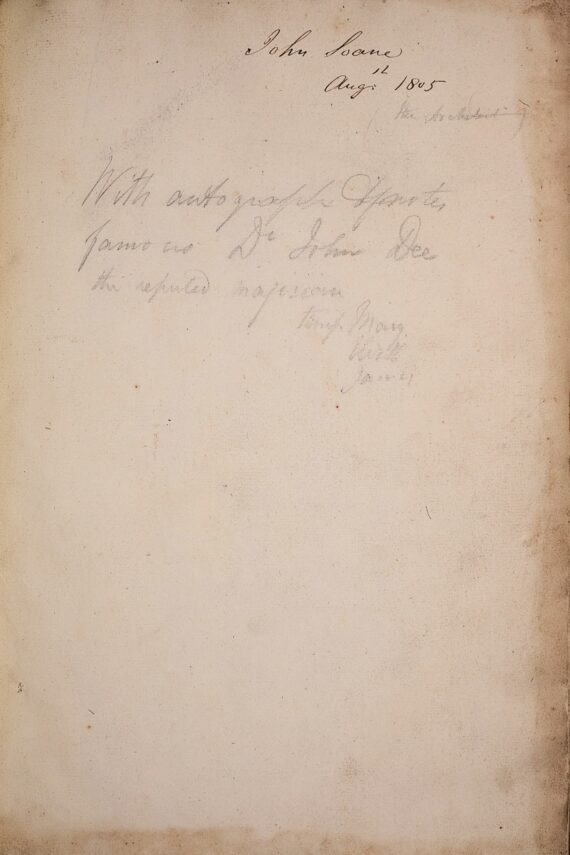
    Another of Dee’s books with an intriguing provenance is his copy of Vitruveus’ De architectura. Vitruvius was a Roman architect and engineer during the first century BC, but his work covered geometry, arithmetic, painting, music, astronomy, military fortification and the construction of machinery in addition to architecture. Besides Dee’s ownership mark, the title page of this book contains the inscription ‘John Soane Aug. 1805’, beneath which is written, in brackets and a different hand, ‘the Architect’. This refers to the renowned architect Sir John Soane, one of the most prominent architects of the Regency period, professor of architecture at the Royal Academy, and dedicated collector of paintings, sculpture, architectural fragments, models, books, drawings and furniture. His unique home can still be visited by the public today. This book had left Soane’s collection by 1871, when it appears in Chetham’s Library’s accessions register, having been purchased for three shillings and five pence from a Mr John Walker in London. Furthermore, Dee’s copy of the De architectura was not included in the first printed catalogue of Soane’s library in 1830, suggesting the book had left his collection during his lifetime.

    A blank page except for three annotations. The first, in ink, reads ‘John Soane, August 1805’; the second, in pencil and in brackets beneath it, reads ‘the Architect’; and the third, also in pencil and beneath both, reads ‘with autograph + notes famous Dr John Dee, reputed magician’

    Figure 2: Annotations in John Dee’s copy of Vitruveus’ De architectura (Chetham’s Library, P.8.23, n.p.).

    The acquisition of the remaining three books that belonged to Dee during the nineteenth century was linked to the formation of the Chetham Society in 1843, and to the influence of the local antiquarians who founded it (most notably James Crossley, Francis Robert Raines, Thomas Corser and Richard Parkinson). The Chetham Society is the oldest historical society in the North West of England, and the second most senior historical society in the North. The society’s interest in Dee is apparent in one of the earlier titles published by the society, The Autobiographical Tracts of Dr John Dee (1851). In the preface to this work, James Crossley explained that ‘the following Tracts having been printed off some time ago, it has been considered desirable to include them as part of the present volume. The Correspondence of Dr. Dee, with selections from his MSS. and printed works, will form a separate publication, to which will be prefixed a fuller account than has yet been given of the Life and Writings of this most extraordinary person’.

    The forthcoming publication referred to by Crossley could be either of two different works, the first of which was being prepared by Chetham’s Librarian Thomas Jones (1845–75). This work, A Selection of the Letters Written by Dr Dee with an Introduction of Collectanea Relating to his Life and Works, was listed as forthcoming in a list of works under contemplation and in progress in 1869. Unfortunately, Jones died before the work was completed, but the manuscript of it in his own hand was donated to the library as part of the Francis Robert Raines Collection in 1878. It was also during Jones’ librarianship that Dee’s printed items entered the collection, and the notes in the library’s accessions register that these copies belonged to Dee suggests that this was an important factor in their acquisition. The other work that Crossley may have been referring to was one being undertaken by John Eglinton Bailey, another Chetham Society stalwart and Lancashire antiquarian. Bailey was in the process of transcribing the diary that Dee kept during his time in Manchester, a work that was intended for private circulation, with only twenty copies published in 1880. The following year, he established the Palatine Notebook, a journal in which he published pieces on Dee’s printed books within Chetham’s Library, including Dee’s copy of Konrad Gesner’s De remediis secretis. Bailey was also a regular contributor to The Bibliographer, and wrote that ‘amongst other relics of the celebrated Dr Dee in Chetham’s Library is his copy of the 1533 edition of Arrian’s Circumnavigation of the Black Sea’.

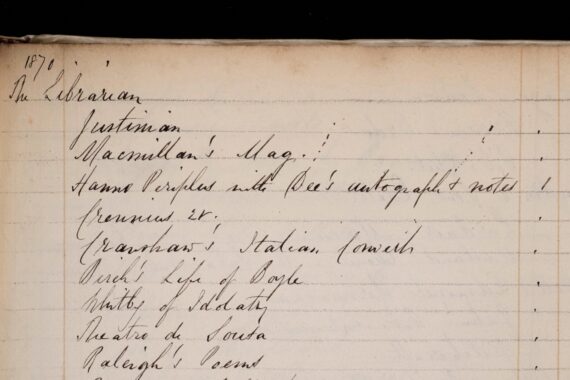
    A ruled table containing a list of books written in a cursive hand in ink beneath the sub-heading ‘the Librarian’. The third book on the page is ‘Hanno Periplus with Dee’s autograph and notes’.

    Figure 3: John Dee’s copy of Arrian’s Periplus euxeinou pontou in Chetham’s Library’s accessions register (Chetham’s Library, Chet/4/11/1, fol. 168r).

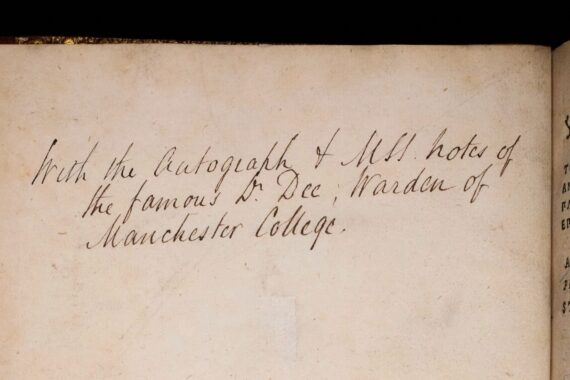
    Chetham’s Library’s accessions register records that Dee’s copy of Arrian’s Periplus euxeinou pontou entered the library’s collections in 1870 through purchase, and specifies that it contains ‘Dee’s autograph notes’. This detail was re-iterated in the acquired book itself, in which a nineteenth-century hand added the words ‘Autograph and MSS of the Famous Dr Dee Warden of Manchester College’. It is difficult to discern what happened to the book between Dee’s ownership of it and its acquisition by at the library (it was among those that were plundered while he was abroad), but there was clearly an appetite at Chetham’s Library and in its circle for collecting books that had belonged to Dee. This is further illustrated by Bailey’s correspondence with a Mr B. H. Beedam, in which he mentioned that he ‘came across another Dee note … the late Joseph Lilly, the bookseller, had a copy of Aristotelis Metereologica et cum Comentarius F. Vicomercarti, with the autograph of the former Dr Dee’. He cited the catalogue of the sale by Sotheby’s of the second portion of Lilly’s books in June and July 1871. The book that Bailey mentioned, Dee’s copy of Francesco Vimercati’s In quatuor libros Aristotelis meteorologicorum commentarii, entered the library’s collection by 1883. The fact that the correspondence mentioned ‘another Dee note’ suggests that books connected to Dee were actively being sought, at the very least by Bailey, who was serving as a member of the Chetham Society’s council by 1876, and as its secretary from 1882.

    A blank page containing an annotation reading ‘With the autograph + MSS notes of the famous Dr Dee, Warden of Manchester College’, in a cursive hand in ink.

    Figure 4: Annotation in John Dee’s copy of Arrian’s Periplus euxeinou pontou (Chetham’s Library, Mun. 7.C.4.116, n.p).

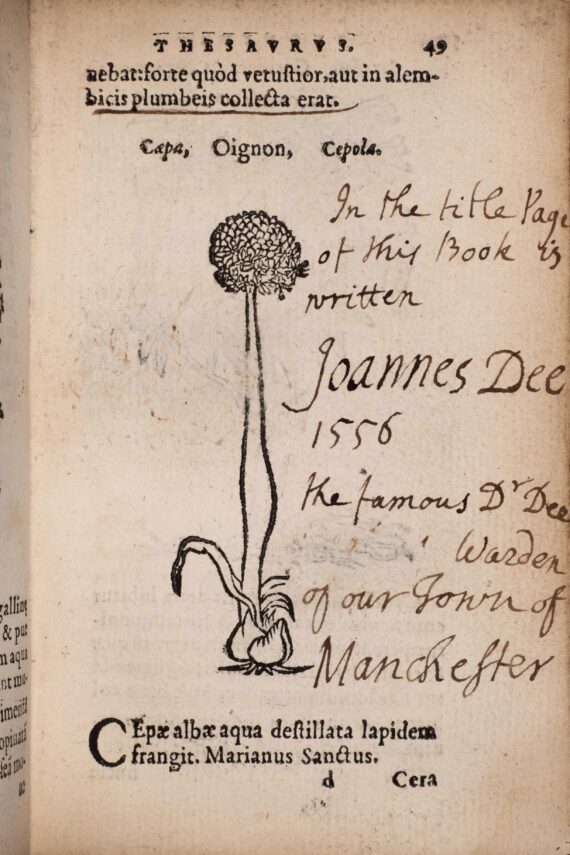
    The final printed book that belonged to Dee, his copy of Konrad Gesner’s De remediis secretis, which entered the library’s collections in 1871, once again through purchase (at a cost of seven shillings). This is one of the library’s more heavily annotated books owned by Dee, featuring his notes, alchemical illustrations and recipes. A note has been added in a later hand on page 49 ‘the famous Dr Dee Warden of our Town of Manchester’. The book also contains an ownership inscription by John Barker de Hopwood, a name that belonged to a local gentry family. During his time in Manchester, Dee had leant books to Edmund Hopwood, justice of the peace, so it is possible that the book had remained with members of the Hopwood family (although further research is needed to confirm this).

    A printed page containing an illustration of a flower. In the margin is an annotation reading ‘In the title page of this book is written Joannes Dee 1556 the famous Dr Dee Warden of our Town of Manchester’, in a cursive hand in ink.

    Figure 5: Annotation in John Dee’s copy of Konrad Gesner’s De remediis secretis (Chetham’s Library, Mun. 7.C.4.214, p. 48).

    It is therefore clear that the printed books owned by Dee that are now found in Chetham’s Library’s collections did not remain in the college buildings between Dee’s departure and the library’s foundation in 1653. Many of these books instead found their way into the vast collections of like-minded individuals such as John Byrom and John Soane, and were later acquired by the library as a result of the interest (and consequent collecting activity) of the nineteenth-century antiquarians associated with the library and the Chetham Society in one of Manchester’s most famous historical residents. Although Dee’s years in Manchester were largely unhappy and disappointing, he remains one of the most fascinating figures associated with the city, and will surely remain so.


    Blog post by Laura Bryer

  3. Shakespeare’s Third Folio: Early Readers and Their Marginalia

    Leave a Comment

    Chetham’s Library’s copy of the 1664 Third Folio, the subject of a recent blog post, is a handsome complete copy in an eighteenth-century dark blue calfskin binding, with decorative gilt borders and gilt-edged pages. It was first mentioned in the printed catalogue of the library, published in 1826, the previous volume of which had been compiled in 1791. The Third Folio has therefore been at Chetham’s Library since the late eighteenth century or the first quarter of the nineteenth century. On the page showing the famous Droeshout portrait of Shakespeare and Ben Jonson’s poem, which refers to the portrait and praised Shakespeare’s wit (‘Reader, look/ Not on his Picture but his Book’), the name Jo: Eddowes is inscribed in a seventeenth- or eighteenth-century hand. Jo(hn?) Eddowes was probably an early or even the first owner of the book.

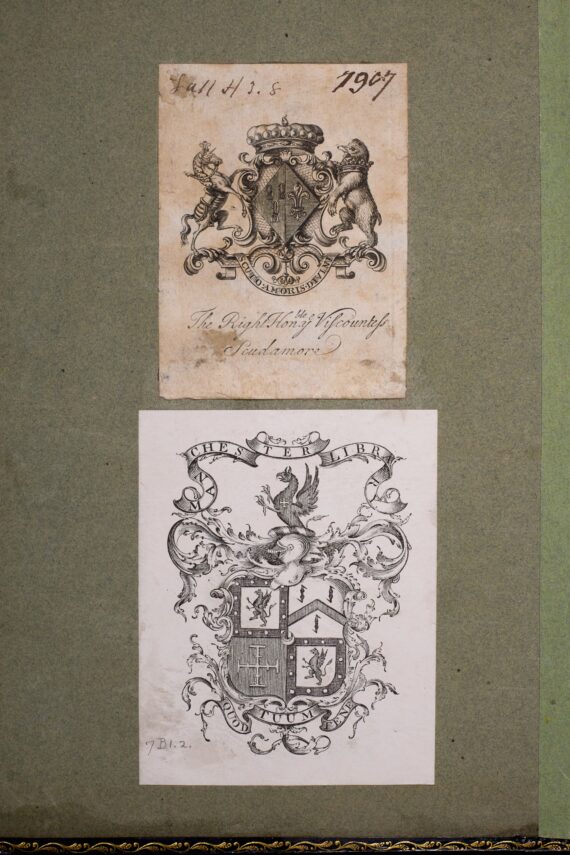
    Inside the front cover, two bookplates have been pasted down. One of these is the bookplate of Chetham’s Library, showing Humphrey Chetham’s coat of arms featuring the familiar griffin. The other bookplate shows the coat of arms of the Scudamore family with the inscription ‘The Right Honble. Ye Viscountess Scudamore’. The coat of arms bears the motto ‘Scuto Amoris Divini’ (‘by the shield of divine love’), and the deviser of the motto chose Latin phonological approximations to the English sounds, with ‘scut-’ signifying ‘shield’ in Latin and ‘amor-’ signifying ‘love’. The English etymology of Scudamore (probably a village place name meaning ‘low moor’) was therefore disregarded in order to produce a new, more elevated Latin-inspired meaning.

    Two heraldic bookplates pasted down inside the front cover of Chetham’s Library’s copy of the Third Folio, one above the other.

    Figure 1: The bookplates of Viscountess Scudamore and Chetham’s Library in the Third Folio (Chetham’s Library, Mun. 7.B.1.2, front pastedown).

    The Third Folio is the sole book in Chetham’s Library whose previous owner can be identified as Viscountess Scudamore. Frances Scudamore (1684-1729) was the daughter of Simon, fourth Baron Digby, and the wife of the third Viscount Scudamore of Sligo, the Tory MP for Herefordshire. He predeceased her, dying in 1716 at the age of 32 from the effects of a fall from his horse. During the early 1700s, the Third Folio is likely to have been kept in the library of the Herefordshire mansion of the Scudamores, Holme Lacey, which is now a hotel.

    In 1623, the First Folio was priced at 15 shillings without a binding, or about £1 with a binding. The price of the Third Folio in 1664 would have been perhaps a few shillings more. There is no record of the volume being donated to Chetham’s Library, so it is likely that it was purchased at some point between 1792 and 1826. On one of the blank initial leaves there is a pencilled price of £65, which may have been the price that was paid for it by the library. Meanwhile, inside the back cover, a small newspaper cutting referring to a Sotheby’s sale in March 1899 of another copy of the Third Folio for £260 has been pasted down. At the 2025 Melbourne book fair, a copy of the Third Folio was on sale for $2 million.

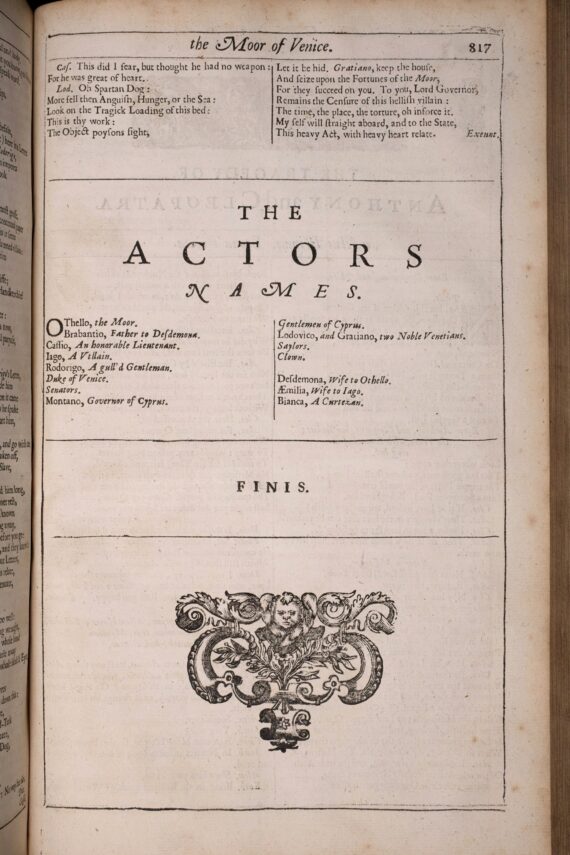
    A page from the Third Folio, containing the character list for Othello. The names are listed below a heading that reads ‘The Actors Names’. At the bottom of the page is an elaborate decorative woodblock print.

    Figure 2: The character list for Othello in the Third Folio (Chetham’s Library, Mun. 7.B.1.2, p. 817).

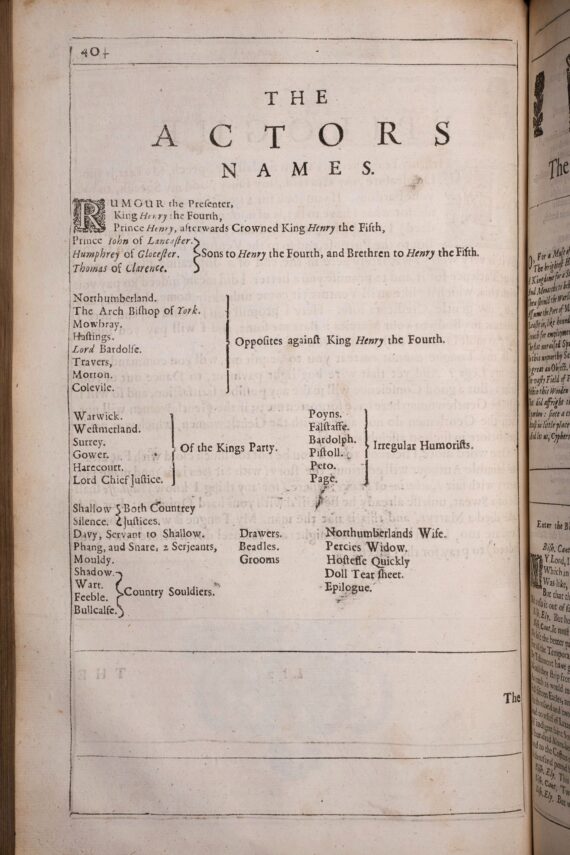
    Chetham’s Library’s copy of the Third Folio bears some marks of past readers studying the texts closely. In the early modern period, the convention of printing a list of characters and the location of the action before the start of a play was starting to become standard. In the Third Folio, as in the previous two editions, the character lists are highly inconsistent. Only seven plays feature ‘The Actors Names’ (i.e. the names of the characters) but, unusually, these are printed at the end of each play. In most cases, the list of characters fills a space on the final page of the play text that would otherwise be blank. For Henry IV Part 2 and Timon of Athens, however, the lists occupy a whole page, and the characters are grouped not only according to their status and gender, but also their dramatic functions or allegiances.

    A page from the Third Folio, containing the character list for Henry IV Part 2. The names are listed below a heading that reads ‘The Actors Names’.

    Figure 3: The character list for Henry IV Part 2 in the Third Folio (Chetham’s Library, Mun. 7.B.1.2, p. 404).

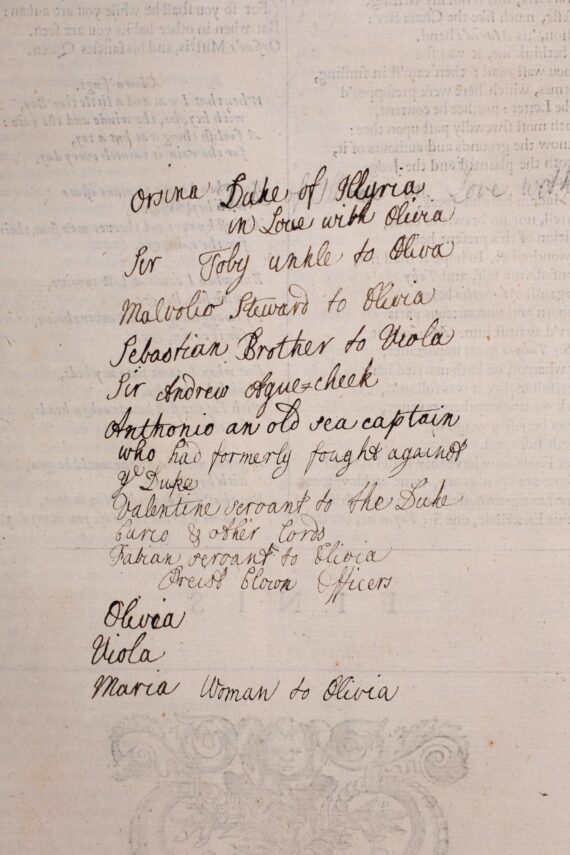
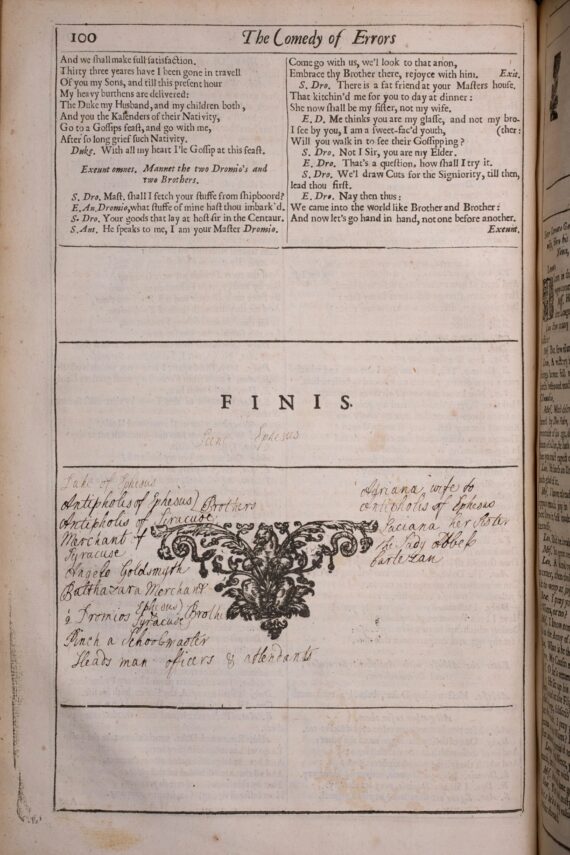
    In Chetham’s Library’s copy of the Third Folio, an early reader added character lists at the conclusion of five comedies: Twelfth Night; The Taming of the Shrew; As You Like It; The Merchant of Venice, and The Comedy of Errors. These lists follow the practice of some printed lists in identifying some characters’ occupations, status and relationships to other characters, and are presented approximately in the order of the social status or importance of the character’s role in the play. The female characters are listed separately after the male characters. In the list compiled by a reader of the Twelfth Night, Orsino appears at the head of the list, identified as the Duke of Illyria ‘in love with Olivia’. Sir Toby Belch appears second in the list, although his surname is omitted and he is identified as the ‘uncle to Olivia’. Oddly, the reader has given the most detailed description to a relatively minor character: ‘Anthonio, an old sea captain who had formerly fought against ye Duke’.

    An early handwritten character list for Twelfth Night, copied onto a blank page. At the top of the list are Orsino Duke of Illyria and Sir Toby, and at the bottom are Olivia, Viola, and Maria woman to Olivia.

    Figure 4: An early reader’s character list for Twelfth Night in the Third Folio (Chetham’s Library, Mun. 7.B.1.2, p. 276).

    In the case of The Comedy of Errors, the compiler may have felt that a character list would help them follow the complexities of the plot. This play’s comedic confusion arises from there being two sets of identical twins, accidentally separated at birth; each twin has the same name as his brother, with one set of twins being masters and the other set their servants. The plot is based on a comedy by the Roman playwright Plautus, in which the plot similarly revolves around multiple mistaken identities. Unless a reader had a strong theatrical imagination, private reading of the text was likely to produce even more confusion than a public performance. The act of compiling and consulting the list may have helped the early reader of the play clarify the characters and the plot.

    A page from the Third Folio, at the end of The Comedy of Errors. At the bottom of the page is an elaborate decorative woodblock print, around which is an early handwritten character list for the play.

    Figure 5: An early reader’s character list for The Comedy of Errors in the Third Folio (Chetham’s Library, Mun. 7.B.1.2, p. 100).

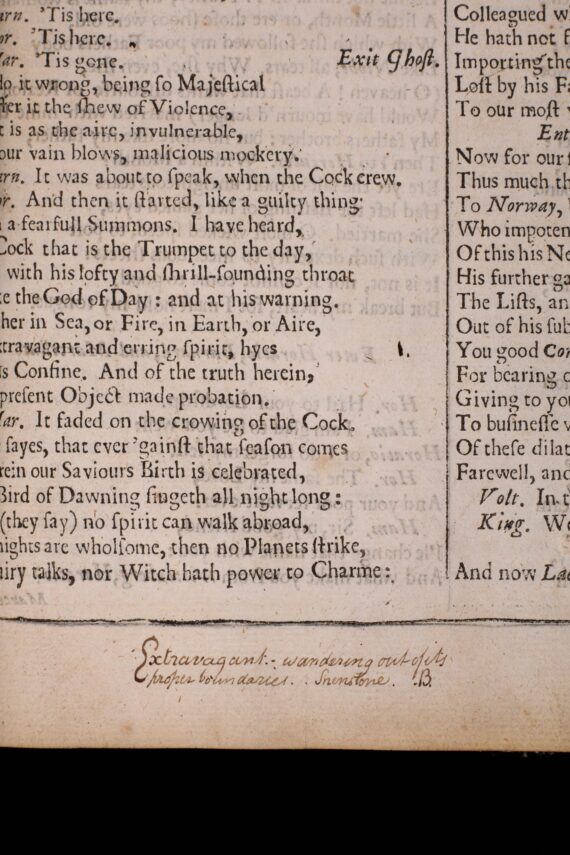
    The printed text of Hamlet carries two marginal notes. The first is a gloss of Horatio’s description of the Ghost of Hamlet’s Father in Act 1 scene 1 as an ‘extravagant and erring spirit’. The Ghost describes how he is punished in Purgatory in daytime but leaves each night to wander the earth, and the gloss reads: ‘extravagant: wandering out of its proper boundaries’. The wording of the reader’s definition is very close to that of the first meaning given by Dr Samuel Johnson in his Dictionary of the English Language (1755): ‘wandering out of his bounds’. According to Johnson, this was ‘the primogeneal sense [of the term], but not now in use’. This archaic meaning was derived from the word’s Latin etymology: ‘extra’ means ‘outside of’, and ‘vagrans’ means ‘wandering’. By the mid-eighteenth century, this meaning of ‘extravagant’ had been largely displaced by a semantic shift towards associations with wildness and recklessness, often financial. Remarkably, the usage that Johnson quoted to support his definition was the same line from Hamlet that was glossed by this reader.

    A handwritten note at the bottom of the page, which reads ‘Extravagant: wandering out of its proper boundaries’.

    Figure 6: A reader’s definition of the use of ‘extravagant’ in Hamlet (Chetham’s Library, Mun. 7.B.1.2, p. 731).

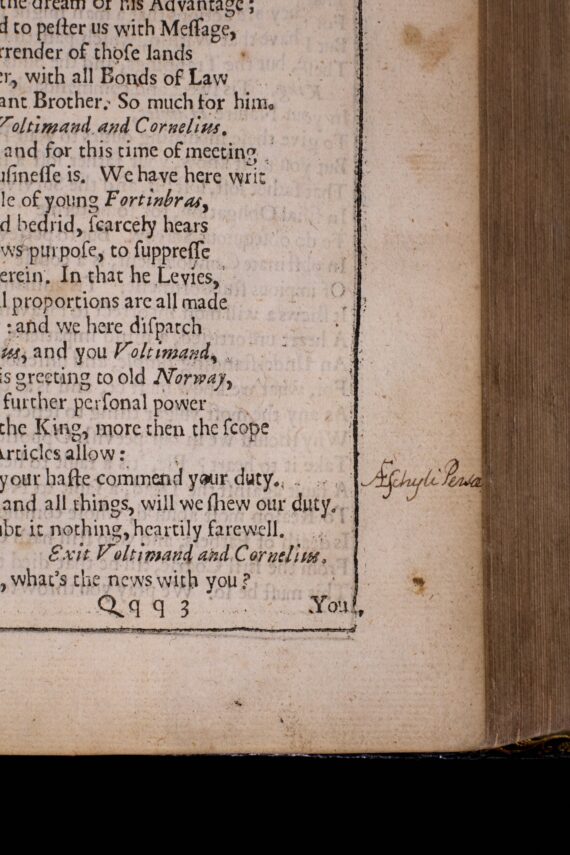
    One other annotation occurs in the text of Hamlet. Next to Claudius’s speech in Act 1 Scene ii, in which he sends his messengers Cornelius and Voltemand on a mission to the king of Norway, a reader has written in Latin the marginal note ‘Aeschyli Persae’, a reference to what is probably the earliest extant Greek tragedy, Aeschylus’ Persians. It is difficult to see any direct and specific relevance of Claudius’s speech to Aeschylus’s play, and it is more likely that the reader had a comparison of characters and dramatic situations in mind. In both Persians and Hamlet, the ghost of a deceased father returns from the underworld and comments on his son’s behaviour. In Persians, the ghost of Darius is appalled by what he learns of Xerxes’s military failure, and attributes it to insanity: ‘what else but a disease of mind was this | that took hold of my son?’ Meanwhile, the revelations of the Ghost of Hamlet’s Father initially inspire Hamlet to feign madness in order to achieve his revenge.  Later critical comparison of Shakespeare with Aeschylus has centred not on Persians but on the Oresteia, and the similarity of Hamlet and Orestes as sons seeking revenge for the deaths of their fathers. The early reader of this copy of Hamlet was intrigued not by the more obvious parallel with the Oresteia’s theme of revenge, but by that between the return from the afterlife of the two paternal ghosts.

    A handwritten note at the bottom of the page, which reads ‘Aeschyli Persae’.

    Figure 7: A reader sees a parallel between Hamlet and Aeschylus’ Persians (Chetham’s Library, Mun. 7.B.1.2, p. 731).

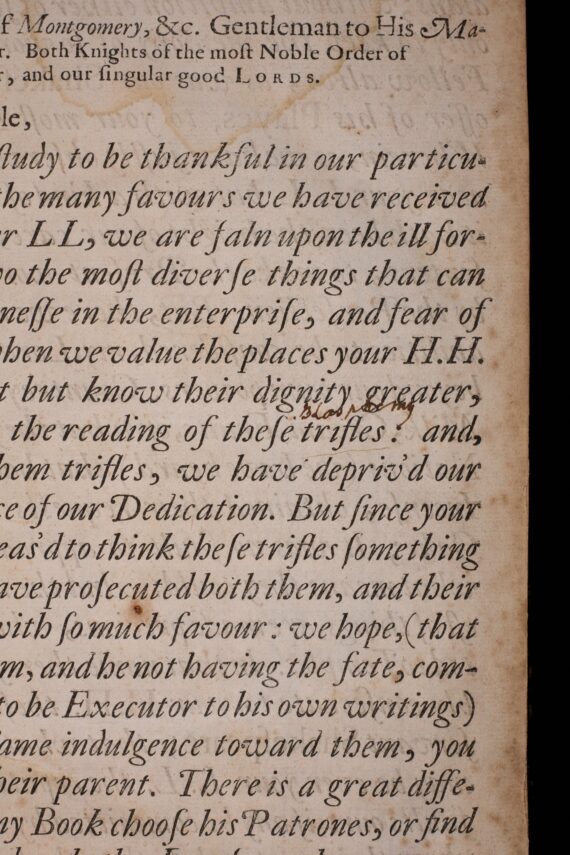
    Finally, one other, probably later, handwritten addition to Chetham’s Third Folio is less learnedly obscure but very strongly felt. The book’s dedicatory epistle to William Herbert, Earl of Pembroke and Philip Herbert, Earl of Montgomery, is couched in the typical language of seventeenth-century flattery of aristocratic patrons, but Heminge and Condell went further in their sycophancy and appear to disparage the plays that they are supposedly recommending. They present the plays to the earls as ‘the remains of your servant Shakespeare’, request their ‘indulgence’, and refer to the plays as ‘these trifles’. Above the word ‘trifles’, a reader has written a single word, ‘blasphemy’. The judgement is a noteworthy example of literal Bardolatory, with Shakespeare’s plays conceived of by the reader as if they were a sacred text.

    The handwritten word ‘blasphemy’ between the lines of the dedicatory letter, next to the words ‘these trifles’.

    Figure 8: A reader expresses their shock at the apparent disparagement of Shakespeare’s plays (Chetham’s Library, Mun. 7.B.1.2, n.p.).

    The word ‘Bardolatory’ was coined by G. B. Shaw in 1901 to denote the excessive worship of Shakespeare that developed from the time of Garrick’s Shakespeare Jubilee in 1769 and peaked in Victorian England with such panegyrics as Thomas Carlyle’s in On Heroes and Hero-Worship (1841). To express the supreme value that he placed on Shakespeare, Carlyle proposed a hypothetical choice between losing Shakespeare or the ‘Indian Empire’. Despite his well-deserved reputation as a racist imperialist, Carlyle opted to lose the Empire on the grounds that it was only temporary, while Shakespeare would undoubtedly act as a nationally unifying force a thousand years in the future. As a Victorian Bardolator, Carlyle was highly influential. The hand in which the word ‘blasphemy’ is written appears to be different from and later than that of other additions to the text, and the addition may well have been made by a nineteenth-century reader who shared Carlyle’s view of Shakespeare. If this was the case, then it would have occurred after the book was acquired by Chetham’s Library. Such was the reader’s sense of outrage at the plays being labelled ‘trifles’ that they were willing to flout the library’s rules in order to express their extreme indignation at the apparent belittlement of Shakespeare’s work.


    Blog post by John Cleary
    With thanks to Laura Bryer, Emma Nelson and Ellen Werner for their help and advice.


  4. John Dee and Alchemy

    Leave a Comment

    When John Dee initially sought appointment as the warden of a collegiate church following his travels on the continent, Manchester was far from his mind. Instead, he had fixed his hopes on the wardenship of the Hospital of St Cross in Winchester, or else the provostship of Eton College or the mastership of Sherborne School. Among the reasons that he listed for preferring the wardenship of St Cross above all other appointments was its ease of access to glass-blowers in the south of England, which would have enabled him to personally oversee the production of glass instruments, and the space afforded by the hospital buildings for the establishment of a printing workshop and what would now be called a ‘research institute’ to advise the royal court. It seems likely, given his mention of such glass instruments, that Dee’s proposed research included alchemy.

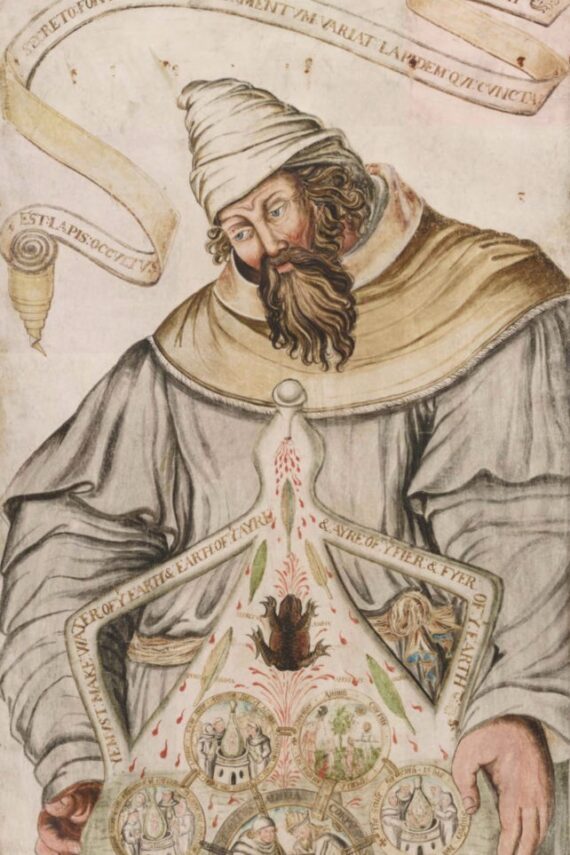
    The practice of alchemy, ‘a form of speculative thought that, among other aims, tried to transform base metals such as lead or copper into silver or gold and to discover a cure for disease and a way of extending life’, fascinated scientists for centuries. First practiced in Hellenic and Greco-Roman Egypt during the classical period, interest in alchemy was revived in the West following the translation of lost Greek scientific and medical texts from Arabic (in which they had been preserved) into Latin during the twelfth century and their re-introduction into the Western textual canon. Even the practice’s name reflects its route of transmission, since the word ‘alchemy’ descends from the Arabic word ‘al-kīmiyā, meaning ‘the Egyptian [science]’. Alchemy remained a common preoccupation in medieval Europe, reflected in surviving alchemical manuscripts such as the famous Ripley Scrolls, a family of parchment scrolls that display learnedly-obscure mystical imagery, the meaning of which is not fully understood even today.

    A painted manuscript illustration of a bearded man wearing a conical hat and loose robes. In his hands is a large glass vessel with two handles, containing eight circles with figures inside. Each circle is linked by a chain to a central circle containing two men holding a book.

    Figure 1: Hermes Trismegistus, the purported founder of alchemy, holding a large vessel known as a Hermetic Vase in a sixteenth-century ‘Ripley Scroll’ (San Marino, Huntington Library, HM 30313).

    The appeal of alchemy persisted during the early modern period, and the practice was adopted by those who, in subsequent centuries, would come to be described as scientists: the modern word ‘chemistry’ shares its etymology with ‘alchemy’, and the first recorded instances of the terms ‘research’ and ‘researcher’ in a scientific sense in English both occur in an alchemical context (albeit after Dee’s lifetime). Even the renowned scientist Isaac Newton (1643–1727) is known to have taken an interest in alchemy alongside his more famous scientific pursuits; indeed, the two were very closely entwined for him. Besides the more famous goals of transmuting base metals into precious ones and discovering the philosopher’s stone, the art of alchemy also extended to practices that might today be termed ‘chemical technology’, such as the production of pigments and salts, the refinement of ores, the manufacture of acids and the distillation of alcohol, and to medicine,  pursuits that were all linked by their experimental approach.

    John Dee was arguably Britain’s most famous alchemist, and his interest in the subject was reflected in his personal library, which was one of the largest in sixteenth-century England. His collection included a large number of books about alchemy, many of which can now be found in the library of the Royal College of Physicians, which contains more than one hundred books from Dee’s library. Nor was Dee’s engagement with alchemy purely theoretical: he constructed alchemical laboratories at his home of Mortlake, and in 1571, he travelled to the Duchy of Lorraine (present-day Lorraine in France) to acquire and bring back ‘a great cartload of specially made vessels’ for these laboratories. As was seen, he also hoped to supervise the production of glass instruments from the Hospital of St Cross.

    The title page of John Dee’s copy of the De remediis secretis. Above the work’s title in bold print and capitals, Dee has written ‘Joannes Dee 1556’. At the foot of the page is a printer’s sign depicting a seahorse (shown as a horse with its forelegs and a fish’s tail) clasping a sword in its mouth, beneath which is another annotation by Dee.

    Figure 2: The title page of John Dee’s copy of Konrad Gesner’s De remediis secretis (Chetham’s Library, Mun. 7.C.4.214).

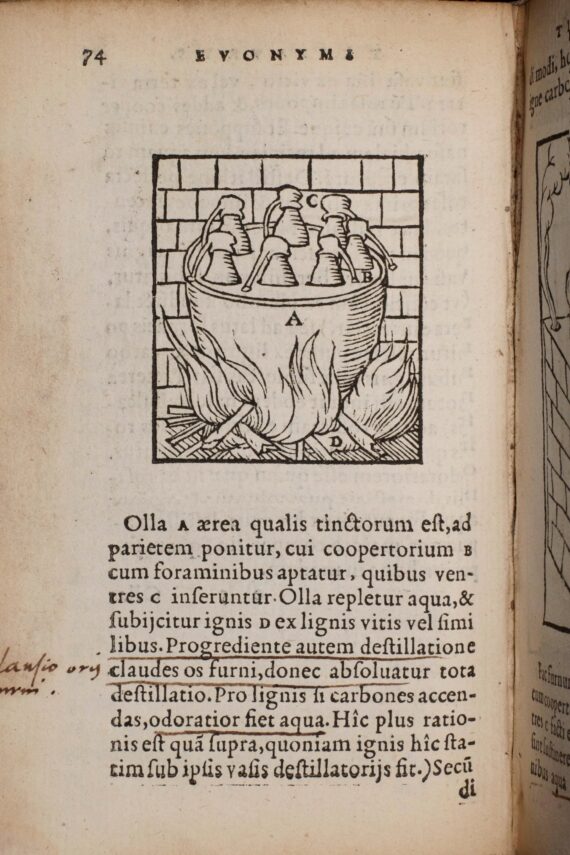
    A woodcut illustration of an alchemical furnace. It depicts a cauldron above a fire, with glass vessels with spouts protruding from the lid. The text beneath the illustration has been underlined and annotated by Dee.

    Figure 3: A depiction of a furnace in Konrad Gesner’s De remediis secretis (Chetham’s Library, Mun. 7.C.4.214, p. 74).

    Fortunately, Dee’s own handwritten catalogue of his library survives, and is preserved in the library of Trinity College, Cambridge. This catalogue can be viewed online, while the an edition of the catalogue was published by the Bibliographical Society in 1990. Meanwhile, a search for ‘alchemy’ in Chetham’s Library’s catalogue of printed books returns sixty-seven results, forty-seven of which relate to books published between 1500 and 1699. Cross-referencing these two catalogues enables us to identify three books that Dee is known to have possessed copies of that can also be found in our collections. One of these alchemy books actually belonged to Dee himself, a copy of Konrad Gesner’s De remediis secretis, published psuedonymously in Lyon in 1555. This work was primarily concerned with the art of distillation and its use in medicine, and it contains illustrations depicting furnaces, glassware and other equipment used in the distillation process. Chetham’s Library’s copy of this book contains extensive manuscript annotations, underlining and even small drawings, most of which were made by Dee himself.

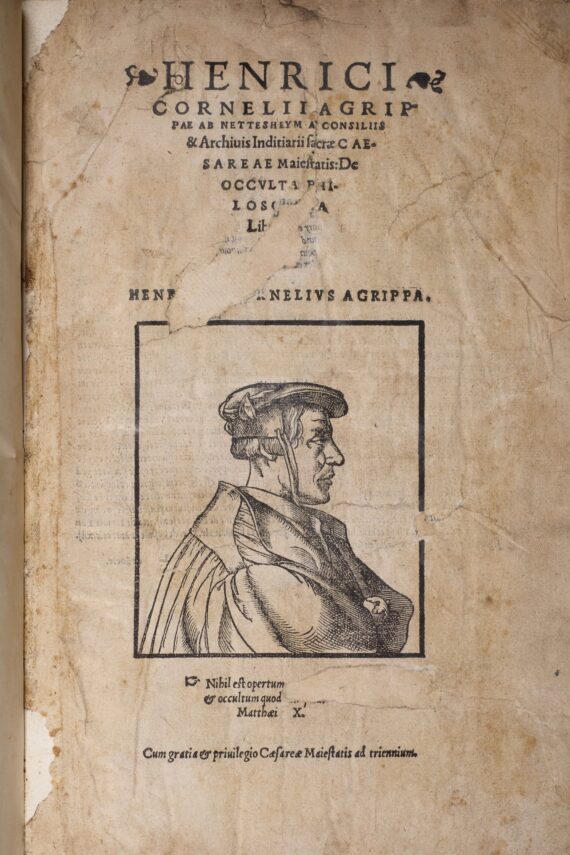
    The title page of another copy of the De occulta philosophia. At the top of the page, the title is arranged in increasingly shorter lines to form an inverted triangle. Beneath it is a woodcut portrait of the author in profile.

    Figure 4: The title page of Heinrich Cornelius Agrippa von Nettesheim’s De occulta philosophia (Chetham’s Library, 2.I.5.32).

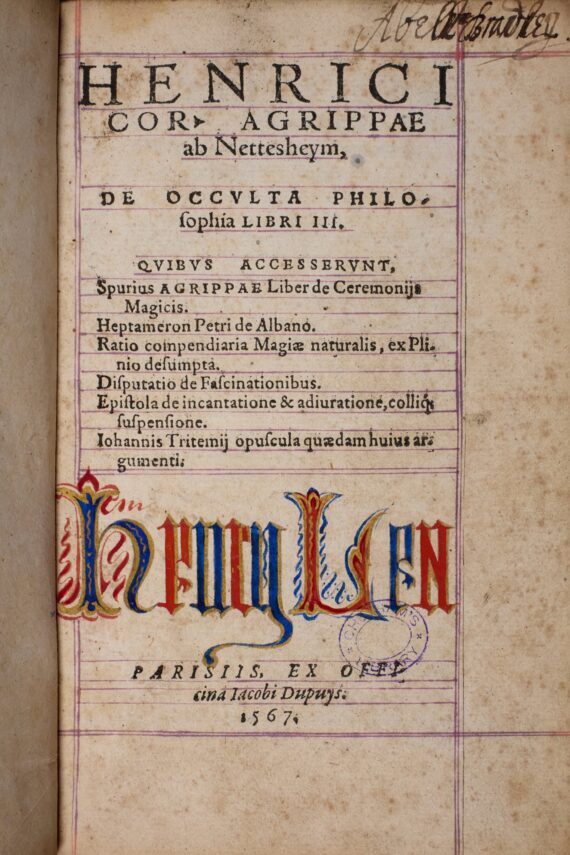
    The title page of the De occulta philosophia. The title and description are bordered by ruled lines in purple ink, and at the foot of the page, the name ‘Henry Len’ is written in alternating blue and red gothic letters with gold flourishing.

    Figure 5: The title page of Heinrich Cornelius Agrippa von Nettesheim’s De occulta philosophia (Chetham’s Library, 3.A.2.28).

    Another book that Dee is known to have owned a copy of was Heinrich Cornelius Agrippa von Nettesheim’s De occulta philosophia. Von Nettesheim was a physician, legal scholar, soldier, theologian, occult writer, and court historiographer to the Holy Roman Emperor, Charles V. He was born in Cologne and studied and taught at the university there, before travelling widely and lecturing in theology at various universities. He may also have founded a secret society devoted to magic, astrology and the Kabbalah, and, like Dee, he has since been compared to the literary Dr Faustus, who made a pact with the devil in order to obtain knowledge, wealth and power. The De occulta philosophia was divided into three parts concerning the natural world, the celestial world, and the divine world. In it, Von Nettesheim explained the philosophy and methods of magic, alchemy and astrology, and provided examples, illustrations, diagrams and techniques. He drew information from classical, medieval, and renaissance sources, and synthesised them into ‘a coherent explanation of the magical world’ in accordance with the Christian faith (although the work still faced censure from the Inquisition). Chetham’s Library possesses two editions of this book that were published during Dee’s lifetime: one that was published in Basel or Cologne in 1533, and another that was published in Paris in 1567. More recently, the publisher Inner Traditions released a modern hardback edition of Von Nettesheim’s book, which the publishers Simon & Schuster described as ‘one of the most important texts in the Western magical tradition for nearly 500 years’. The book was priced at no less than £170!

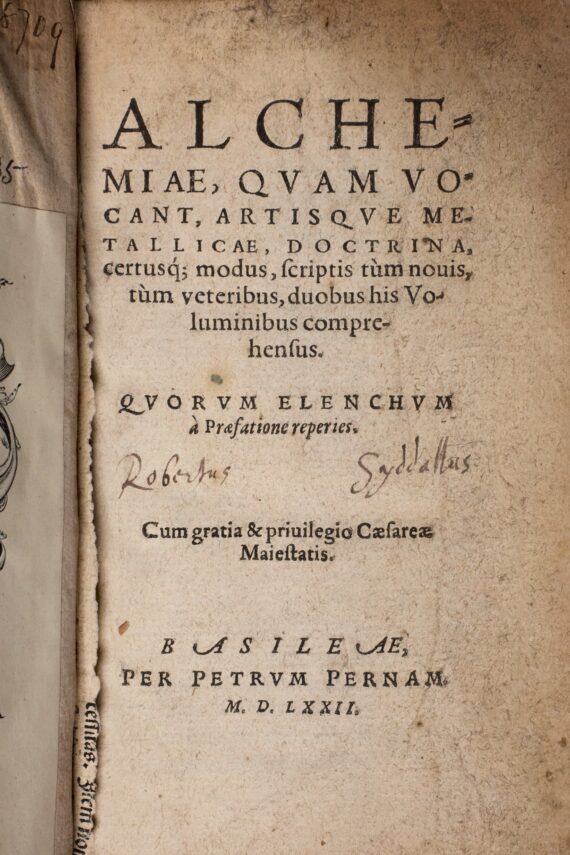
    The title page of the Alchemiae quam vocant. At the top of the page, the title is in bold capitals. Halfway down the page, the name ‘Robertus Sydallus’ is written in black ink.

    Figure 6: Title page of Guglielmo Gratarolo’s Alchemiae quam vocant (Chetham’s Library, 3.E.3.36).

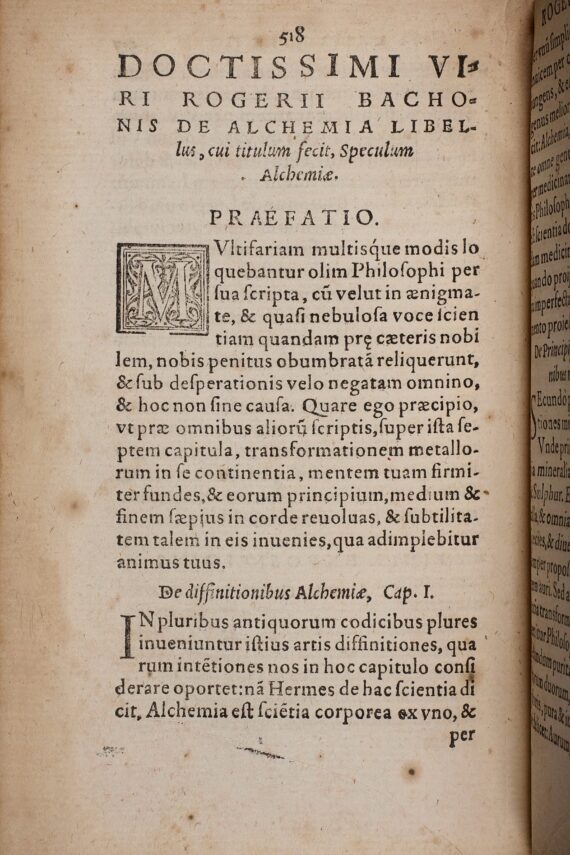
    A page from the Alchemiae quam vocant, containing the preface of a text attributed to Roger Bacon. The first letter of the preface, an ‘M’, is printed from an elaborate woodblock.

    Figure 7: A text attributed to Roger Bacon in the Alchemiae quam vocant (Chetham’s Library, 3.E.3.36, p. 518).

    A third book that Dee is known to have owned a copy of was known by an exceptionally long title, Alchemiae, quam vocant, artisque metallicae, doctrina, certusque modus, scriptis tum nouis, tum veteribus, duobus his voluminibus comprehensus (‘The doctrine and certain manner of alchemy, as they call it, or the art of metals, in both new writings and old, contained in these two volumes’). This book was edited and published by Guglielmo Gratarolo, a physician and alchemist from a wealthy Italian family who studied at Padua and Venice. As a Calvinist, he was forced to flee Italy and sought refuge in Graubünden, Strasbourg and finally Basel, where he taught medicine and edited texts on a wide range of subjects, including medicine, dietetics, memory, wine, agriculture, and alchemy. It was there that Chetham’s Library’s copy of the Alchemiae quam vocant was printed in 1572. In the preface to this work, Gratarolo announced his intention of editing and publishing new and existing alchemical texts for a new generation of scholars, while correcting the obscure passages in them to make them easier for readers to understand. At a time when out-of-print texts were much harder to access than they are today, this must have been an invaluable book for any aspiring alchemist to possess. Chetham’s Library’s collections also contain two more books about alchemy that were edited by Gratarolo: Johannes de Rupescissa’s De consideratione quintae essentiae rerum omnium (Basel, 1597), and Giovanni Braccesco’s De alchemia (Hamburg, 1673).

    Despite his strongly-expressed preference for the wardenship of St Cross, Dee was appointed as the warden of Christ’s College in Manchester and installed in February 1596. As was seen in a recent blog post, the college’s affairs were in a disordered state, and his attempts to resolve them brought him into conflict with the fellows. He nevertheless found some time to pursue his interest in alchemy while he was in Manchester, although his plans for a research institute never came to fruition. Another of Dee’s unrealised proposals was the foundation of a national library, and while his period in Manchester came half a century before Humphrey Chetham left money for the creation of a public library in the town, it is almost certain that he would have thoroughly approved of the project. Indeed, it is probably the case that he would have been much happier if he had come to Manchester as a librarian, rather than as the warden of a college of priests!


    Blog post by Patti Collins

  5. Shakespeare’s Third Folio: The Page vs. the Stage

    Leave a Comment

    One of the most fascinating books in Chetham’s Library’s less well-known literature collection is a copy of Mr William Shakespeare’s comedies, histories and tragedies, published according to the true original copies, better known as the Third Folio (1664). The title page of this work specified that it was ‘the third impression’, meaning that it largely reproduced the First and Second Folios, published respectively in 1623 and 1632. The First Folio is a collection of thirty-six plays, only eighteen of which had been previously published in the small individual editions known as quartos. Without it, we would not have half of Shakespeare’s dramatic output, including MacbethJulius CaesarThe Tempest and Twelfth Night. Although it has never enjoyed the celebrity status of the First Folio, the Third Folio has two major claims to distinction: its comparative rarity, and the addition of a group of plays not published in the First and Second Folios. Out of the seven extra plays included at the end of the Third Folio, only one—Pericles, Prince of Tyre (1607)—is now generally acknowledged to be mainly the work of Shakespeare. All seven of the additional plays had been published during Shakespeare’s lifetime in quarto form, and on the title pages of these editions they had been attributed either to ‘William Shakespeare’ or ‘W.S.’, an indication of the commercial power of Shakespeare’s name even during his own lifetime.

    The inclusion of Pericles in the Shakespearean canon facilitates a fuller picture of Shakespeare’s obsessions during the later part of his writing career. The play deals with themes of restitution and the re-establishment of justice, linking it to the other late plays such as The Winter’s Tale, Cymbeline and The Tempest, which are often classified as romances rather than comedies or tragedies. Pericles, like Leontes in The Winter’s Tale, after years of suffering and separation, regains his daughter and his wife. Pericles is an exiled ruler who, with supernatural aid, is ultimately restored to his land, as is Prospero in The Tempest. The heroines of the four plays—Marina, Perdita, Imogen and Miranda—all embody fortitude and innocence. All four romances have potentially tragic elements, too, but the sense of injustice and loss is resolved in denouements featuring recognitions, restorations, healing and harmony.

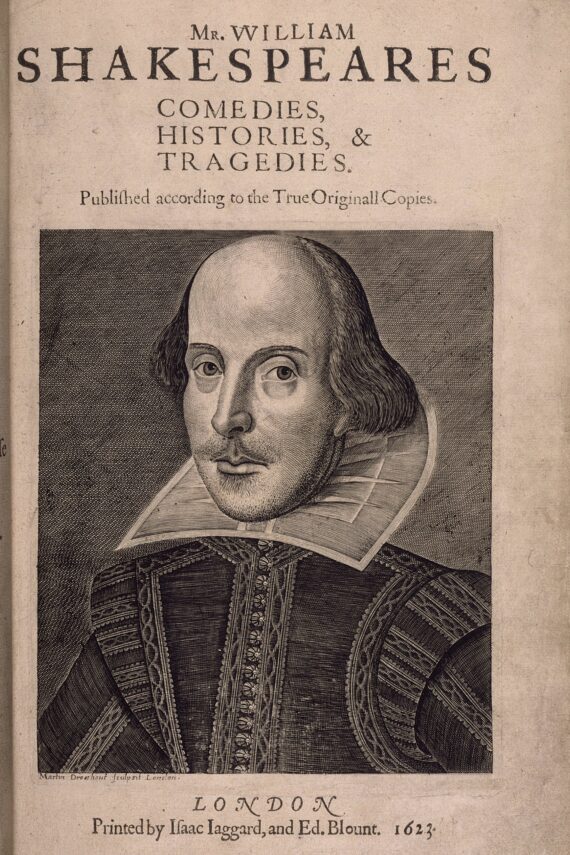
    An engraved portrait of William Shakespeare. Above it is the title ‘Mr William Shakespeares Comedies, Histories, & Tragedies. Published according to the True, Original Copies’. Beneath the portrait is the book’s place of publication (London), printers and date (1623).

    Figure 1: The Droeshout Portrait in the First Folio.

    The Third Folio is a rarer book than the First Folio. Some copies of the Third Folio bear the date 1663 while others, including Chetham’s Library’s copy, are dated 1664. It is likely that 750 copies of the First Folio book were printed, of which at least 235 survive, while only about 182 copies of the Third Folio have thus far been traced. Since the seventeenth-century London book trade was centred in the area around St Paul’s Cathedral, unsold copies of the Third Folio are thought to have been destroyed two years after its publication during the Great Fire of London in 1666.

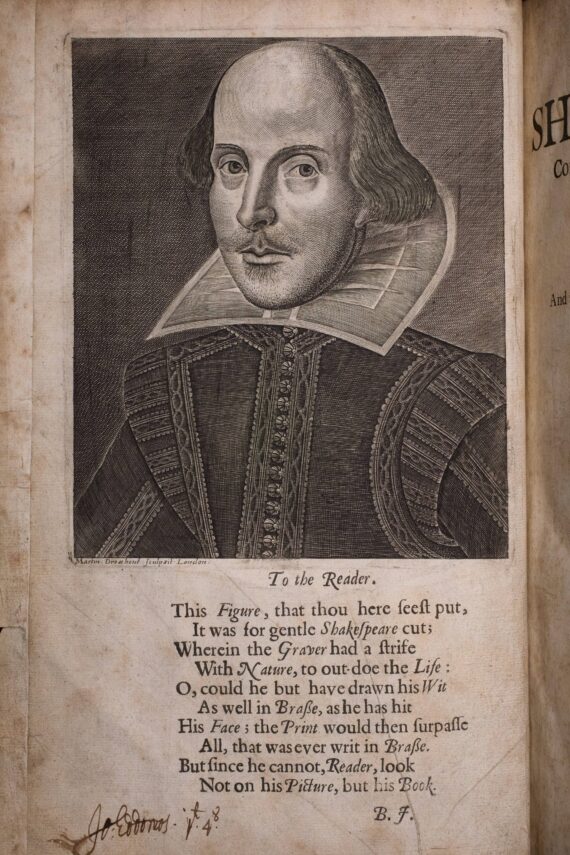
    The layout of the first two printed pages of Chetham’s Library’s copy of the 1664 Third Folio differs from that of all earlier printings. In this copy, the famous Droeshout engraved portrait of Shakespeare and Ben Jonson’s poem ‘To the reader’ appear on the first printed page, facing the title page. In the First, Second and 1663 Third Folios, the first printed page contains only Jonson’s poem, while the engraved portrait occupies most of the title page. The printers of the 1664 Third Folio moved the Shakespeare portrait to the preceding page in order to make room for a list of the seven extra plays on the title page. In the 1663 Third Folio, this list of plays appears near the back of the volume, before the seven supplementary plays. The greater prominence afforded to the list in the 1664 printing may indicate their value as a unique selling point of the Third Folio. Indeed, when the Bodleian Library acquired a Third Folio upon its publication, it de-accessioned its copy of the First Folio on the grounds that it was obsolete, only re-accessioning the same copy two-hundred-and-fifty years later.

    An engraved portrait of William Shakespeare. Beneath it, a poem reads 'To the Reader: This Figure, that thou here seest put, / it was for gentle Shakespeare cut; / Wherein the Graver had a strife / with Nature, to outdo the Life: / O, could he but have drawn his Wit / As well in Brasse as he has hit / His Face; the Print would then surpasse / All, that was ever writ in Brasse. / But since he cannot, Reader, look / Not on his Picture, but his Book. / B. J.’ Beneath is a handwritten note, Jo: Eddowes.

    Figure 2: The Droeshout Portrait and Ben Jonson’s ‘To the reader’, facing the title page, which lists the seven additional plays in the 1664 Third Folio (Chetham’s Library, Mun. 7.B.1.2, facing title page).

    Paratextual material from the First Folio was also carried over into the Third Folio. As well as Jonson’s poem, the Third Folio contains two letters signed by Shakespeare’s fellow actors in the King’s Company, John Heminge and Henry Condell, who are usually credited with ‘editing’ the First Folio. They presumably collected and provided the printers with the texts of the thirty-six plays, including the eighteen previously unpublished plays, but did not ‘edit’ in the modern sense of ensuring presentational consistency. The Third Folio was ‘printed for P.C.’, Philip Chetwinde, who probably added the seven extra plays ‘never before printed in folio’, as the title page boasts.

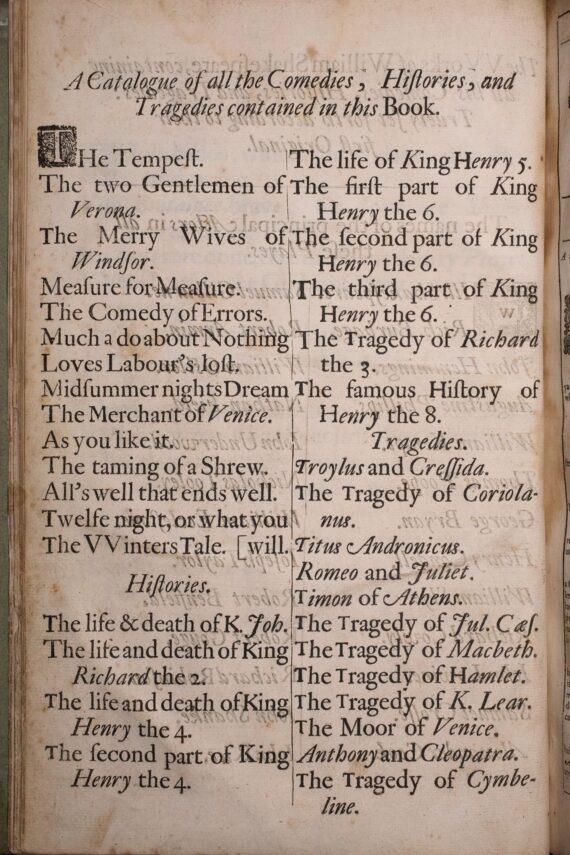
    The first letter in all of the Folios is a dedication to the aristocratic brothers, William and Philip Herbert, using the sycophantic language that was standard for addressing patrons at the time. The second letter, ‘To the great variety of readers’, encouraged the reader to buy the book. These are followed by four dedicatory poems in praise of Shakespeare, a list of actors, and a catalogue of the plays divided into the familiar genres of comedies, histories and tragedies. Although the text of Troilus and Cressida was included in the First Folio, the title of the play was not listed; in the Third Folio, the omission was rectified, and ‘Troylus and Cressida’ appears at the head of the list of tragedies.

    A list in two columns of all of the plays that appear in the Third Folio in order. At the top of the page is printed ‘A Catalogue of all the Comedies, Histories and Tragedies contained in this Book’.

    Figure 3: The Comedies, Histories and Tragedies listed in the order in which they appear in the Third Folio (Chetham’s Library, Mun. 7.B.1.2, n.p.).

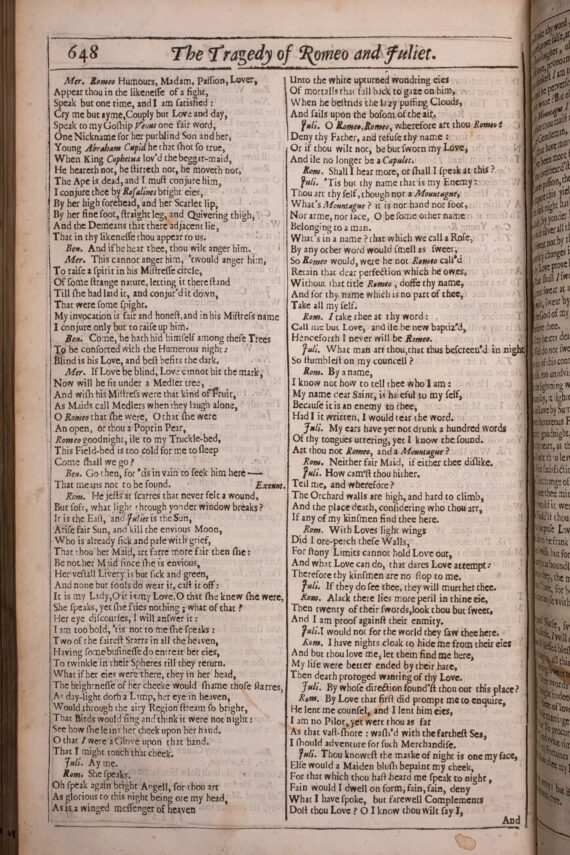
    The publication of the Third Folio in 1663–4 reflects the renewed interest in drama during the Restoration period. Performances of plays had been illegal between 1642 and 1660, and the Restoration of Charles II brought with it an enormous appetite for the many types of entertainment that had been denied the mass of people during the period of the Cromwellian Republic. There were initially few new plays to mount, so theatrical producers such as Thomas Betterton, Thomas Killigrew and William D’Avenant turned to texts from earlier in the century, chief among them Shakespeare’s plays. By the 1660s, however, these plays had come to seem very old-fashioned and did not always delight the public. Samuel Pepys, an ardent theatre-goer, recorded enduring the very first Restoration performance of Romeo and Juliet in March 1662: ‘the play of itself the worst I ever heard in my life, and the worst acted that I ever saw these people do’. Six months later, he was no happier with A Midsummer Night’s Dream, denouncing it as ‘the most insipid ridiculous play that I ever saw in my life’. Despite Jonson’s praise in his second dedicatory poem (‘he was not of an age but for all time!’), the image of Shakespeare as a timeless genius was not yet firmly established.

    A page from the Third Folio containing the balcony scene from Romeo and Juliet.

    Figure 4: The balcony scene in Romeo and Juliet that failed to entrance Samuel Pepys (Chetham’s Library, Mun. 7.B.1.2, p. 648).

    Restoration producers of plays quickly realised that if Shakespeare’s plays were to be staged, they must be adapted to suit the taste of the times. Accordingly, extended musical interludes, singing, dancing and extravagant visual spectacle featured prominently, in a marked contrast to the more austere and technically limited stagings of the Elizabethan and Jacobean theatres. A further radical change saw female roles played by actresses rather than boy actors for the first time, and such was the popularity of women on the stage that adaptations of older plays increased the number of female parts. In William D’Avenant’s and John Dryden’s adaptation of The Tempest, for example, both Caliban and Miranda are given sisters, Sycorax and Dorinda, with entirely new romantic entanglements. Another cultural shift was evident in the Restoration distaste for unrelieved tragedy. Some previously tragic dramas were given happy endings. In Nahum Tate’s notorious re-write of King Lear, the aged monarch lives on at the end of the play in serene retirement, and instead of being hanged, Cordelia becomes queen and finds true love and happiness with Edgar. Chetham’s Library’s copy of the Third Folio contains a book plate indicating that it was owned by the Viscountess Scudamore in the early eighteenth century. If the lady attended a performance of King Lear and then rushed home to read the text of the play in her copy of the Third Folio, she would have had a very unpleasant surprise!

    It is clear that there was a disconnect between the versions of Shakespeare being seen by audiences on the late seventeenth-century stage, and the plays as they were published in the 1663 and 1664 Third Folios, as well as the subsequent edition, the Fourth Folio of 1685. In contrast to the free theatrical adaptations, the Third Folio retains Heminge and Condell’s insistence from the First Folio that the texts were ‘published according to the true original copies’. They refer to the earlier quarto versions of the plays, which were ‘stolne, and surreptitious copies, maimed, and deformed by the frauds and stealthes of injurious impostors’. These are now ‘offer’d to your view cur’d, and perfect of their limbes; and all the rest, absolute in their numbers as he [Shakespeare] conceived them’. Heminge and Condell’s boast of the integrity and authenticity of the texts that they published had become highly ironic by the late seventeenth century, since the texts were no longer seen as theatrically viable in their original form. The Third Folio, even more than the First and Second Folios, was a collection of texts not for theatrical performance, but for private reading and study.


    Blog post by John Cleary
     

  6. John Dee and the Tudor College

    3 Comments

    At around midday on 15 February 1596, following an arduous journey by road and water, John Dee arrived in Tudor Manchester. Five days later, he was installed in a (presumably chilly) ceremony as warden of the town’s collegiate church, now Manchester Cathedral, and it cannot have been long after that he realised the college that he had come to preside over was a poor and fractious one. Dee’s wardenship was marked by strife and financial hardship for the college and himself, and in September 1597, he wrote to his friend, Sir Edward Dyer, to complain about the ‘most intricate, cumbersome, and (in manner) lamentable affayres & estate of this defamed & disordered colledge of Manchester’.

    The causes of the college’s disordered state during the late sixteenth century were diverse and overlapping, but the chief was confusion over the college’s possessions that stretched back to the middle of the century. As a secular-clerical foundation (a foundation staffed by priests rather than monks), the college had weathered Henry VIII’s dissolution of the monasteries, but its fate was sealed during the early years of Edward VI’s reign by the Chantry Act of 1547. According to this act, the college was dissolved, its lands were seized by the crown, and the fellows were pensioned off. When the college was refounded by Mary in 1557, it was re-endowed with its former lands, and some of the fellows who had been there before the dissolution returned again. One of these was the future warden Laurence Vaux, a Catholic recusant who refused to swear the oath of supremacy following Elizabeth I’s ascension just two years later. By the time the queen’s commissioners visited the college in October 1559, Vaux had already fled to the continent, taking the college’s previous silver plate, vestments and muniments (the title deeds to the college’s properties) and hiding them with the local Standish family in an attempt to frustrate the aims of the Protestant reformers and set the stage for the college’s eventual Catholic restoration.

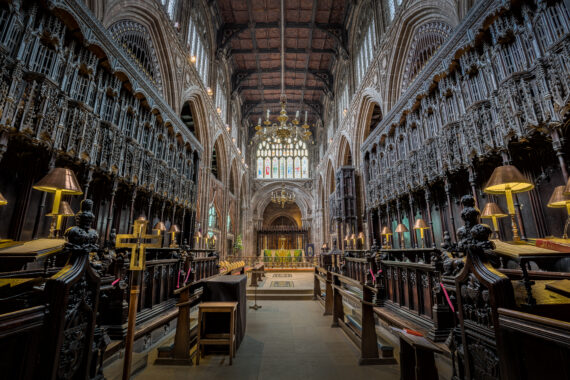
    The quire of Manchester Cathedral, looking upwards. On either side of the centre of the quire there are intricately-carved wooden quire stalls, and the ceiling is comprised of carved wooden panels. In the distance is the altar.

    Figure 1: The medieval quire of Manchester Cathedral, formerly the town’s collegiate church.

    In 1561, Elizabeth appointed Thomas Herle as the college’s warden. It is difficult to judge this warden’s character, since half of the scholarly literature on him claims that he was tasked with stripping the college of its properties and leasing them to the queen, while the other half sees this as a prudent action that set the college on a firmer legal foundation while guaranteeing an annual rent from the crown. Meanwhile, other properties were leased locally for periods of up to ninety-nine years, securing lump sum payments to the warden and fellows at the expense of the college’s long-term income. Herle spun such a convoluted web of leases that it became hard to know who the rightful tenants of many properties were, a problem that was probably exacerbated by Vaux’s action in 1557. In any case, Herle proved unpopular as warden, and following a petition from the town’s parishioners, Elizabeth re-founded the college in 1578 under the new name of Christ’s College. At the same time, she reduced the size of its community by half, possibly because the college’s income was by then insufficient to support a larger community: during the late sixteenth century, several fellows had to support themselves through medicine, law and even hospitality. Herle was pensioned off when the college was re-founded, although it has been suggested that he continued to cause trouble during the subsequent wardenships of John Wolton (1579–80) and William Chaderton (1580–95) by forging charters using a copy of the college’s seal matrix. One of these suspect charters still survives in the archives of Manchester Cathedral.

    One of the first tasks that faced Dee when he was installed as warden was to resolve the confusion around the college’s possessions and income. A draft of a commission that was drawn up in 1596, also in the cathedral archives, instructed Dee to investigate the poor state of the college and the authenticity of the college’s muniments, which were said to be ‘imbeseled, rased, diminished, defaced & kept from the sayd Warden & fellowes of the sayd Colledge to the greate loss & hinderance of the sayd Warden and fellowes’. In the manorial court of Newton (one of the college’s properties), Dee strove to recover lost tithes and prevent encroachments onto the college’s properties, although the process was inefficient: one offender, Richard Heape, had first appeared before the court in 1584 and was subsequently prosecuted by Dee at the court of the Duchy of Lancaster in London, but the case was not resolved until 1602. Dee also sought to define the parish boundaries, carrying out surveys and promoting the medieval custom of ‘beating the bounds’, fixing stakes, and engaging the most famous mapmaker, Christopher Saxton, to define and measure the town.

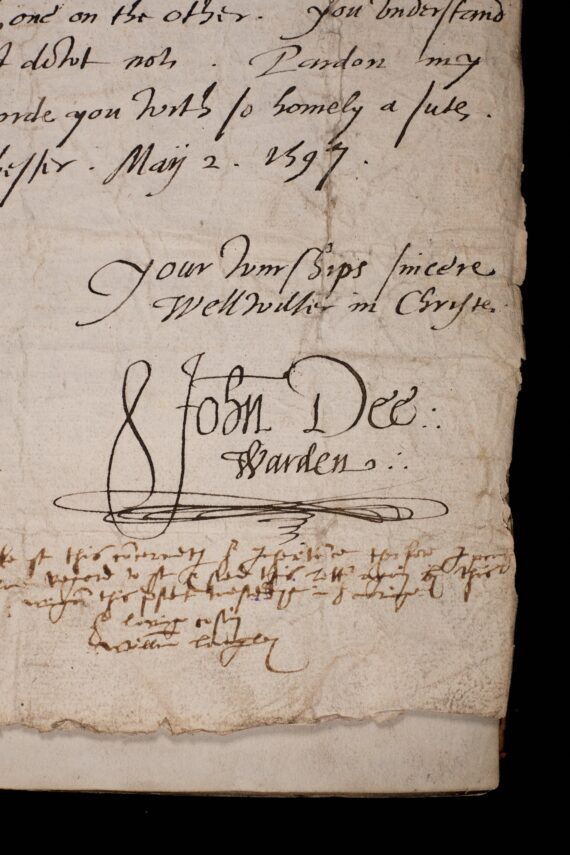
    The corner of a sheet of sheet of paper containing a letter. A cursive hand has written ‘Your wurships sincere wellwisher in Christe’, and beneath it written ‘John Dee: Warden’.

    Figure 2: John Dee’s signature on a letter to William Langley, rector of Prestwich, dated 2 May 1597, concerning the bounds of the parish of Manchester (Chetham’s Library, Raines C.6.63, vol. 32, p. 9).

    The problems around the college’s income were compounded by more general factors. The final decade of the sixteenth century was marked by pronounced economic depression and widespread famine across England, and four consecutive years in which the wheat harvest was poor meant that the country came to depend on imported Polish rye. In the aforementioned letter to Sir Edmund Dyer, Dee reported that he had received ‘barrels of rye from Danzig, some cattle from Wales, and some fish from Hull’, but complained that ‘so hard & thinne a dyet, never in all my life, did I, nay was I forced, so long, to tast’, nor had his servants ever had ‘so slender allowance at their table’. The general economic depression also resulted in inflation, leading to the general erosion of clerical incomes during this period as fixed monetary tithes and tithes of livestock came to count for less than they previously had. Dee found his stipend of four shillings a day as warden insufficient to support himself and his household, and he was repeatedly obliged to pawn his valuables in order to borrow money from local gentry, including Edmund Chetham.

    All of these hardships could perhaps have been borne if Dee had found a welcoming community at the college, but his dealings with the fellows were acrimonious. The late sixteenth century was still a time of religious turmoil, and national troubles were played out on a smaller scale in Manchester’s college. The previous warden, William Chadderton, had concurrently been the bishop of Chester (1579–95), and he had placed the college at the heart of the Protestant reformation of Lancashire. In order to suppress Catholicism in the region, Chadderton was prepared to overlook a strand of Protestant nonconformity that had emerged within the college community, reflected in the refusal of several fellows to wear the surplice, a type of vestment that was regarded with suspicion by radical Protestants as a relic of Catholicism. Dee’s appointment as warden was partly intended to curb such nonconformity, and this brought him into conflict with the ‘turbulent fellows’. Dee described the fellow Oliver Carter’s ‘impudent and evident disobedience in the church’, possibly related to the wearing of the surplice, and Carter—who also practiced as a solicitor—threatened to sue Dee.

    Dee left Manchester in 1598, and did not return until the summer of 1600. Despite his ‘heady displeasure’ with the college’s fellows in his absence, he reconciled with them, but within months trouble returned and he was called before the bishop of Chester’s commissioners to answer charges that the fellows had brought against him. In November 1604, he quit Manchester again. He may have intended to return, since his family stayed behind, but following the death of his wife Jane and potentially his three youngest daughters during a plague outbreak in Manchester the following year, he settled in his home of Mortlake. He was probably not disappointed to have left Manchester since he never found the peace and time for quiet study that he had sought in his appointment. Instead, his time in Manchester was defined by the troubles of the sixteenth-century college.


    Blog post by Emma Nelson


  7. The Manchester Woman: Mrs Isabella Linnæus Banks

    4 Comments

    One member of the Sun Inn Group of poets who met at Poets’ Corner, who is now among the most famous but was little-known at the time, was Mrs Isabella Banks (née Varley). One of nineteenth-century Manchester’s most prolific authors, she published no fewer than twelve novels, three volumes of poetry and three volumes of short stories between 1865 and 1894, but she also lived a life that could itself have provided the narrative for a Victorian novel. Her friend, the social reformer and writer Florence Fenwick Miller, wrote of Isabella that her literary productivity (of novels rather than poetry) was necessitated by her need to provide an income for her family: ‘not till she was forty three did Mrs Banks resume her pen … it was rather that circumstances compelled her to find food and education for her brood than because she desired literary position’. She had married for love in 1846, but her husband—a newspaper editor—moved the family around the country from Harrogate to Birmingham, Dublin, Durham, Sussex and Windsor, as he struggled with drink and depression until his death in 1881.

    Isabella was born in 1821 and grew up in the Cheetham area of Manchester. Her mother’s family were manufacturers of ‘smallware’, what we might refer to now as ‘haberdashery’, while her father was originally a chemist; after his eyesight was damaged in an accident, however, he and his wife opened a haberdashery shop from their home. Isabella was educated locally, and she and her siblings seem to have had a happy childhood. Her parents had a wide social circle, took her to the theatre and encouraged her to join the local Mechanics Institute, where she attended talks and exhibitions and made full use of the library. Her eldest brother was a member of the Manchester Athenaeum, and through him she was present at the Free Trade Hall when Charles Dickens visited Manchester in 1857.

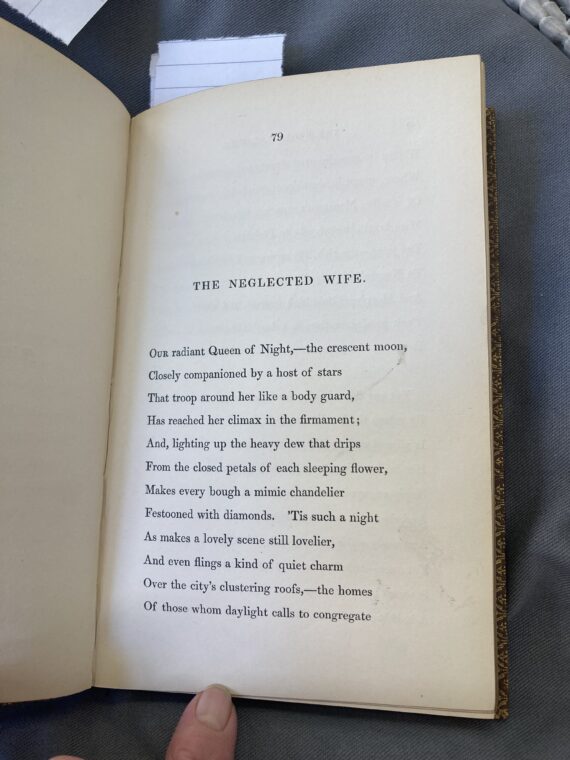
    A copy of Isabella Varley, 'The Neglected Wife', in Isabella Varley, Ivy leaves. The title is above the text of the poem.

    Figure 1: Isabella Varley, ‘The Neglected Wife’, in Ivy leaves (Manchester Central Library, 821.89B30, p. 79).

    As a young woman, Isabella took a keen interest in poetry; her first published work was a poem entitled ‘A Dying Girl to her Mother’, which appeared in the Manchester Guardian on 12 April 1837, when she was only 16 years old. The following year, she began to manage a small school near her home. In 1842 she became a member of the ladies committee of the Anti-Corn Law League, and she was also a lifelong advocate for women’s suffrage. In the same year, a friend of the family, John Bolton Rogerson, became the editor of the Oddfellows Magazine. He published another of Isabella’s poems, entitled ‘The Neglected Wife’ (figure 1), which was awarded the third prize in the magazine’s annual literary competition. It is impossible to read this poem now without feeling that it foreshadows the situation which Isabella eventually found herself in following her marriage to George Linnæus Banks:

    “Her husband is a truant from his home,
    Haply engaged in noisy revelry,
    And she with uncomplaining, patient love,
    Anxiously waits his long-delayed return.
    Yet once, and that so short a time agone
    It seems but yesterday-her slightest word,
    A half-breathed wish, had brought him to her side,
    And he would linger there as if entranced”

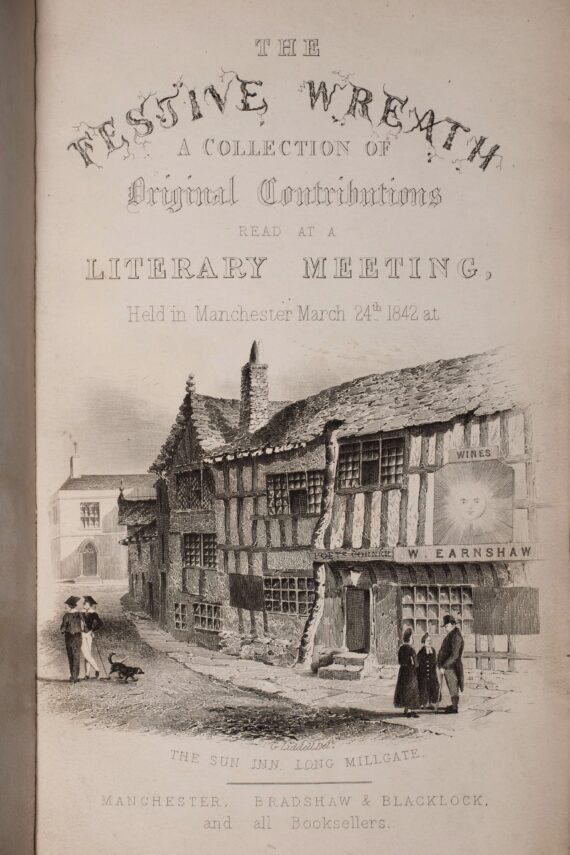
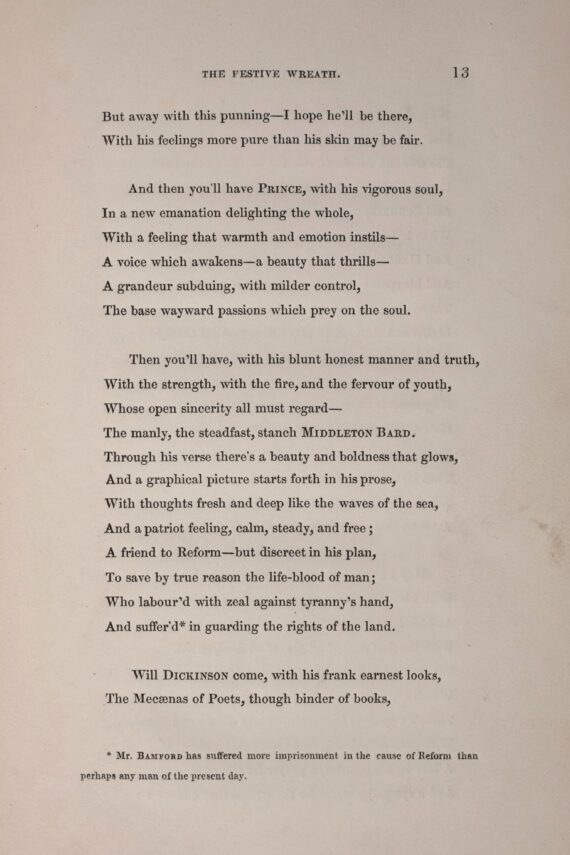
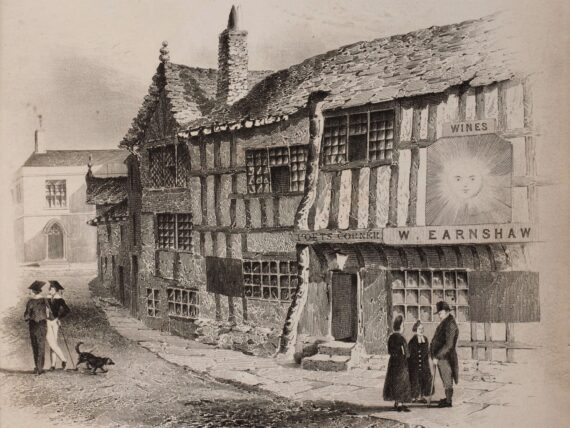
    John Rogerson was also a founding member of the Sun Inn Group, and he persuaded Isabella to become involved with the group. As the late Chetham’s Librarian Michael Powell wrote in 2017, however, ‘the young Isabella Varley attended the March 1842 soirée at the Sun Inn but lacked the confidence to perform alongside her fellow, mostly male poets and listened to their readings whilst hiding behind velvet curtains’. The songs and poems presented at the March 1842 meeting were subsequently collected together in an anthology, published in July that year as The Festive Wreath: A Collection of Original Contributions Read at a Literary Meeting, Held in Manchester, March 24th, 1842, at the Sun Inn, Long Millgate. Isabella’s poem ‘Love’s Faith’ was included in the anthology. In 1844, when Isabella was in her early twenties, a book of her poetry entitled Ivy Leaves was published by Simpkin, Marshall & Co. of London. How this publication was funded is unclear, although it seems highly unlikely that her family were the source. A significant proportion of the poems in the book are about death and dying: they include ‘The White World’, ‘The Spirit Visitants’, ‘The Funeral Bell’ and ‘Homeward Bound’ (a poem about a dying sailor). This book also re-published ‘The Neglected Wife’.

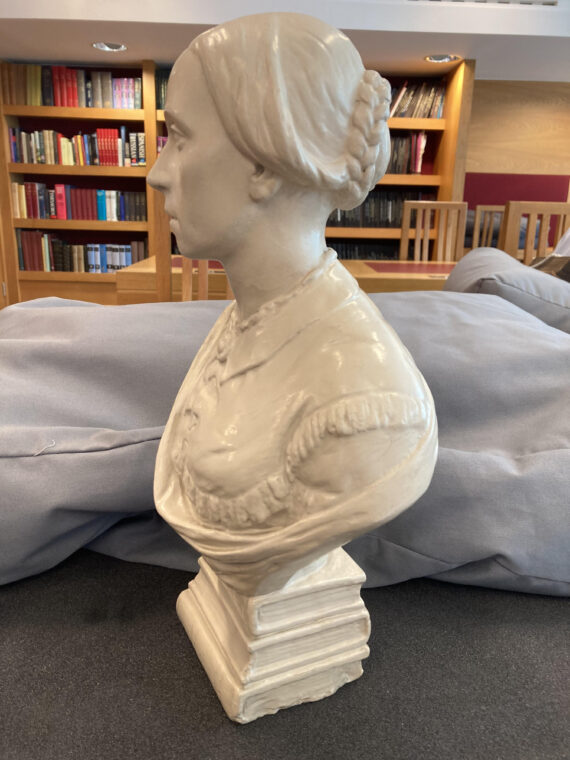
    A bust of a young Isabella Varley, photographed side-on. The bust is white, and Isabella has her hair tied up in a bun.

    Figure 2: A bust of a young Isabella Varley (John Rylands Library, VFA.40).

    It seems likely that Isabella first met her future husband, George Linnæus Banks, through Rogerson. George—always referred to by Isabella as Linnæus—was a newspaper man, writer and poet, and an active radical and public speaker. Isabella’s biographer E. L. Burney quotes ‘the writer in Manchester Faces and Places’ who stated that ‘“a young Birmingham poet had been attracted by Miss Varley’s poems in the Oddfellows Magazine, and she on her part had not been so much attracted as amused by a review in the same publication of a volume of his, Blossoms of Poetry. Later on these two young litterateurs were introduced in a somewhat singular manner”’. They married in 1846 at Manchester’s collegiate church—now the cathedral—when Isabella was 25 years old. The E. L. Burney Collection at the John Rylands library, which contains letters, notebooks and other objects associated with Isabella Banks, contains a small plaster bust of Isabella (figure 2); there is no information about the bust’s provenance or maker, but it seems to depict her at roughly this date. The sculptor seems to suggest a sadness in his sitter.

    Linnæus struggled with alcoholism and depression throughout their life together, which appears to be the reason why they frequently moved from one end of the country to the other; he went from the Harrogate Advertiser to the Birmingham Mercury, and then to The Dublin Daily Express, the Durham Chronicle, the Sussex Mercury and the Windsor Royal Standard. On more than one occasion, he sold the family’s furniture and belongings to fund his addiction, and it was a need for money that prompted Isabella to start writing fiction to support her family. Her first novel, God’s Providence House, was published in 1865, along with Daisies in the grass: a collection of songs and poems, by Mr. and Mrs. G. Linnæus Banks. also appeared. The copy of these poems in the library’s collections features a handwritten dedication by Isabella. She wrote at least a dozen more novels, some of which first appeared in instalments in magazines, but the family were still struggling financially. Her final volume of poetry, Ripples and breakers, was published in 1878; it is often biographical in nature, and Burney suggested that it ‘describes her struggles to keep her house and home together’.

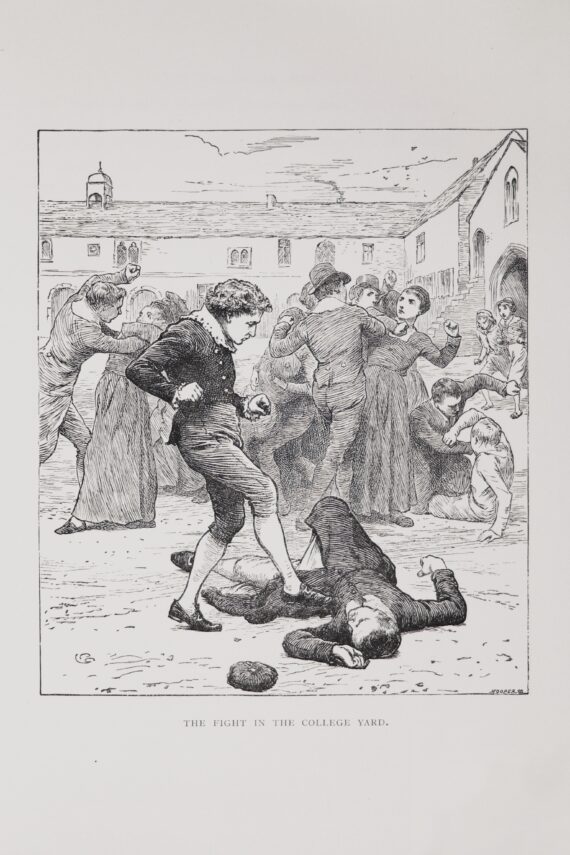
    A print depicting a fight between schoolboys in the yard of Chetham's Hospital (now Chetham's Library). One of the boys is kicking another boy who has fallen.

    Figure 3: A fight in the yard of Chetham’s Hospital School (Chetham’s Library, 12.F.3.21, np).

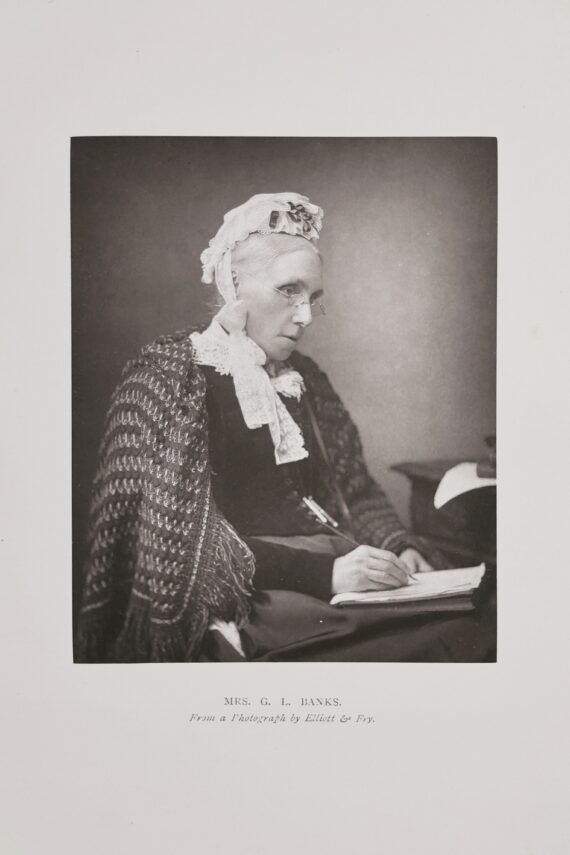
    Isabella’s most famous novel was of course The Manchester Man (1876). The novel traces the life of a Manchester resident, Jabez Clegg, who was saved from drowning in a flood and educated at Chetham’s Hospital School (figure 3). The dramatic illustration above—which depicts a fight between schoolboys in the yard of the school, with what is now Chetham’s Library clearly visible in the background—is found in the 1896 edition of the novel. According to Burney, Isabella arranged to visit Chetham’s Hospital School and Library in 1866 when she first started researching her story, and she donated her manuscript copy of the novel to the library in 1887. The library still has this copy as well as sixteen printed editions of the work, including several copies of the popular 1896 edition, published by Abel Heywood and illustrated by Charles Green and Hedley Fitton. One of these includes a frontispiece photograph of Mrs Banks (figure 4). The image is striking, but perhaps not flattering; it depicts her at around 76 years old as a bespectacled old lady.

    A photograph of an older Isabella Banks. She is wearing glasses, a cap and a shawl, and sits with a pen and paper in her hands.

    Figure 4: Photograph of Isabella Banks (Chetham’s Library, 12.F.3.21, np).

    Isabella also applied for—and received—several grants from the Royal Literary Fund. In an article on female applicants to this fund published in 1990, S. J. Mumm described how ‘Isabella Banks, best known as the author of The Manchester Man, had ten children to provide for as well as supporting an alcoholic, abusive husband who entertained at intervals the delusion that he was the second Christ, and whose “chief pleasure [was] to thwart and persecute his unhappy wife”. Taking up the pen at the age of forty-three under the compulsion of dire want, her literary income was deservedly higher than most of the other applicants, peaking at £320 in 1881, but it was unequal to the demands placed upon it’. In fact, Isabella only gave birth to eight children, only three of whom survived her. George died in 1881, and Isabella herself died in 1897. Ironically, it was Isabella’s devotion to her own very troubled man that inspired her prolific and extremely successful literary career.


    Blog post by Patti Collins

  8. ‘The Peaceful, the Pure, the Victorious Pen!’: The Sun Inn Group

    Leave a Comment

    During the nineteenth century, Manchester was one of the most written-about cities globally; it was famously the subject of Percy Shelley’s ‘The Mask of Anarchy’, written following the Peterloo Massacre in 1819, and was later studied in Friedrich Engels’ The Conditions of the Working Class in England (1845) following weeks spent studying at Chetham’s Library with Karl Marx that summer. None of these writers were native to Manchester, however; although there were a few famed nineteenth-century Mancunian writers in the nineteenth century—chiefly Elizabeth Gaskell—many of them went overlooked or otherwise achieved little fame. Our current exhibition therefore shines a light on a collective of such overlooked writers, known as the Sun Inn Group. This group of largely working-class poets took their name from the Sun Inn, a timber-framed building that stood opposite the entrance to Chetham’s Library on Long Millgate where they met to recite poetry together in the 1840s. In turn, this public house earned the affectionate title of ‘Poet’s Corner’ from the literary gatherings that took place there.

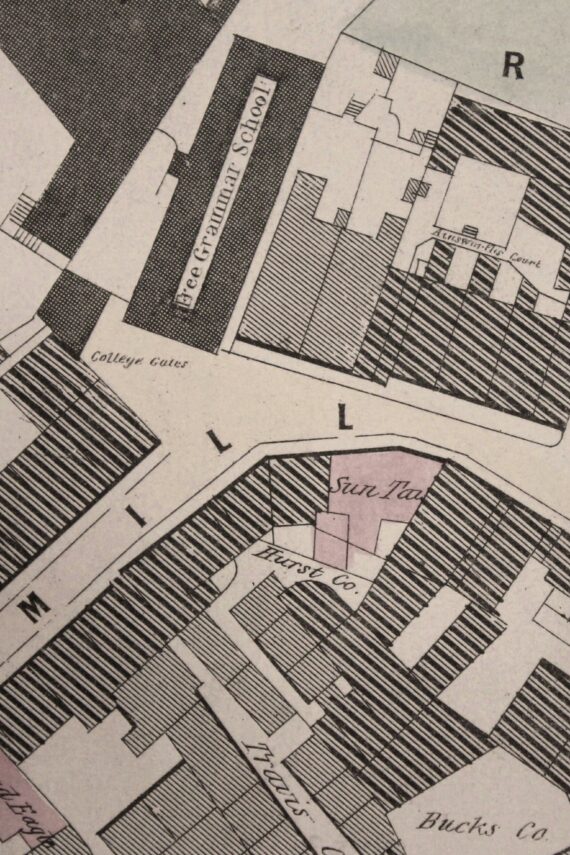
    An old map of Manchester that has been coloured in pale pink and blue. It shows the Sun Inn opposite the entrance to Chetham's Library on Long Millgate.

    Figure 1: Joseph Adshead’s map of Manchester in 1851, showing the Sun Inn opposite the entrance to Chetham’s Library on Long Millgate (Chetham’s Library, Gal.M.2.1).

    Although the Sun Inn Group was relatively short-lived, it did manage to achieve relative local fame, with The Manchester Guardian occasionally reporting on their meetings. One meeting was reportedly attended by roughly thirty people, who gave a series of speeches, poetic recitals and songs, and was—according to the Guardian—‘conducted with much harmony and kind feeling’. Amongst the attendees was John Bolton Rogerson, who, in addition to being a poet, acted as the group’s most significant organisational figure, arranging many of their meetings, acting as the chairperson or vice-chairperson during them, and later ensuring that members of the group received paid poetry commissions during his time as an editor for the Oddfellows’ Magazine. Rogerson was also responsible for compiling and editing the group’s only published anthology, The Festive Wreath, which was comprised of poems read at a meeting held in March 1842. According to the Guardian, this meeting was attended by over forty individuals.

    The title page to The Festive Wreath (1842). The title reads 'The Festive Wreath: a collection of original contributions read at a literary meeting held in Manchester, March 24th 1842, at the Sun Inn, Long Millgate'. Beneath the title is a print depicting the Sun Inn, a leaning timber-framed building. Two stone steps lead up to the door, above which is a sign reading ‘Poets’ Corner’; next to that is another sign depicting a sun with a face.

    Figure 2: The title page of The Festive Wreath (Chetham’s Library, 8.J.5.70).

    Our collections include a copy of The Festive Wreath, which is currently on display as part of our exhibition. Much of this anthology—including a preface written by Rogerson—appears keen to assure readers of the group’s poetic capabilities and legitimacy, often listing the poets’ other accomplishments after their names. The collection also stresses the importance of the Sun Inn Group’s gathering together to combine their abilities for a greater purpose. The collection’s first poem, ‘The Poet’s Welcome’, was penned by the group’s leading light John Critchley Prince. In the poem, he welcomed both the poets and spectators in attendance at the meeting, and emphasised the significance of the gathering, declaring:

    ‘The scattered sons of humanizing song,
    Like twilight starts ought not to reign apart
    As jealous of each other’s light, but come
    Clustering in one most glorious galaxy
    Of mental splendour – as I see you now.

    Although the poem feels overzealous in promoting the supposedly-divine nature of poetry, Prince’s love of poetry was lifelong. In the sixth edition of his own anthology, Hours with the Muses (1857)—a copy of which can also be found in our collections—he wrote that ‘poetry has been the star of my adoration, affording me a serene and steady light through the darkest portion of my existence.’ Prince’s journey towards becoming a poet was a difficult one; his father, a reed-maker, resented his son’s interest in literature, and the family’s financial struggles made accessing literature a difficult endeavour. Prince nevertheless stressed that ‘poverty, want, and punishment were unable to exterminate’ his passion for poetry. In a working men’s journal, Prince reminisced about how he had stolen away from his labour, into a ‘mental feast from the pages of a Pope, a Prior, a Gay, and more especially a Goldsmith’, a medley of older poets on whom Prince’s own poetry later drew. As his list indicates, Prince’s poetry is more evocative of older poets such as Milton, Spenser, and Shakespeare, all of whom were more accessible to those with little money than the contemporary Romantics, whose works were more expensive and took some time to become available in the north.

    A similar sentiment is echoed later in The Festive Wreath, in Alexander Wilson’s self-referential poem ‘The Poet’s Corner’, an upbeat drinking song that implicitly attributes the success of the Sun Inn Group to ‘Tragedy, Comedy, Byron and Burns; / To Milton and Moore’. This poem is also the second of two within the anthology that explicitly names many of its members (the first being George Richardson’s poem ‘A Poetical Replication’). These poems are incredibly helpful when it comes to identifying the Sun Inn Group’s most prominent participants, and work to paint a colourful picture of the contemporary Mancunian literary landscape. Both poems are keen to portray their group as being comprised of a range of different members, each with their own poetic styles: Richardson turns from Samuel Bamford’s prosaic ‘graphical picture[s]’ to John Scholes’ medievalist ‘legend of Naworth’s old tower’.

    Part of George Richardson's poem 'A Poetical Replication'. Shown are verses describing Robert Rose, John Critchley Prince, Samuel Bamford and William Dickinson.

    Figure 3: George Richardson’s ‘A Poetical Replication’, in The Festive Wreath (Chetham’s Library, 8.J.5.70, p. 13).

    Alongside their members’ various poetic inclinations, both Wilson and Richardson emphasised the group’s diversity of character and origin; Wilson playfully characterised the group as consisting of ‘publicans, sinners, Cork Cutters [a reference to James Boyle] and dinners’, and suggested a variety of political beliefs, writing of ‘whig agitators, and tory debaters’. Indeed, politics do not appear to have been a particularly taboo subject, although the group rarely used their poetry for the purpose of political activism. Richardson’s reference to Bamford eagerly underlines Bamford’s radical political beliefs and activism, and mentions the many times that he had had been arrested and imprisoned: a footnote jovially informed readers that ‘Mr. Bamford has suffered more imprisonment in the cause of Reform than perhaps any man of the present day’.

    Despite their range, however, these poems do not capture the full picture. The Sun Inn Group was home to a number of female poets, including Isabella Varley (née Banks), Eliza Craven Green and Eliza Battye, all of whom had poems featured within The Festive Wreath. None of these members were present at the festival: the Guardian noted that a number of the group’s female members did not attend, but did have some of their poems read during the event. Isabella Varley was an elusive member of the group who once hid behind a pair of curtains to hear her poem recited during a meeting. If one were to use ‘The Poets’ Corner’ and ‘A Poetical Replication’ as a basis for the group’s members, however, it would seem like there were no female members within the Sun Inn Group at all. Similarly, Richardson and Wilson’s poems seemingly refer to Robert Rose, ‘the bard of colour’, out of obligation alone; Richardson made no mention of Rose’s poetic capabilities, and merely requested that Rose attend the meeting ‘with his feelings more pure than his skin may be fair’, while Wilson wrote that Rose’s prose had poetry flow from it (as if to suggest that Rose was otherwise incapable of the delicate art of poetry).

    The rest of The Festive Wreath consists of less self-referential poetry, featuring lyric pieces, ballads, sonnets, and various other pieces of conventional poetry. Perhaps the most striking element of this collection is the continued thread of domesticity and the commonplace. Craven Green’s poem, ‘Children Sleeping’, devotes itself to the domestic sweetness of witnessing one’s kin asleep, while John Ball’s poem, ‘To My Daughter’ is ‘affectionately dedicated’ to his wife, and takes joy simply in the sound of his two year-old daughter’s attempts at lisping her parents’ names. As was previously mentioned, the group lacked a particularly political edge to their poetry, but there is nevertheless a sense of something radical in their emphasis on domestic matters, respite and personal relationships. Elijah Riding’s simply-named ‘Stanzas’ is a patriotic piece, which sees him celebrate love for one’s country through the mere act of spending time with one’s friends and families, the transformative capacity of which is capable of lifting oneself out of life’s difficulties. Rogerson’s own poem within the collection, ‘The Minstrel’s Lot’, laments that the poet often goes ‘unpitied and uncar’d for by the crowd’ while living a humble and often difficult life, but is posthumously granted ‘an age of fame’, with people undertaking pilgrimages to their grave while the rich man’s grave lies forgotten. With any luck, our latest exhibition will re-enact the same fate that Rogerson foresaw for himself and his companions.


    Blog post by Anna Pirie


  9. Poets’ Corner: Industry and Identity

    2 Comments

    ‘Near to the gates of Chetham College, in Long Millgate, stands one of those ancient and picturesque houses, which occasionally start to view like spectres of a bygone age, but are now fast disappearing before the levelling hand of improvement’. So begins the preface to an anthology of poems called The Festive Wreath (1842), written by a group of largely working-class poets who came to be known variously as the ‘Sun Inn Group’, the ‘Manchester Poets’ and the ‘Bards of Cottonopolis’. The group’s meeting place was this picturesque house, the Sun Inn, a timber-framed building on the corner of Long Millgate, which came to be known in the early 1840s as ‘Poets’ Corner’, from the literary gatherings that took place there. Notable members of the group included its leading light John Critchley Prince, the radical reformer Samuel Bamford, the ‘Bard of Colour’ Robert Rose, and Isabella Varley—who later wrote and published The Manchester Man under her married name, Mrs G. Linnæus Banks.

    Chetham’s Library’s latest exhibition focuses on this group and its poetry. The Sun Inn group was the one of the most prolific of the societies of working-class poets that emerged in Britain’s industrial cities around the middle of the nineteenth century. It played an important role in shaping Manchester’s literary and cultural identity at a key moment in the city’s history; while some of its members wrote about working-class conditions at a time when Manchester was rapidly expanding as an industrial powerhouse, others embraced a far broader range of themes, challenging contemporary views of the city as a literary wasteland. Some of the group wrote in their Lancashire dialect, a choice that went against the grain and contributed to a growing interest in regional dialect literature in subsequent decades. Although their poetry has been largely forgotten, and the Sun Inn no longer exists—its license was withdrawn and it became an antiques shop, its roof collapsed in a storm in July 1914, and it was demolished in the 1920s—the group staked out a claim to a literary identity for the city, foreshadowing its modern status as a UNESCO City of Literature. Over the coming months, we look forward to exploring this group’s membership and sharing some of its poetry with you.

    A print depicting the Sun Inn, a leaning timber-framed building. Two stone steps lead up to the door, above which is a sign reading ‘Poets’ Corner’; next to that is another sign depicting a sun with a face.

    Figure 1: An illustration of the Sun Inn and Poet’s Corner, in The Festive Wreath (Chetham’s Library, 8.J.5.70).