- About
- Visiting
- What’s On
- Venue hire
- Catalogues
- Collections
- 101 Treasures of Chetham’s
- Digital Resources
- The Flowers of Histories
- A Book of Hours from France
- The Manchester Scrapbook
- Thomas Barritt of Manchester
- Art Treasures Examiner of 1857
- Manchester Association for Constitutional Order
- The North Western Museum of Science and Industry: Some Reminiscences by Richard Hills
- Criminal Manchester
- The Cup of Destiny
- Athenaeum Souvenir
- Middle English Manuscripts
- Manchester and Liverpool of Today
- Hollingworth’s Mancuniensis
- Memoir of Cecil Wray
- William Seward’s Diary
- The Anti-Monopolist
- Fishwick’s History of Rochdale
- Knyvett’s Defence of this Realm
- Tractatus de Nigromantia
- Axon Ballads
- Printed Books & Ephemera
- Archives & Manuscripts
- Prints and Photographs
- Blog
- Support us
For the Private Amusement of Chetham’s Library
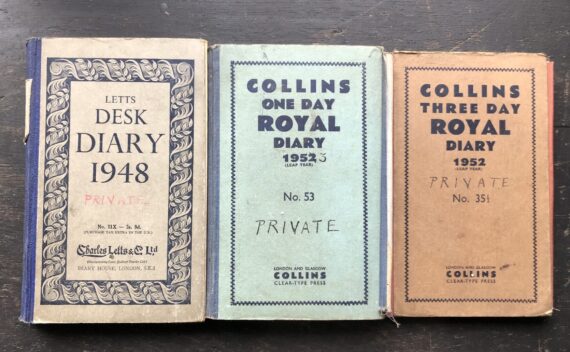
Early last year, our exhibition ‘Chetham’s Librarians: Lives and Legacies’ celebrated our past librarians, and was timed to coincide with the appointment of Julianne Simpson as the new Chetham’s Librarian. As part of the research for this exhibition, I had the fantastic opportunity to delve into some of our past librarians’ diaries that we have in our collections. Most of these are quite dry, and relate strictly to business such as reader appointments, shelving numbers and committee meetings; as such, it can be quite hard to extract the librarians’ personalities and character from their pages. The diaries from the late 1940s are an entirely different matter, however.
One of our recent blog posts explored the librarianship of Charles T. E. Phillips (1920-43), who was responsible for safeguarding Chetham’s Library through the Second World War. Following Phillips’ death, the library closed to visitors and readers, and care of it was entrusted to Charles Nowell, Chief Librarian at Manchester Central Library. As the war came to an end, however, the decision was made to appoint a new librarian and re-open the library. Applications were invited, and in 1944, the position of Chetham’s Librarian was offered to Miss Hilda Lofthouse. At the time of her acceptance, Hilda was in her early 30s and working for the foreign office; as such, her appointment was deferred until the end of the war. Soon afterwards, Miss Pauline Leech was appointed as her assistant, to lend a much-needed hand in getting the library up and running again. Pauline had worked as a codebreaker at Bletchley Park throughout the war, and despite her father’s attempts to persuade her to stay on at Bletchley, she was determined to train as a Librarian.

Figure 1: Photographs of Hilda Lofthouse and her cat, and Pauline Leech at Bletchley Park.
Hilda and Pauline are easily two of Chetham’s Library’s most legendary figures, and when you ask any member of staff about their diaries, their faces light up. The first ‘Librarian’s Log’ by these women (and intermittently by another assistant, Kathleen Mark) begins in 1947, and they continued to keep annual diaries right up to 1975. Despite the instruction written on the very first page of the diary for 1947 – that it was ‘kept for the private amusement and to act as a safety valve, by the three persons named below, and is not to be considered an archive’ – these diaries entered our collections after Pauline’s death in 1994. I for one am very glad that they did, since each entry – whether short or long – gives us a wonderful snapshot into their everyday lives in the library.
The arduous task that these women faced must have been exhausting. During the war, the windows of the medieval college building had been boarded up to prevent gas from entering through them, but this meant that the building and collections lacked sufficient ventilation, and were ‘covered with a dust that is thick and greasy, and full of the acids common to Manchester dirt’. Although Charles Nowell had organised a six-month cleaning campaign in the library in preparation for its re-opening, there was still plenty to be done, and a great deal of care for the collection was needed after the library was re-opened. Nevertheless, it seems as if the women enjoyed the challenge, and they kept a tally of their achievements at the top of each page: rooms cleared, collections catalogued, shelves re-organised.
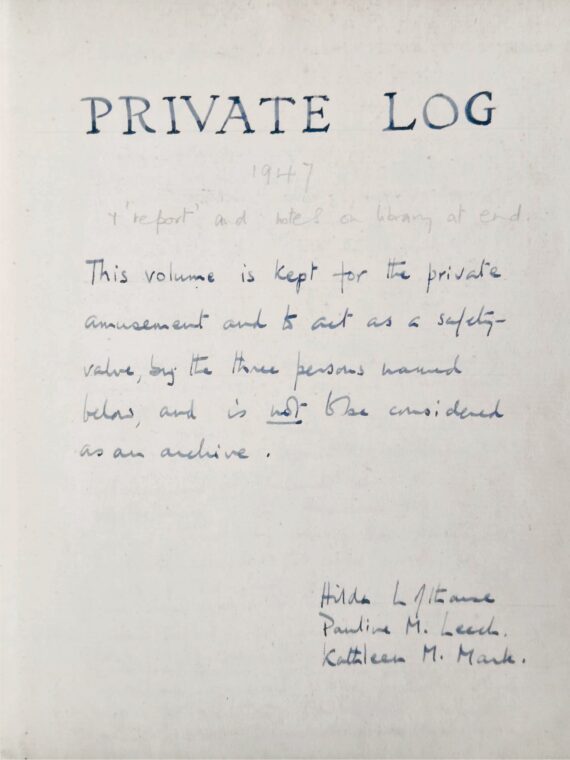
Figure 2: The first page of the 1947 diary (Chetham’s Library, C/LIB/LD/12, n.p.).
There was only one real threat to these women’s work, namely, the readers! Numerous entries celebrate the days without readers, when more work could be done, and an entry for 7 February 1947 records ‘heresy from a librarian-aspirant: that libraries are definitely better places without readers than with’. The irony of a librarian not wishing to have readers is not lost on us, but the constant interruptions of visitors and scholars must have been even more strenuous than usual, since a few of Pauline’s entries describe readers having to read by candlelight due to damaged gasworks, and the taps freezing when heating was unavailable! Anyone who has worked in this library during the winter will be very familiar with how cold and drafty the cloisters can get, and the idea of not having access to water for cups of tea and hot water bottles is a truly frightful one!
![A handwritten diary entry in black ink, which reads ‘[Heresy from a librarian-aspirant: That libraries are definitely better places without readers than with]’.](https://static.chethams.com/app/uploads/sites/3/2025/04/I-hereby-scaled-e1744808079268-570x264.jpeg)
Figure 3: Diary entry from 7 February 1947 (Chetham’s Library, C/LIB/LD/12, n.p.).
In addition to these disruptions, work was still being carried out in the library to repair the damage sustained during the war: clearing out the fire-damaged Governor’s rooms and repairing the roof, which had burnt down during the ‘Christmas Blitz’. Several of Hilda and Pauline’s entries mention the noise of the workmen and of the dust they traipsed in around the building, but more often than not, it was the cleaner, Mary, who could be found complaining. One entry, for 24 February 1948, read:
‘Saying of the day. Mary: (dropping teapot and milk-jug upon the step) “These men will have me MOTH-EATEN before they have finished!”’
The entries containing anecdotes about Mary have easily become my favourite passages to read. A particular favourite of mine comes from 26 April 1947, when Pauline wrote that ‘Mary was in a strongly reminiscent mood as she dusted us this morning. We heard 2 of the generations of rats that had lived and died in the library and school – and since Mary saw their skeletons lying mouldering on the bookshelf tops, she has never been able to eat rabbits!’ Once, when we held a ‘spooky’ night-time tour of the library, one of our guests mentioned that they were picking up on the essence of a woman whose name began with an ‘M’, and who was very cross and unhappy as she worked by the gated presses. I responded that that sounded about right, and the thought that Mary’s grumbles might still be heard today made me chuckle.
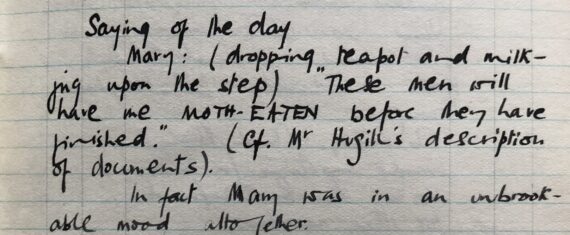
Figure 4: Diary entry from 24 February 1948 (Chetham’s Library, C/LIB/LD/13, n.p.).
Other entries mention regular visitors to the Library, including the feoffees (trustees), long-term readers, and colleagues working at John Rylands Library and the Central Library. Some of these names we recognise from meeting notes and letters of business, but through these diaries we learn a little more about their personalities. Hilda and Pauline seem not to have gotten along well with most of the feoffees, for example, but Colonel Riddick was the exception and seems to have been a favourite of theirs. One entry records ‘a handsome gift received today, by the Librarian and her assistant – viz. One large egg each from one of the Feoffee, Col. Riddick!’ (this was apparently not an uncommon occurrence and must have been a very welcome one, since egg rationing continued until 1953). Another records ‘a day of “excitements”. Col. Riddick with a basket of daffodils discovered floating about the building – and generously handing out the daffodils.’ I can’t speak for the rest of the present staff, but I for one would love it if someone were to float about the library handing out daffodils and freshly laid eggs – it would make a change from the excitement of freshly laid mousetraps!
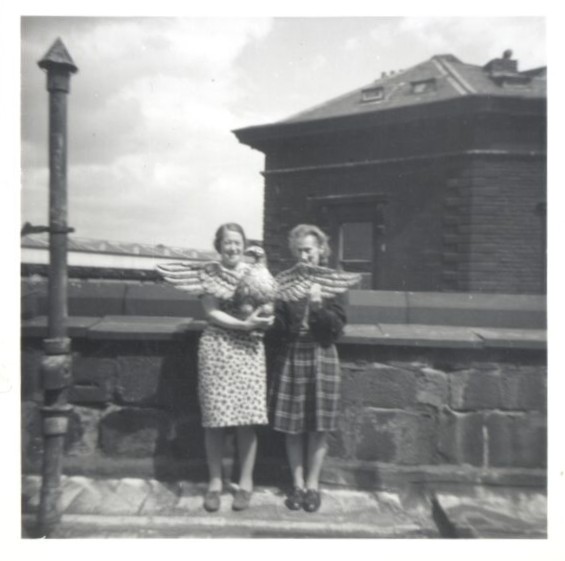
Figure 5: Photograph of Hilda Lofthouse and Pauline Leech holding ‘Goldie’ the eagle. A caption on the back of the photograph reads ‘HL + PL on Chetham’s Library roof. Victoria St. and Railway Offices in background. “Goldie” from Reading Room. 5.8.1969’
Hilda and Pauline’s diaries reveal that, no matter what has been going on outside the medieval walls of Chetham’s Library, nothing really changes within. We still have problems with the heating, electrics and the leaking roof; we’re very familiar with the spiders and mice that make this building their home; and we’re always dusting dusting dusting! There’s something warm and familiar about the fact that, in the 370 years that the library has been open to the public, the staff have been facing the same trials and tribulations all these years – and it’s still true that, in order to work here, you must possess a good sense of humour!
Blog post by Siân-Louise Mason

2 Comments
Sally Turner (Nee Leech)
Pauline was my dad (Ralph Leech)’s cousin and I can remember that she used to send us a book every year for Christmas – Always appropriate to our various ages.(There were 6 of us!!) We lived in Kenya so she had no way of meeting us. I knew that she was a librarian but had no idea about what kind of library it was!
Also I didn’t know until quite recently that she had worked in Bletchley.
Alex Chattington
I was a boy at Chet’s from January 1945 and we returned from evacuation after Easter 1948. I remember it well. The dormitory was as cold as the library!