- About
- Visiting
- What’s On
- Venue hire
- Catalogues
- Collections
- 101 Treasures of Chetham’s
- Digital Resources
- The Flowers of Histories
- A Book of Hours from France
- The Manchester Scrapbook
- Thomas Barritt of Manchester
- Art Treasures Examiner of 1857
- Manchester Association for Constitutional Order
- The North Western Museum of Science and Industry: Some Reminiscences by Richard Hills
- Criminal Manchester
- The Cup of Destiny
- Athenaeum Souvenir
- Middle English Manuscripts
- Manchester and Liverpool of Today
- Hollingworth’s Mancuniensis
- Memoir of Cecil Wray
- William Seward’s Diary
- The Anti-Monopolist
- Fishwick’s History of Rochdale
- Knyvett’s Defence of this Realm
- Tractatus de Nigromantia
- Axon Ballads
- Printed Books & Ephemera
- Archives & Manuscripts
- Prints and Photographs
- Blog
- Support us
The Afterlives of John Dee’s Books
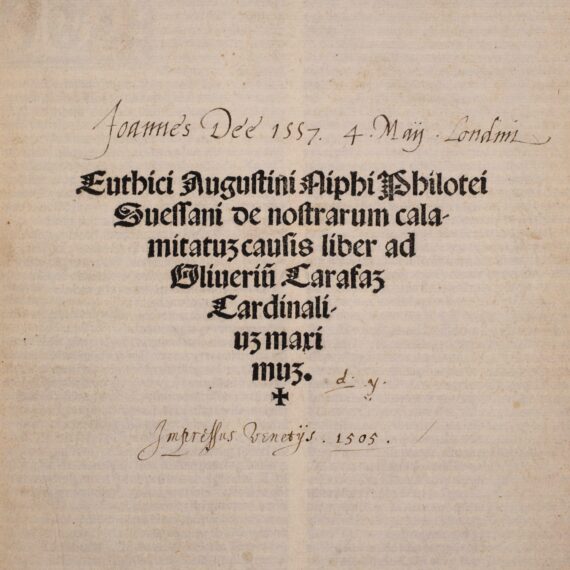
By the 1570s, John Dee had established at his home of Mortlake what has been described as the largest and most diverse library in Elizabethan England, containing—according to Dee—three thousand printed books and a thousand manuscripts. Before he departed for the continent in 1583, he selected eight hundred of his printed books and nearly a hundred manuscripts, requiring four coaches to transport these all around Europe. When he returned from the continent in 1589, however, he found that his home and much of his library at Mortlake had been plundered in his absence. From Dee’s once-fine collection, five books can now be found within Chetham’s Library’s collections, which have commonly been assumed to have remained in the college buildings between Dee’s departure and the library’s foundation in 1653, but their histories are actually much more interesting.
Fortunately for us, Dee compiled two manuscript catalogues of his library in 1557 and 1583. Following his return from the continent, Dee annotated the latter catalogue, now in the library of Trinity College, Cambridge, and his notes provide an insight into the history of his books. This catalogue can be viewed online, also an edition of the catalogue was published by the Bibliographical Society in 1990. In its introduction, the editors suggest that Dee marked the books that he had taken with him with a ‘T’, and the books that he had left in the care of his brother-in-law Nicholas Fromond with an ‘Fr’. Two of Dee’s books now in Chetham’s Library’s collections—Konrad Gesner’s De remediis secretis (Chetham’s Library, Mun. 7.C.4.214) and Agostino Nifo’s Euthici Augustini (Chetham’s Library, Mun. A.6.42 (8))—were marked with a ‘T’, while three—Vitruvius’ De architectura (Chetham’s Library, P.8.23), Arrian’s Periplus euxeinou pontou (Chetham’s Library, Mun. 7.C.4.116) and Francesco Vimercati’s In quatuor libros Aristotelis meteorologicorum commentarii (Chetham’s Library, Dd.3.64(2))—were marked with an ‘Fr’.
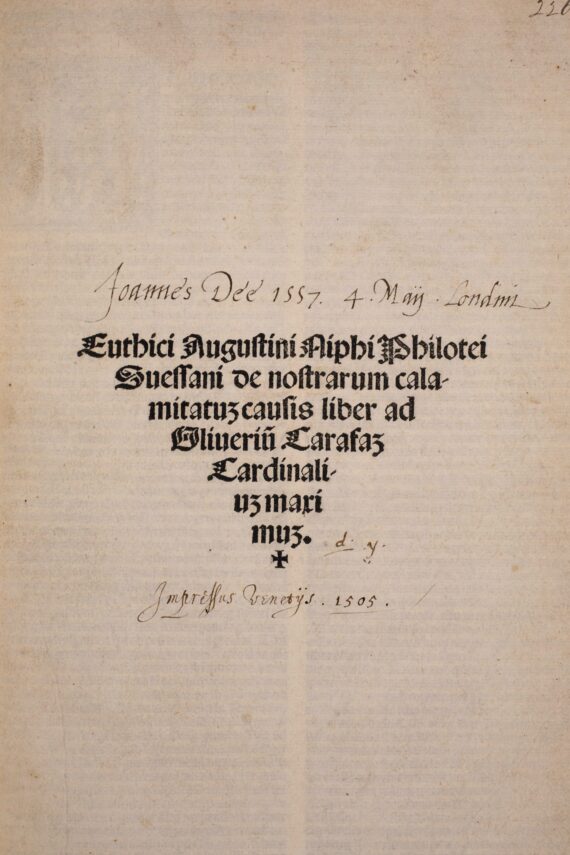
Figure 1: The title page of John Dee’s copy of Agostino Nifo’s Euthici Augustini (Chetham’s Library, Mun. A.6.42 (8)).
In some cases, we also know something of these books’ later provenance. Dee’s copy of Agostino Nifo’s Euthici Augustini, which was marked as taken, can be traced to the collection of the prominent Mancunian scholar and short-hand writer John Byrom (1692–1763). Byrom had close connections with Chetham’s Library: he had been offered and turned down the librarianship, but remained a close associate of one of Chetham’s Librarian Robert Thyer (1732–63), and regularly acted as an agent for the library, purchasing books at London auctions. Like Dee, Byrom was a noted bibliophile, whose large collection of printed books and manuscripts was donated to the library following the death of his descendant, Eleonora Atherton, in 1870.
Another of Dee’s books with an intriguing provenance is his copy of Vitruveus’ De architectura. Vitruvius was a Roman architect and engineer during the first century BC, but his work covered geometry, arithmetic, painting, music, astronomy, military fortification and the construction of machinery in addition to architecture. Besides Dee’s ownership mark, the title page of this book contains the inscription ‘John Soane Aug. 1805’, beneath which is written, in brackets and a different hand, ‘the Architect’. This refers to the renowned architect Sir John Soane, one of the most prominent architects of the Regency period, professor of architecture at the Royal Academy, and dedicated collector of paintings, sculpture, architectural fragments, models, books, drawings and furniture. His unique home can still be visited by the public today. This book had left Soane’s collection by 1871, when it appears in Chetham’s Library’s accessions register, having been purchased for three shillings and five pence from a Mr John Walker in London. Furthermore, Dee’s copy of the De architectura was not included in the first printed catalogue of Soane’s library in 1830, suggesting the book had left his collection during his lifetime.
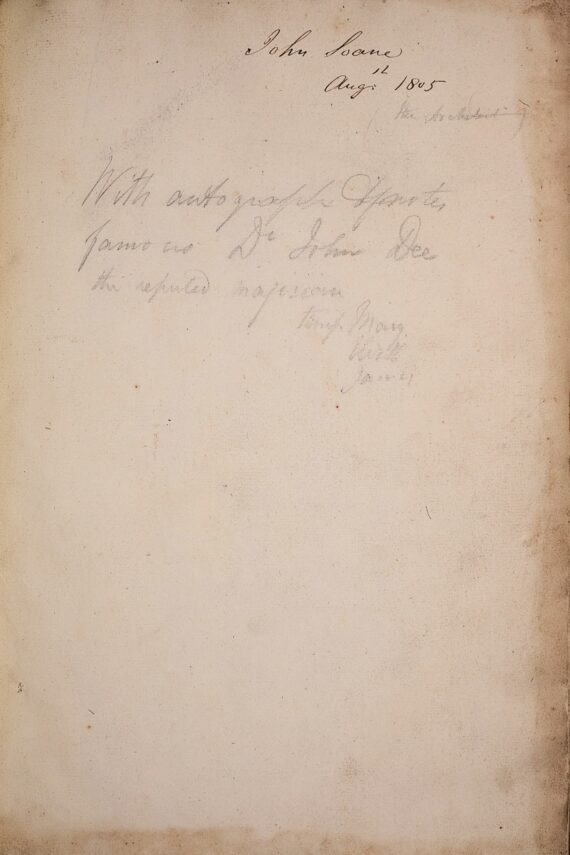
Figure 2: Annotations in John Dee’s copy of Vitruveus’ De architectura (Chetham’s Library, P.8.23, n.p.).
The acquisition of the remaining three books that belonged to Dee during the nineteenth century was linked to the formation of the Chetham Society in 1843, and to the influence of the local antiquarians who founded it (most notably James Crossley, Francis Robert Raines, Thomas Corser and Richard Parkinson). The Chetham Society is the oldest historical society in the North West of England, and the second most senior historical society in the North. The society’s interest in Dee is apparent in one of the earlier titles published by the society, The Autobiographical Tracts of Dr John Dee (1851). In the preface to this work, James Crossley explained that ‘the following Tracts having been printed off some time ago, it has been considered desirable to include them as part of the present volume. The Correspondence of Dr. Dee, with selections from his MSS. and printed works, will form a separate publication, to which will be prefixed a fuller account than has yet been given of the Life and Writings of this most extraordinary person’.
The forthcoming publication referred to by Crossley could be either of two different works, the first of which was being prepared by Chetham’s Librarian Thomas Jones (1845–75). This work, A Selection of the Letters Written by Dr Dee with an Introduction of Collectanea Relating to his Life and Works, was listed as forthcoming in a list of works under contemplation and in progress in 1869. Unfortunately, Jones died before the work was completed, but the manuscript of it in his own hand was donated to the library as part of the Francis Robert Raines Collection in 1878. It was also during Jones’ librarianship that Dee’s printed items entered the collection, and the notes in the library’s accessions register that these copies belonged to Dee suggests that this was an important factor in their acquisition. The other work that Crossley may have been referring to was one being undertaken by John Eglinton Bailey, another Chetham Society stalwart and Lancashire antiquarian. Bailey was in the process of transcribing the diary that Dee kept during his time in Manchester, a work that was intended for private circulation, with only twenty copies published in 1880. The following year, he established the Palatine Notebook, a journal in which he published pieces on Dee’s printed books within Chetham’s Library, including Dee’s copy of Konrad Gesner’s De remediis secretis. Bailey was also a regular contributor to The Bibliographer, and wrote that ‘amongst other relics of the celebrated Dr Dee in Chetham’s Library is his copy of the 1533 edition of Arrian’s Circumnavigation of the Black Sea’.
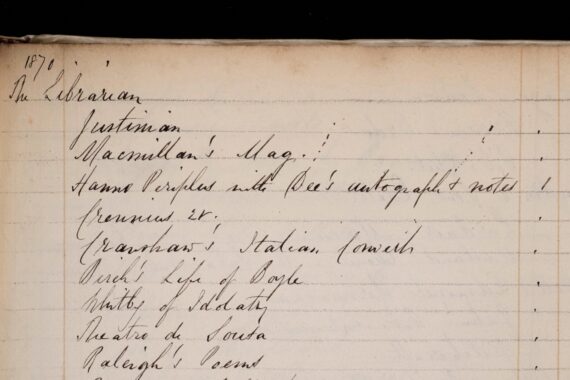
Figure 3: John Dee’s copy of Arrian’s Periplus euxeinou pontou in Chetham’s Library’s accessions register (Chetham’s Library, Chet/4/11/1, fol. 168r).
Chetham’s Library’s accessions register records that Dee’s copy of Arrian’s Periplus euxeinou pontou entered the library’s collections in 1870 through purchase, and specifies that it contains ‘Dee’s autograph notes’. This detail was re-iterated in the acquired book itself, in which a nineteenth-century hand added the words ‘Autograph and MSS of the Famous Dr Dee Warden of Manchester College’. It is difficult to discern what happened to the book between Dee’s ownership of it and its acquisition by at the library (it was among those that were plundered while he was abroad), but there was clearly an appetite at Chetham’s Library and in its circle for collecting books that had belonged to Dee. This is further illustrated by Bailey’s correspondence with a Mr B. H. Beedam, in which he mentioned that he ‘came across another Dee note … the late Joseph Lilly, the bookseller, had a copy of Aristotelis Metereologica et cum Comentarius F. Vicomercarti, with the autograph of the former Dr Dee’. He cited the catalogue of the sale by Sotheby’s of the second portion of Lilly’s books in June and July 1871. The book that Bailey mentioned, Dee’s copy of Francesco Vimercati’s In quatuor libros Aristotelis meteorologicorum commentarii, entered the library’s collection by 1883. The fact that the correspondence mentioned ‘another Dee note’ suggests that books connected to Dee were actively being sought, at the very least by Bailey, who was serving as a member of the Chetham Society’s council by 1876, and as its secretary from 1882.
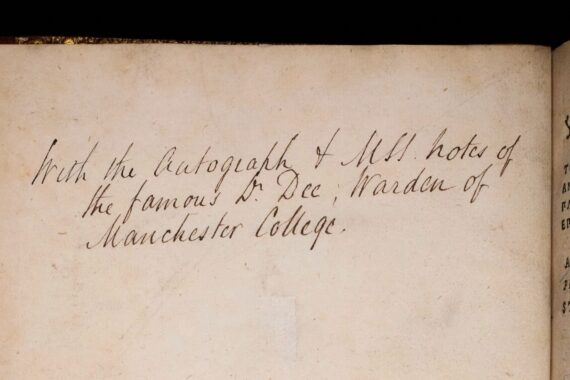
Figure 4: Annotation in John Dee’s copy of Arrian’s Periplus euxeinou pontou (Chetham’s Library, Mun. 7.C.4.116, n.p).
The final printed book that belonged to Dee, his copy of Konrad Gesner’s De remediis secretis, which entered the library’s collections in 1871, once again through purchase (at a cost of seven shillings). This is one of the library’s more heavily annotated books owned by Dee, featuring his notes, alchemical illustrations and recipes. A note has been added in a later hand on page 49 ‘the famous Dr Dee Warden of our Town of Manchester’. The book also contains an ownership inscription by John Barker de Hopwood, a name that belonged to a local gentry family. During his time in Manchester, Dee had leant books to Edmund Hopwood, justice of the peace, so it is possible that the book had remained with members of the Hopwood family (although further research is needed to confirm this).
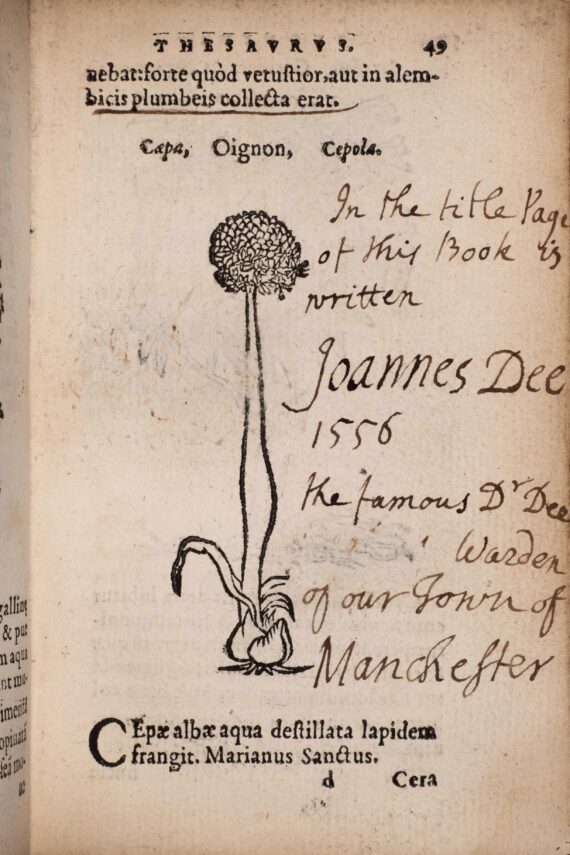
Figure 5: Annotation in John Dee’s copy of Konrad Gesner’s De remediis secretis (Chetham’s Library, Mun. 7.C.4.214, p. 48).
It is therefore clear that the printed books owned by Dee that are now found in Chetham’s Library’s collections did not remain in the college buildings between Dee’s departure and the library’s foundation in 1653. Many of these books instead found their way into the vast collections of like-minded individuals such as John Byrom and John Soane, and were later acquired by the library as a result of the interest (and consequent collecting activity) of the nineteenth-century antiquarians associated with the library and the Chetham Society in one of Manchester’s most famous historical residents. Although Dee’s years in Manchester were largely unhappy and disappointing, he remains one of the most fascinating figures associated with the city, and will surely remain so.
Blog post by Laura Bryer

2 Comments
Mr Andrew Barker
I presume that the copy of Euclid’s Elements in the library and which contains an introduction written by John Dee, was not owned by John Dee. Do you know of the provenance of this work, and how it came to the library?
Emma Nelson
We do know a little bit about the provenance of the copy of Euclid’s Elements with John Dee’s preface in the library (O.7.43). Its earliest provenance is unknown, but in the first half of the eighteenth century it belonged to the antiquary and natural philosopher Martin Folkes (1690-1754). It would be possible to determine the precise date when it entered the library’s collections by searching the manuscript accessions register, but it was certainly here by 1791, when it was included in the library’s first printed catalogue.