- About
- Visiting
- What’s On
- Venue hire
- Catalogues
- Collections
- 101 Treasures of Chetham’s
- Digital Resources
- The Flowers of Histories
- A Book of Hours from France
- The Manchester Scrapbook
- Thomas Barritt of Manchester
- Art Treasures Examiner of 1857
- Manchester Association for Constitutional Order
- The North Western Museum of Science and Industry: Some Reminiscences by Richard Hills
- Criminal Manchester
- The Cup of Destiny
- Athenaeum Souvenir
- Middle English Manuscripts
- Manchester and Liverpool of Today
- Hollingworth’s Mancuniensis
- Memoir of Cecil Wray
- William Seward’s Diary
- The Anti-Monopolist
- Fishwick’s History of Rochdale
- Knyvett’s Defence of this Realm
- Tractatus de Nigromantia
- Axon Ballads
- Printed Books & Ephemera
- Archives & Manuscripts
- Prints and Photographs
- Blog
- Support us
Poets’ Corner: Industry and Identity
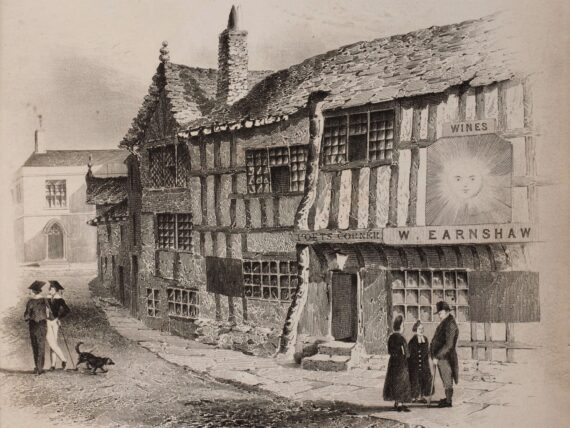
‘Near to the gates of Chetham College, in Long Millgate, stands one of those ancient and picturesque houses, which occasionally start to view like spectres of a bygone age, but are now fast disappearing before the levelling hand of improvement’. So begins the preface to an anthology of poems called The Festive Wreath (1842), written by a group of largely working-class poets who came to be known variously as the ‘Sun Inn Group’, the ‘Manchester Poets’ and the ‘Bards of Cottonopolis’. The group’s meeting place was this picturesque house, the Sun Inn, a timber-framed building on the corner of Long Millgate, which came to be known in the early 1840s as ‘Poets’ Corner’, from the literary gatherings that took place there. Notable members of the group included its leading light John Critchley Prince, the radical reformer Samuel Bamford, the ‘Bard of Colour’ Robert Rose, and Isabella Varley—who later wrote and published The Manchester Man under her married name, Mrs G. Linnæus Banks.
Chetham’s Library’s latest exhibition focuses on this group and its poetry. The Sun Inn group was the one of the most prolific of the societies of working-class poets that emerged in Britain’s industrial cities around the middle of the nineteenth century. It played an important role in shaping Manchester’s literary and cultural identity at a key moment in the city’s history; while some of its members wrote about working-class conditions at a time when Manchester was rapidly expanding as an industrial powerhouse, others embraced a far broader range of themes, challenging contemporary views of the city as a literary wasteland. Some of the group wrote in their Lancashire dialect, a choice that went against the grain and contributed to a growing interest in regional dialect literature in subsequent decades. Although their poetry has been largely forgotten, and the Sun Inn no longer exists—its license was withdrawn and it became an antiques shop, its roof collapsed in a storm in July 1914, and it was demolished in the 1920s—the group staked out a claim to a literary identity for the city, foreshadowing its modern status as a UNESCO City of Literature. Over the coming months, we look forward to exploring this group’s membership and sharing some of its poetry with you.
Figure 1: An illustration of the Sun Inn and Poet’s Corner, in The Festive Wreath (Chetham’s Library, 8.J.5.70).

2 Comments
Terry Revell
Thank you for this information about the Sun Inn and some of the poets associated with the group. I am sorry that I missed the exhibition and the others relating to the ‘Manchester Poets’. I am researching a man called Thomas Barlow, who frequented the inn to sing/read his songs and poems. Thomas was from Glossop and worked for Edmund Potter in his calico bleaching works at Dinting. Close associates of his were John Crichley Prince and Samuel Laycock. He became known for a book of poems he had published in 1867 entitled “A pic-nic at Woodhead”. I would be grateful if you could tell me if the library contains any reference to him.
Emma Nelson
We’re really glad you enjoyed this blog post! Unfortunately, having looked through our catalogue, we’ve not been able to find a copy of ‘A pic-nic at Woodhead’. We have works by two Thomas Barlows, but neither seems to be the individual that you’re interested in – sorry!