- About
- Visiting
- What’s On
- Venue hire
- Catalogues
- Collections
- 101 Treasures of Chetham’s
- Digital Resources
- The Flowers of Histories
- A Book of Hours from France
- The Manchester Scrapbook
- Thomas Barritt of Manchester
- Art Treasures Examiner of 1857
- Manchester Association for Constitutional Order
- The North Western Museum of Science and Industry: Some Reminiscences by Richard Hills
- Criminal Manchester
- The Cup of Destiny
- Athenaeum Souvenir
- Middle English Manuscripts
- Manchester and Liverpool of Today
- Hollingworth’s Mancuniensis
- Memoir of Cecil Wray
- William Seward’s Diary
- The Anti-Monopolist
- Fishwick’s History of Rochdale
- Knyvett’s Defence of this Realm
- Tractatus de Nigromantia
- Axon Ballads
- Printed Books & Ephemera
- Archives & Manuscripts
- Prints and Photographs
- Blog
- Support us
Fit for a King: Royal Bindings in Chetham’s Library
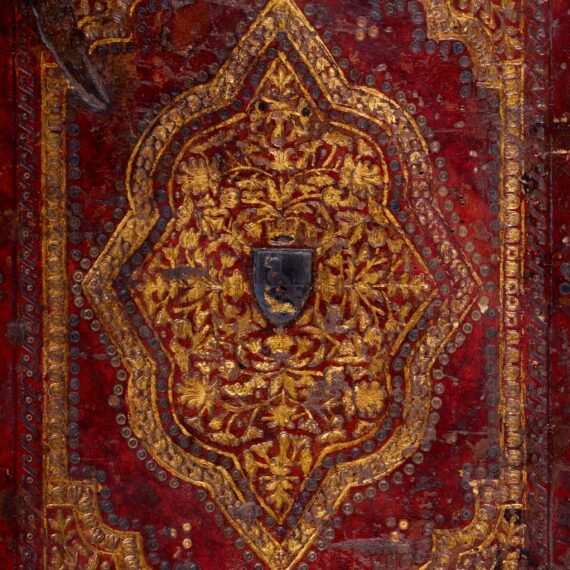
Although many of the books in Chetham’s Library’s collection were bound for the library, some books came to the library already bound, and these bindings reveal something of their histories before they arrived here. Foremost among the latter group are some of the library’s finest treasures. In Meetings with Remarkable Manuscripts, the eminent codicologist Christopher de Hamel articulated his self-formulated rule that ‘if you’re not sure whether a book is royal, it isn’t’, and several books in Chetham’s Library’s collections leave no doubt as to their origins. The bindings of such books are just as valuable as their contents (if not more so!), and when the two are taken together, these books speak fluently about their past.
As far as we know, Chetham’s Library’s collections contain four royal books. The first of these is a manuscript containing a copy of Aulus Gellius’ Noctes Atticae (Attic Nights), a compendium of notes on grammar, philosophy, history and other subjects that was widely popular during the medieval period. Chetham’s Library’s manuscript dates to the late fifteenth century, and was produced in Florence by the scribe Humbert and the illuminator Antonio di Niccolò di Lorenzo di Domenico for the banker Francesco Sassetti (1421–90). Sassetti had joined the Medici bank at Geneva in the late 1430s, was promoted to branch manager in 1447–8, and became the general manager of the Medici bank in Florence following the death of Giovanni di Cosimo de Medici in 1463. A humanistic library was an essential part of the image of any prominent figure in renaissance Italy, and Sassetti was no exception: he assembled a rich library that included works by classical authors such as Aulus Gellius, as well as contemporary authors. Sassetti’s management of the Medici bank was flawed, however, leading to the liquidation of several branches in the 1480s and personal financial hardship for Sassetti, which forced him to sell many of his books.
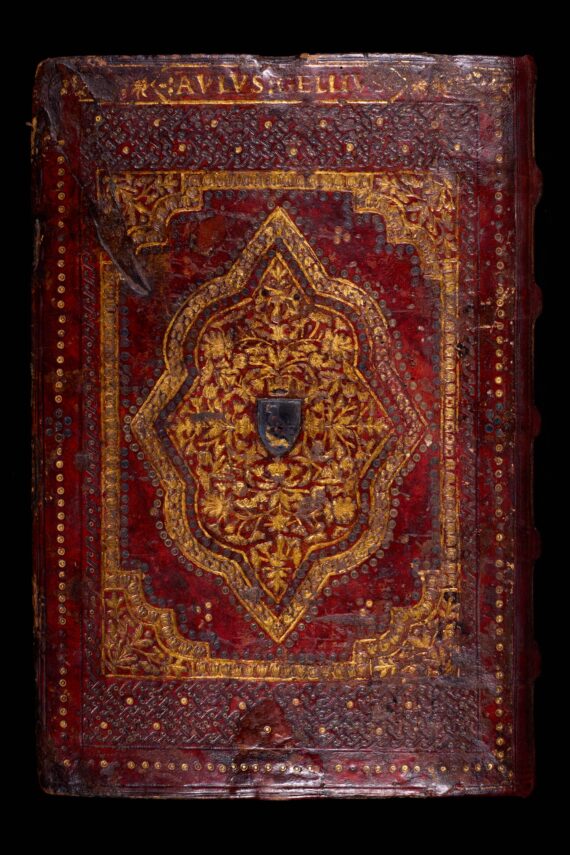
Figure 1: The cover of Matthias Corvinus’ copy of Aulus Gellius’ Noctes Atticæ (Chetham’s Library, Mun. E.8.23).
At this time, Italian cultural tastes represented the height of fashion across Europe, and there was no shortage of buyers for the books that Sassetti put onto the market. This manuscript, and several others, were purchased by buyers who had been sent to Italy by the king of Hungary, Matthias Corvinus (1458–90). An avid reader, Corvinus often stayed up late into the night reading, and his library—the Bibliotheca Corviniana—was among the finest in Europe. When it reached Hungary, the manuscript was re-bound in red goatskin leather in a style that blended aspects of contemporary Florentine bindings with local features. The king’s emblem, a raven standing on a branch and holding a ring in its beak, serves as the centrepiece of the gilt and blind-stamped (without gold) decoration that adorns both covers. The name of the work’s author was also stamped on what we would consider the book’s back cover, reflecting the old practice of storing books with this as the visible cover.
Less than half a century after this book travelled to Hungary, however, the Bibliotheca Corviniana was dispersed during the Turkish sack of Budapest in 1526. Fortunately, more than two hundred books from Corvinus’ library can now be found in libraries around the world, but it is difficult to trace their individual journeys. By the eighteenth century, his copy of the Noctes Atticae had found its way into the hands of the Manchester poet, shorthand writer and friend of Chetham’s Library, John Byrom (1692–1763). Byrom’s collection is notable, among other reasons, for the large number of books that still retain their original bindings, when the tendency of the time was to re-bind them to match the owner’s other books. A large part of Byrom’s collection, including this manuscript, was donated to Chetham’s Library by his descendant, Eleanora Atherton, in 1870. It is one of only two Corvinus bindings in British libraries (the other is a copy of Seneca’s Tragoediae (Tragedies) at the Bodleian Library, which can be viewed online).
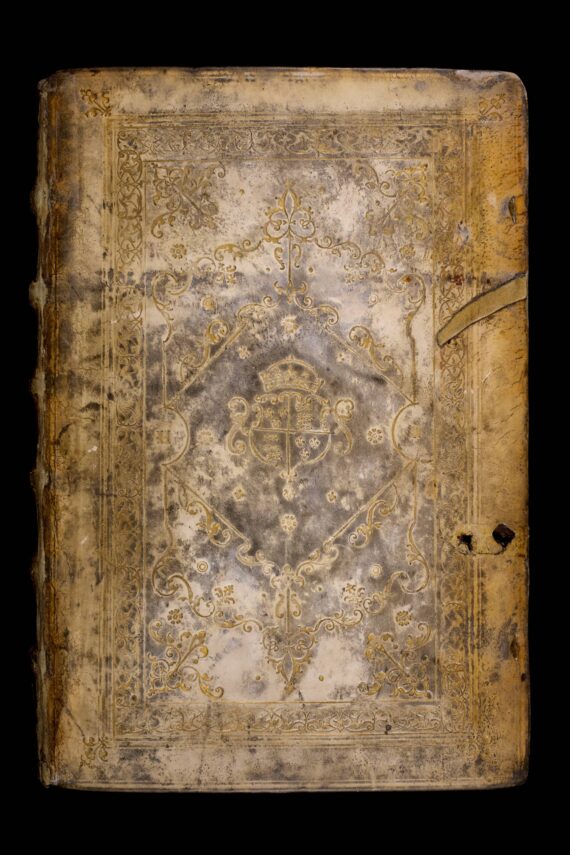
Figure 2: The cover of Henry VIII’s copy of Prosper of Aquitaine’s Opera (Chetham’s Library, Mun. E.3.37).
The library’s second royal book is a handsomely bound folio edition of the works of the fifth-century theologian Prosper of Aquitaine, printed in Lyon in 1539. The book’s binding in white deerskin features fine gilded stamped decoration that incorporates the English royal coat of arms, an ‘HR’ monogram, and flowers that resemble the Tudor rose. Meanwhile, the head, fore-edge and foot of the book’s text-block are inscribed with the legend ‘REX IN ÆTERNUM VIVE’ (‘O king, may you live forever’). There is no doubt whatsoever, especially given the work’s printing date, that this book belonged to Henry VIII. The binding was almost certainly executed by Thomas Berthelet, the royal printer and bookbinder between 1530 and 1547, since so many of his other bindings feature the same legend on their fore-edges. Although the traditional view that the Dissolution of the Monasteries under Henry VIII represented the defining moment of loss for British medieval libraries and manuscripts is now starting to be challenged, it is remarkably fitting given Henry’s religious reforms that this book’s spine was strengthened using parchment taken from a work of canon (religious) law! How this book made its way from the royal collections to Chetham’s Library’s bookshelves is a mystery. It was purchased for the library in London on 16 July 1674 for the modest price of eight shillings, but at that date was not recognised for what it was: the library’s accessions register incorrectly recorded its printing date as 1639, and its place of publication as Basel!
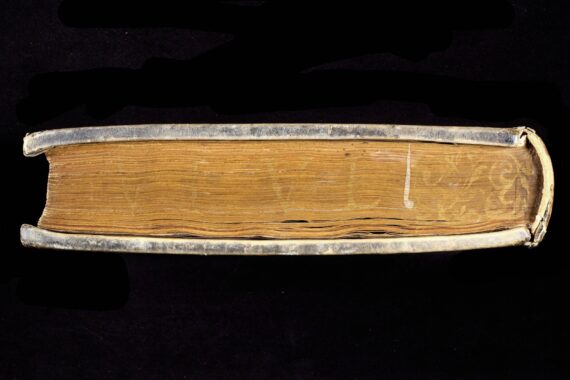
Figure 3: The fore-edge of Henry VIII’s copy of Prosper of Aquitaine’s Opera (Chetham’s Library, Mun. E.3.37).
The third royal book in Chetham’s Library’s collections is a manuscript copy of a short treatise on ‘the defence of this Realme against all forraine invasion’, written by the Norfolk gentleman and Member of Parliament Sir Henry Knyvett (1537–98). Knyvett was no armchair commentator, and this was a field in which he had plenty of experience: he had led a force of one hundred cavalry against the French at the Siege of Leith (where he ‘lost both lim and blood’) in 1560, and was knighted by Elizabeth I for his valour fighting the Spanish Armada in 1598. In his treatise, which he ‘scribbled in hast’ a few days after Spanish forces captured Calais in late April 1598, Knyvett proposed the re-ordering of the militia and increased training in the use of the longbow. Despite the speed with which it was written, however, this copy of the treatise is a luxurious presentation copy that was surely meant to win Elizabeth’s favour: it was written in a fine script, embellished with gold, and bound in her favourite red velvet. All of this was to no avail, however, since it had been decreed a year earlier that England’s bowmen were to be replaced with musketeers. How this book found its way into Chetham’s Library’s collections is once again a mystery: it was donated to the library before 24 March 1680, but the precise date and the donor’s identity are unknown.
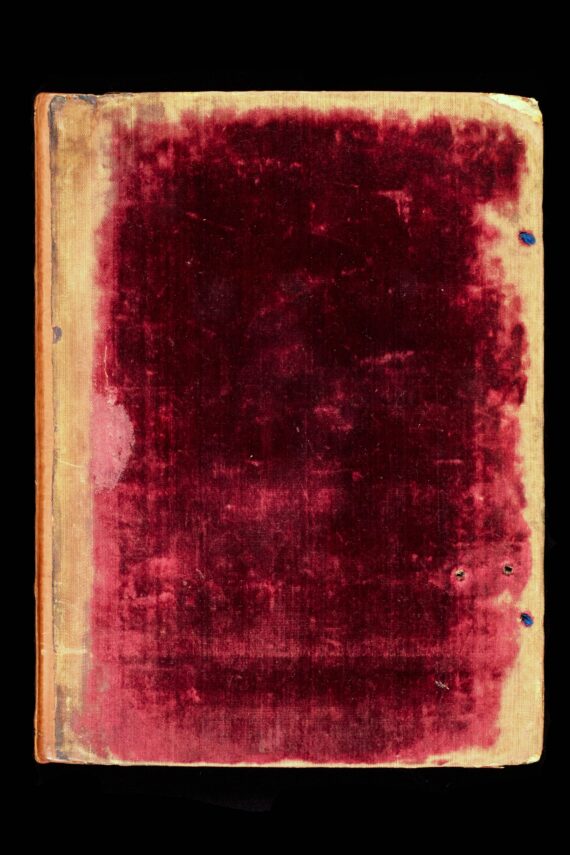
Figure 4: The cover of Henry Knyvett’s treatise (Chetham’s Library, Mun. A.4.37).
The royal books in Chetham’s Library’s collections demonstrate the way in which the possessions of Renaissance monarchs reflected their status, power and authority. Just like their palaces, art and attire, the bindings of royal books visibly expressed their owners’ political supremacy and magnificence. The red velvet binding of the Sir Henry Knyvett’s treatise similarly shows how subjects could appeal to their monarch’s tastes in the hope of winning their favour. Meanwhile, the bindings of a fourth royal book in Chetham’s Library’s collections tell us something about its story after it left royal hands. This is a manuscript containing two works by Coluccio Salutati (1331–1406), a Florentine chancellor and humanist who wrote treatises on government and ethics. This manuscript once belonged to Humphrey, Duke of Gloucester, the youngest of Henry IV’s four sons and a prince in his own right. Duke Humphrey was a notable early English humanist and a notable patron, and is most famous for having bequeathed 281 books to the University of Oxford in 1447 to provide a library for the students there. Although most of these books were later dispersed, the library in which they were kept is still known as ‘Duke Humfrey’s Library’.
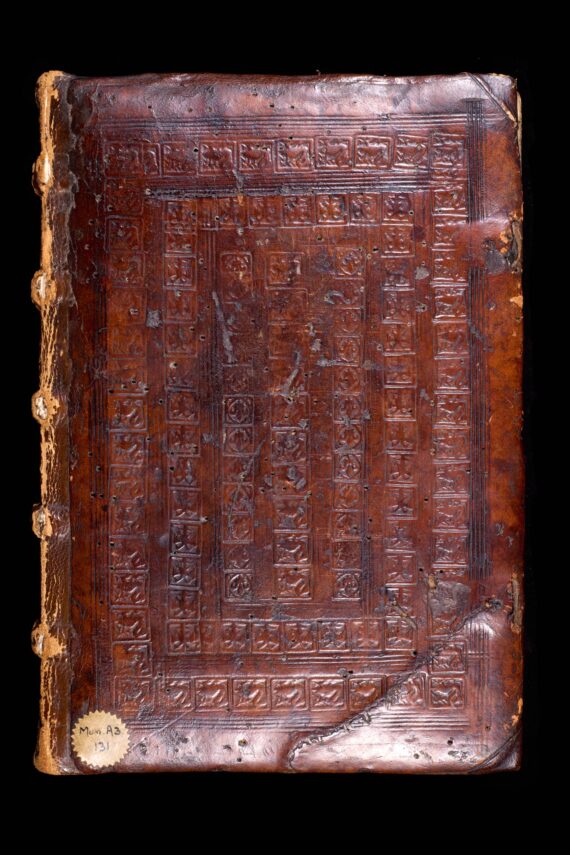
Figure 5: The cover of Duke Humphrey’s copy of Coluccio Salutati’s works (Chetham’s Library, Mun. A.3.131)
Duke Humphrey’s copy of Coluccio Salutati’s works passed through several hands after his death, and one of its earliest owners, a legal scholar named William Witham (d. 1472), was probably responsible for having it re-bound by a bookbinder working at Salisbury in the 1460s. As such, the manuscript no longer looks like it would have when Duke Humphrey owned it. Eventually, this manuscript found its way into the hands of John Byrom, who again retained its medieval binding, and later it entered the library through the same route as Matthew Corvinus’ copy of Aulus Gellius’ Noctes Atticae.
Blog post by Emma Nelson