- About
- Visiting
- What’s On
- Venue hire
- Catalogues
- Collections
- 101 Treasures of Chetham’s
- Digital Resources
- The Flowers of Histories
- A Book of Hours from France
- The Manchester Scrapbook
- Thomas Barritt of Manchester
- Art Treasures Examiner of 1857
- Manchester Association for Constitutional Order
- The North Western Museum of Science and Industry: Some Reminiscences by Richard Hills
- Criminal Manchester
- The Cup of Destiny
- Athenaeum Souvenir
- Middle English Manuscripts
- Manchester and Liverpool of Today
- Hollingworth’s Mancuniensis
- Memoir of Cecil Wray
- William Seward’s Diary
- The Anti-Monopolist
- Fishwick’s History of Rochdale
- Knyvett’s Defence of this Realm
- Tractatus de Nigromantia
- Axon Ballads
- Printed Books & Ephemera
- Archives & Manuscripts
- Prints and Photographs
- Blog
- Support us
Chetham’s Library Welcomes New Doctoral Students
As the springtime gradually starts to make itself felt and the weather becomes increasingly pleasant, there’s also another kind of change in the air at Chetham’s Library. Like any historic rare-books library, Chetham’s Library exists within a broader academic community, and in addition to our staff and visitors who work hard to keep the library open and make its collections accessible to a diverse assortment of readers, the library has recently welcomed two new doctoral students to swell its ranks. Both are engaged in surfacing “hidden voices” in early printed books (books printed between c. 1450 and 1750) within Chetham’s Library’s catalogue.
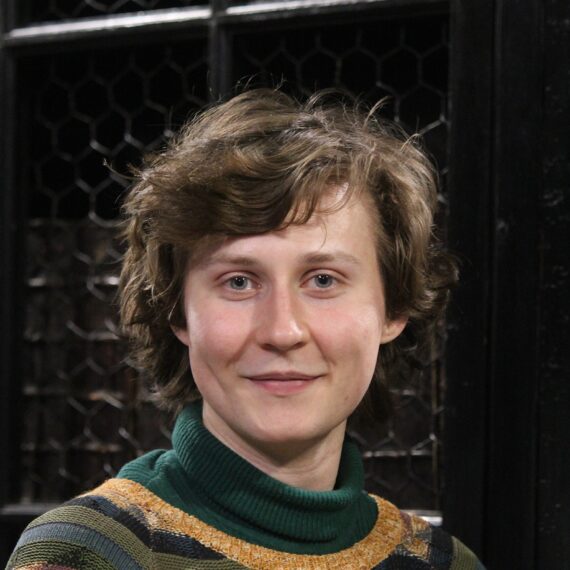
The first of our new doctoral students is Finch Collins, whose background is in early modern history and rare-books librarianship. Finch completed his master’s degrees at Indiana University Bloomington, and before moving to Manchester to begin his doctoral research, he worked as an assistant rare-books curator at Linda Hall Library in Kansas City, Missouri, where he stewarded a collection of historical scientific and technical books including two with Galileo’s own handwriting in them! His research interests include book history, queer bibliography, and library cataloguing in theory and practice. He’s especially interested in the ecosystem of information about early printed books and how it can be made more comprehensive, equitable and sustainable, and in the intellectual and technical structures that underpin (and sometimes undermine) access to cultural heritage. Finch has actually been with us since October, so he’s already started to settle into his project and the library’s day-to-day life.
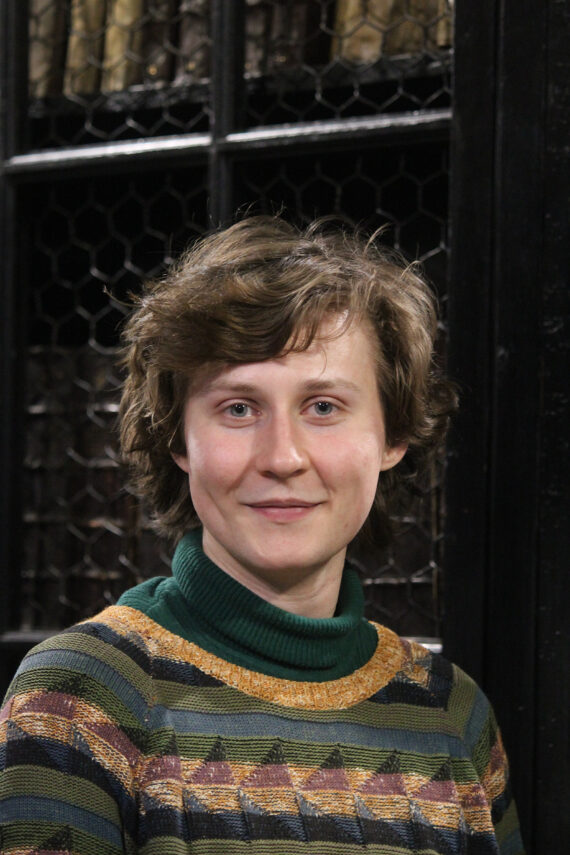
Finch Collins, one of Chetham’s Library’s new doctoral students.
Finch’s thesis focuses on ‘A Data-Driven Approach to Social Justice in Library Catalogues of Small and Medium Heritage Collections’. According to Finch, ‘at Chetham’s Library, I research how digital tools can help surface the hidden voices of marginalised people from European early printed books. Early modern Europe was a rich and varied place. People from all walks of life made, read and used printed books, including women, members of minority religious communities and people of colour. However, the way that library catalogues have historically recorded information about early printed books and the people who were involved with them can hide these stories. In my project, I intend to use digital tools, especially linked open data, to draw out these stories from the library’s catalogue. Linked open data is machine-readable metadata (data about data) that is structured to be available to anyone and interconnected. While it’s still early days, I’ve had some success using linked open data to locate female authors within Chetham’s Library’s catalogue. I’m fortunate to be building on thorough catalogue records and the work done by staff to showcase the diversity of the library’s collections and history, such as the recent “A Woman’s Write” exhibition. With my project, I hope to promote public awareness of the involvement of marginalised people in early printed book production and circulation, and to drive change in library cataloguing technologies, standards and practice. In previous roles, I’ve located marginalised people in early printed books and shared their stories through writing, presentations, and exhibitions, and I’m looking forward to contributing to such public programming at Chetham’s Library’.
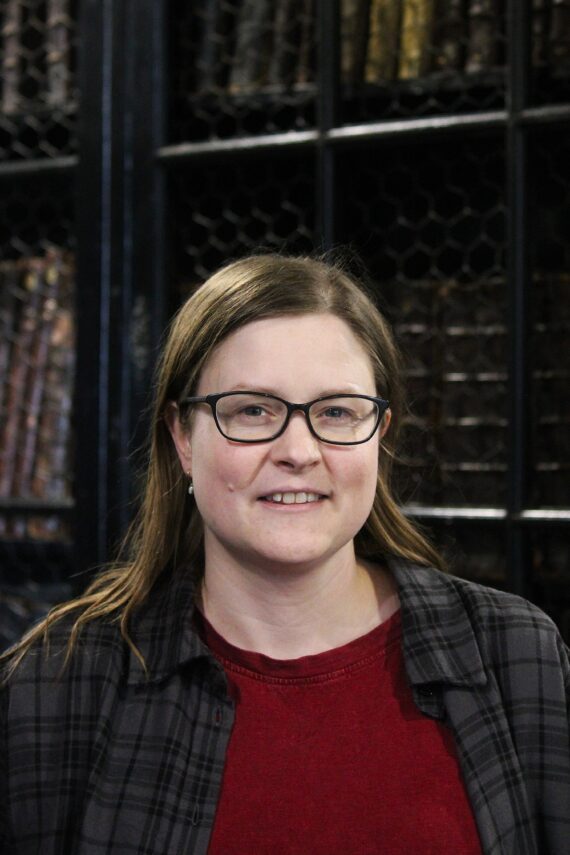
Harriet Hale, one of Chetham’s Library’s new doctoral students.
Our second new doctoral student is Harriet Hale, who started part-time in January. Alongside master’s degrees in Literature and Philosophy (Sussex University) and Library and Information Studies (University College London), Harriet has worked in the libraries of Trinity College Cambridge, Cambridge University and the Wallace Collection. Harriet has extensive experience in rare-books librarianship and metadata, and comes to us from University College London, where she continues to work as a cataloguer in a part-time capacity. Her research interests include the early modern book trade, library metadata, and the intersections of different branches of the humanities.
Harriet’s thesis centres around ‘Names, Authority Files, and Cataloguing Practices’, looking into the limitations of traditional cataloguing practices and opportunities of different approaches to increasing the visibility of names. According to Harriet, ‘starting a PhD after ten years in the workplace has been both a privilege and something of a culture shock! However, years of working with library metadata has made its structure and constraints second nature, and I am enthused to delve deeper into the opportunities of improving the discoverability of “hidden voices” at Chetham’s Library and beyond. My recent work on University College London’s Liberating the Collections project has brought these issues to the fore for me, and I am deeply invested in improving the visibility of marginalised voices and motivated by the ethos that these individuals and their work deserve to be remembered’.
In addition to an academic thesis, both projects will develop practical solutions for small and medium-sized cultural heritage organisations such as Chetham’s Library, which will improve the visibility of these marginalised voices and demonstrate the interest and relevance of their collections to diverse modern audiences. As they undertake new and exciting research into the library’s collections over the coming years, Finch and Harriet will undoubtedly become familiar faces around the library. We’re sure you’ll join us in wishing them both all the best with their projects, and an enjoyable and rewarding time at Chetham’s Library!