- About
- Visiting
- What’s On
- Venue hire
- Catalogues
- Collections
- 101 Treasures of Chetham’s
- Digital Resources
- The Flowers of Histories
- A Book of Hours from France
- The Manchester Scrapbook
- Thomas Barritt of Manchester
- Art Treasures Examiner of 1857
- Manchester Association for Constitutional Order
- The North Western Museum of Science and Industry: Some Reminiscences by Richard Hills
- Criminal Manchester
- The Cup of Destiny
- Athenaeum Souvenir
- Middle English Manuscripts
- Manchester and Liverpool of Today
- Hollingworth’s Mancuniensis
- Memoir of Cecil Wray
- William Seward’s Diary
- The Anti-Monopolist
- Fishwick’s History of Rochdale
- Knyvett’s Defence of this Realm
- Tractatus de Nigromantia
- Axon Ballads
- Printed Books & Ephemera
- Archives & Manuscripts
- Prints and Photographs
- Blog
- Support us
John Dee, Re-animator of Corpses, and Humphrey Chetham, Rejected Young Lover: Fictional Versions of Real People in W. H. Ainsworth’s Guy Fawkes (1841)
William Harrison Ainsworth, the popular Victorian historical novelist, had a long association with Chetham’s Library. Born in King Street, Manchester, in 1805, Ainsworth attended Manchester Grammar School on the library’s doorstep, and as a teenager, became a solicitor’s clerk. Escaping the tedium of his job, he spent many hours reading in Chetham’s Library. His favourite poems were those of Byron, featuring tortured heroes, while the historical novels of Walter Scott and the Gothic romances of Ann Radcliffe and Matthew Lewis also inspired him. The atmosphere of Chetham’s Library also exerted a powerful effect on his imagination: although there is no historical evidence to suggest that Guy Fawkes had any direct association with Christ’s College, Manchester, or with John Dee, its warden at the time of the Gunpowder Plot, Ainsworth set several scenes in his novel Guy Fawkes, or The Gunpowder Treason: An Historical Romance (1841) in the buildings that later became Chetham’s Library and Hospital School. In this work, he mixed real historical characters, such as Guy Fawkes, John Dee and Humphrey Chetham, with romantic inventions such as the heroine Viviana Radcliffe, the young, beautiful Roman Catholic mistress of Ordsall Hall, who is also the love interest of both Fawkes and Chetham. Throughout the novel, Ainsworth characterised Chetham as an altruistic, rational and tolerant Protestant, in contrast with the more dashing, violent and impulsive Catholic Fawkes. It is, of course, Fawkes whom Viviana favours.
The novel begins in late June 1605, when the Gunpowder Plot is already well advanced. Guy Fawkes is in Manchester, witnessing the gory executions of two Jesuit priests outside the Collegiate Church. The executions, although fictitious, were based by Ainsworth on real executions carried out in Lancaster, York and London during Elizabeth I’s reign. A local prophetess, Elizabeth Orton, intervenes dramatically but dies after attempting to escape from the soldiers pursuing her. Shortly afterwards, a young Humphrey Chetham and Guy Fawkes witness her body being exhumed from the section of the collegiate church’s graveyard reserved for criminals. It is Chetham who recognises the body snatchers: ‘the famous Doctor Dee … divine, mathematician, astrologer—and if report speaks truly, conjuror … and the other in the Polish cap is the no-less celebrated Edward Kelley, the doctor’s assistant, or, as he is ordinarily termed, his seer’.
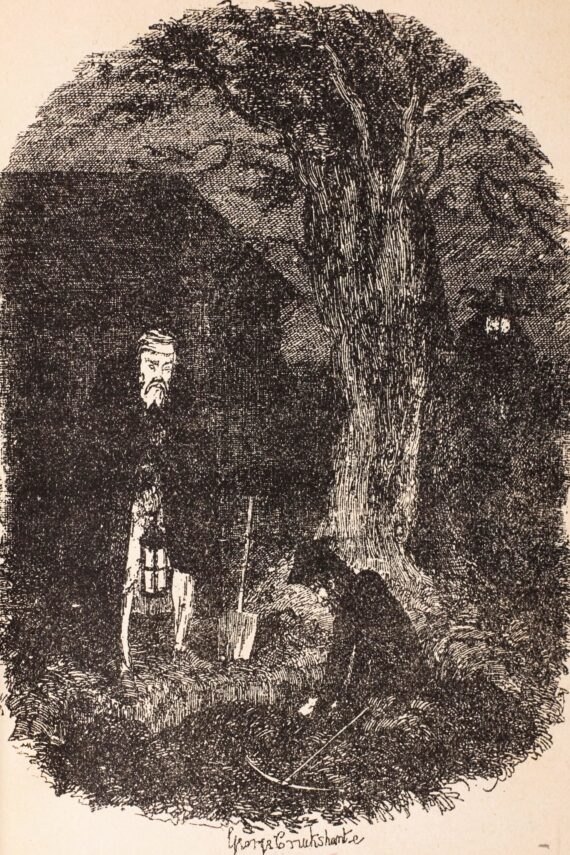
Figure 1: John Dee and Edward Kelley exhume the body of Elizabeth Orton, watched by Guy Fawkes (Chetham’s Library, 12.F.2.14, plate after p. 60).
Disregarding the inconvenient facts that Kelley had died in 1597 and that Dee had left Manchester in November 1604, Ainsworth constructed a narrative in which Fawkes witnesses Dee and Kelley re-animate the corpse of Elizabeth Orton in order to hear more of her prophecies. In a scene of supernatural horror, Fawkes asks the corpse for information about the success of his scheme. The prophecy, however, is ambiguous: ‘”the end will be death,” replied the corpse’.
Eager to learn more about his future fate, Fawkes is taken by Dee into ‘a large chamber, panelled with oak, and having a curiously moulded ceiling, ornamented with grotesque sculpture’, recognisable as the present Audit Room. From there, he is led through intricate passages to a chamber ‘which was evidently the magician’s sacred retreat’. In a recess behind a black curtain, Dee’s show-stone is placed on a table ‘covered with cabalistic characters and figures, referring to the celestial influences’. If Ainsworth was thinking here of the present Reading Room, the recess he describes may be the alcove in which Marx and Engels later came to study, or a small room known as the ‘scriptorium’. Ainsworth’s description of the ensuing ritual involves Dee and Kelley throwing gums and herbs onto a brasier, producing noxious and fragrant odours and multi-coloured flames, with accompanying incantations, howling, shrieking, music, laughter and silence: ‘“the spirits are at hand!” cried Dee. “Do not look behind you or they will tear you to pieces!”’. Fawkes is afforded three visions: one shows the conspirators taking their oath in the past; a second vision is of a gloomy vault filled with wood and barrels of gunpowder in the present; finally, in the future, Fawkes sees a crowd of skeletons pointing their bony fingers at ‘a figure resembling himself, stretched upon the wheel, and writhing in the agonies of torture’. Dee forewarns Fawkes of the failure of his plot and attempts to discourage him from proceeding further with it, to no avail.
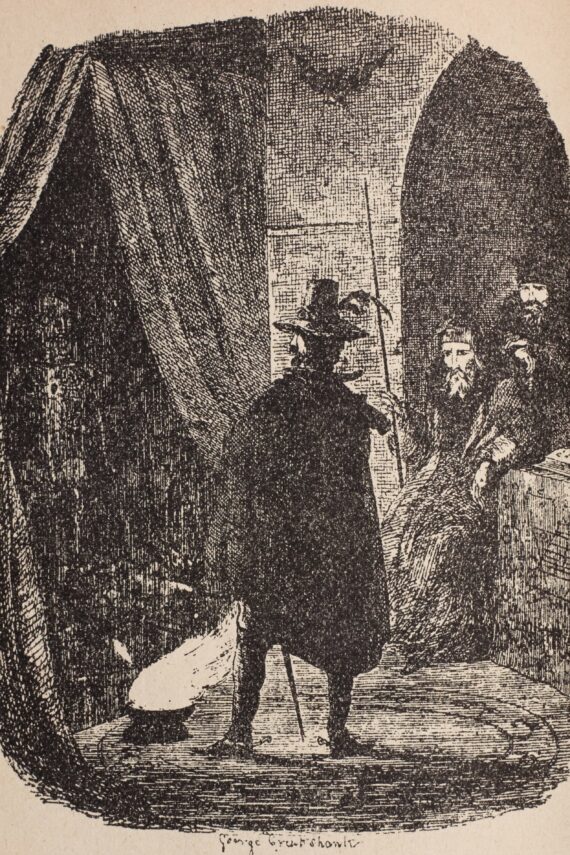
Figure 2: John Dee and Edward Kelley summon up a vision of Guy Fawkes’ future fate (Chetham’s Library, 8.E.1.27, plate before p. 61).
Ainsworth was clearly not averse to embellishing the myth of Doctor Dee with all the paraphernalia of Gothic fiction at his disposal, including the re-animation of a corpse, elaborate conjuring and horrific prophetic visions. Later in the narrative, Dee appears as a more benevolent figure, saving the life of the injured Fawkes with the aid of his supernatural knowledge. He consults his show-stone and produces ‘an elixir of wonderful efficacy … a gourd-shaped bottle with a clear sparkling liquid’. He applies some of this to Fawkes’s temples and makes him drink three draughts of it. Dee, however, is in some doubt over whether this is the right thing to do: ‘I am debating within myself whether it is worthwhile reviving him for a more dreadful fate’. Dee is no doubt remembering the former vision of multiple skeletons pointing at Fawkes being tortured.
Dee’s ministrations lead to Fawkes’ recovery, and he secretly marries the heroine, Viviana Radcliffe. After Fawkes’s arrest and imprisonment, Dee makes a further appearance, attempting to help Viviana. Despite her being Catholic, she had not supported Fawkes’ plot to blow up the king and the Houses of Parliament. She was, however, aware of the conspiracy, and was culpable in not having reported it. It was Dee who had revealed the plot to the Earl of Salisbury, and he therefore believes that he can arrange a merciful judgement on Viviana. He tries to persuade her that he can help her regain her mansion and estates, but that she must obey him by marrying Humphrey Chetham after Fawkes’s death. Although in love with Viviana, Chetham is aware that she does not love him, and is appalled by Dee’s attempts to bargain with her. He did not know of Dee’s intention in advance, and urges him ‘not to clog his proposal with conditions which cannot be fulfilled’. Viviana refuses to marry Humphrey Chetham, but requests that he escort her to London. She voluntarily surrenders herself to the authorities and pleads her case before the Earl of Salisbury and the king: ‘I was restrained from the disclosure [of the Gunpowder Plot] by a fatal passion!’ Her excuse does not impress her inquisitors, however, and she is imprisoned in the Tower of London. In a final meeting with Chetham, she regrets being unable to reciprocate his love, and expresses hope that he will ‘meet with someone worthy of [him]’. Chetham vows that he will never love again. She advises him to return to Manchester, and, as a cure for his unhappiness, to ‘devote [him]self to the business of life’ and ‘employ [him]self in [his] former occupations’. Shortly afterwards, Viviana dies before the conspirators come to trial.
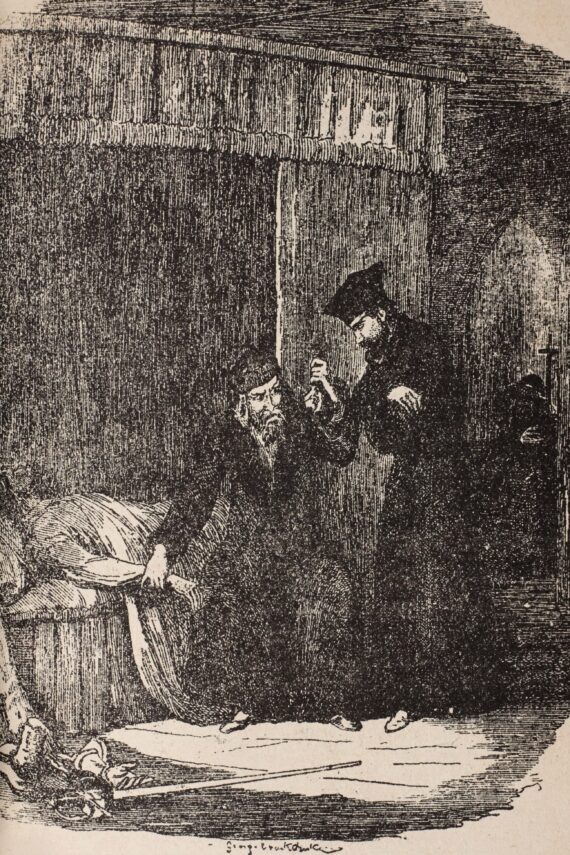
Figure 3: John Dee and Edward Kelley revive the injured Guy Fawkes with a magical potion (Chetham’s Library, 8.E.1.27, plate after p. 140).
Ainsworth portrays Humphrey Chetham as the unsuccessful lover who never recovers from his unrequited passion for Viviana. The trauma of rejection and the premature death of Viviana affect him for the rest of his life: he remains unmarried and channels his energies, as she had advised, into business, making money which he uses for philanthropic purposes. From the perspective of two centuries later, Ainsworth pays tribute to the founder of Chetham’s Library and Hospital School:
‘Obedient to Viviana’s last request, he quitted London … and, acting upon her advice, devoted himself on his return to Manchester to his mercantile pursuits. His perseverance and integrity were crowned with entire success, and he became in due season the wealthiest merchant of the town. But the blighting of his early affections tinged his whole life, and gave a melancholy to his thoughts and an austerity to his manner originally foreign to them. True to his promise, he died unmarried. His long and worthy career was marked by actions of the greatest benevolence. In proportion as his means increased, his charities were extended, and he truly became “a father to the fatherless and destitute”. To him the town of Manchester is indebted for the noble library and hospital bearing his name; and for these admirable institutions by which they so largely benefit, his memory must ever be held in veneration by its inhabitants’.
Ainsworth’s sensationalist historical fiction has not found favour with later generations: the critical consensus has preferred the humour and social conscience of Dickens, the psychological depth of George Eliot, and the romantic passions of the Brontës. Novels such as Guy Fawkes give us an insight into early-Victorian popular taste, however: audiences then preferred simple characterisation, continuous rapid action, and fantastic and supernatural elements above historical accuracy. The teenage Ainsworth, escaping from the uncongenial work in his solicitor’s office, probably contemplated the portrait of Humphrey Chetham in the Reading Room, and twenty years later, he invented a psychological explanation of youthful romantic disappointment to reconcile the severity of Chetham’s later appearance in the portrait with the benevolence of his actions in devoting his wealth to the foundation of the Library and Hospital School, through a fictional association with the college’s most famous warden (for a more factual account of Dee’s time as warden, you can read a recent blog post on the topic).
Blog post by John Cleary