- About
- Visiting
- What’s On
- Venue hire
- Catalogues
- Collections
- 101 Treasures of Chetham’s
- Digital Resources
- The Flowers of Histories
- A Book of Hours from France
- The Manchester Scrapbook
- Thomas Barritt of Manchester
- Art Treasures Examiner of 1857
- Manchester Association for Constitutional Order
- The North Western Museum of Science and Industry: Some Reminiscences by Richard Hills
- Criminal Manchester
- The Cup of Destiny
- Athenaeum Souvenir
- Middle English Manuscripts
- Manchester and Liverpool of Today
- Hollingworth’s Mancuniensis
- Memoir of Cecil Wray
- William Seward’s Diary
- The Anti-Monopolist
- Fishwick’s History of Rochdale
- Knyvett’s Defence of this Realm
- Tractatus de Nigromantia
- Axon Ballads
- Printed Books & Ephemera
- Archives & Manuscripts
- Prints and Photographs
- Blog
- Support us
Thomas de la Warre’s Trans-Atlantic Manuscript
In a letter dated 18 February 1669, the master of Jesus College Cambridge, John Worthington, described Chetham’s Library in Manchester as ‘a fair library of books (where I might pursue my studies) better than any College library in Cambridge’. Founded only sixteen years earlier under the will of the Lancashire textile merchant, banker and landowner Humphrey Chetham, the library had quickly prospered, but the association of the site on which it stood with books and learning was far older. The sandstone buildings that the library came to occupy had originally been constructed to provide accommodation for the fellows of the medieval town’s collegiate church, founded in 1421 by the lord of Manchester, Thomas de la Warre. Like any medieval religious foundation, the college possessed a library that served the needs of its fellows as they served the needs of the wider community. The evidence for this library is scattered, but enough survives to enable us to reconstruct its overall shape and the intellectual life of the college (more on this at a later date). One of the earliest books that belonged to the college, and the only one known to have survived, is a fourteenth-century Mariale (a manuscript containing texts relating to the Virgin Mary) that was probably donated to the college by its founder. In the twentieth century, however, this manuscript travelled across the Atlantic Ocean to California, and the story of how it came to do so highlights the efforts of the numerous individuals who sought to preserve it in Manchester.
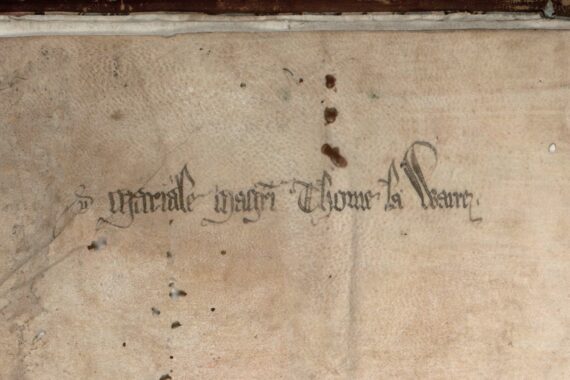
Figure 1: The inscription of Thomas de la Warre in the Mariale (San Marino, Huntington Library, HM 26560, fol. 1v).
That the Mariale was donated to the college by Thomas de la Warre, or was at least owned by him, is indicated by the prominent inscription of his name on its front flyleaf (a blank initial page, although this one was once pasted down to the cover). This flyleaf also bears the traces of the physical condition in which the Mariale was once kept: although the manuscript’s current binding dates to the eighteenth century, marks on the flyleaf indicate that the medieval binding featured two straps that kept the book closed, and that it was once chained in place. This practice was common in late medieval libraries, with many donors expressly stipulating that their books be chained to prevent their removal (a practice that continued into the early modern period, as can be seen at Chetham’s Library in the Gorton Chest). Books that were borrowed or otherwise removed from libraries were more vulnerable to damage and loss, but even the books that remained in libraries were not invulnerable.
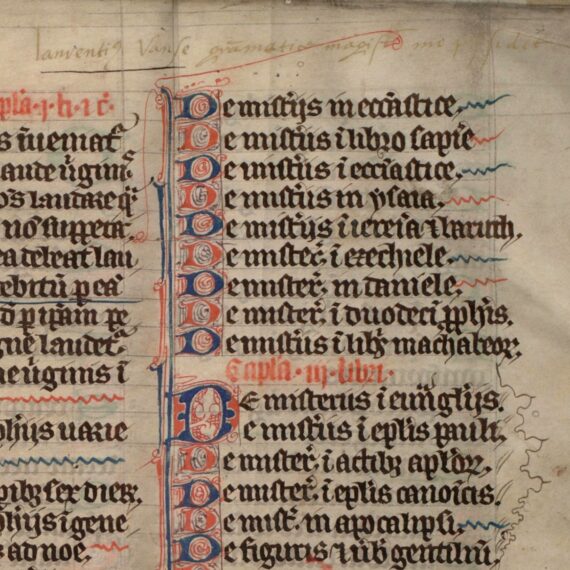
As was seen in one of the library’s recent blog posts, Manchester’s college faced turbulent times during the English Reformation. In 1547, the college was dissolved under the Chantries Act of Edward VI, its lands seized by the crown, and its fellows pensioned off. A decade later, the college was one of only four re-founded by Mary I, and some of the fellows who had been there before its dissolution returned. One such individual was Laurence Vaux, in whose hands the Mariale next resurfaces: a Latin inscription entered on its second folio reads ‘Laurentius Vause grammatice magister me possidet’ (‘Laurence Vaux, master of grammar, possesses me’). It is unclear when Vaux added this inscription; he may have done so after carrying the book away in order to protect it when the college was dissolved, or later as the college’s warden, an office that he succeeded to in 1558. Vaux’s wardenship was short-lived, however, since he fled the college before the visitation of Elizabeth I’s commissioners the following year. The Mariale’s later presence in Manchester suggests that he did not take it with him then, although he did take the college’s previous silver plate, vestments and muniments (the title deeds to the college’s properties).
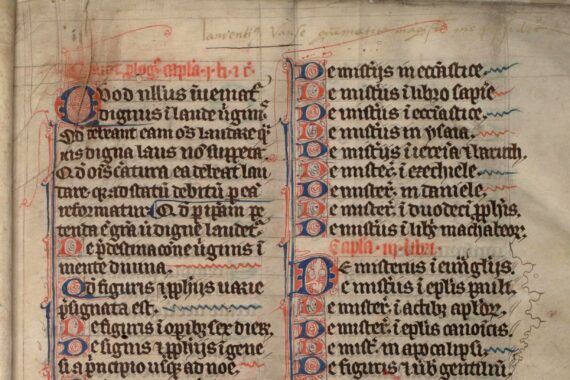
Figure 2: Laurence Vaux’s inscription in the Mariale (San Marino, Huntington Library, HM 26560, fol. 2r).
During the English Civil War, the college’s fellows were driven out by Parliamentary soldiers, and the college was dissolved for the second time by Parliament in 1649. By then, the college buildings had fallen into disrepair, and they were soon afterwards purchased in accordance with Humphrey Chetham’s will and converted for use as a library. The college was subsequently re-founded during the Restoration in 1660, and this time survived until it was converted into Manchester Cathedral in 1847. Thomas de la Warre’s Mariale also proved itself to be remarkably impervious, resurfacing in the hands of another of the college’s wardens, Richard Wroe, in 1697. Wroe had become a fellow of the college in 1674–5, and was appointed as warden in 1684, an office that he continued to hold until his death in 1717–8. The manuscript had therefore survived the eleven years between the college’s dissolution and its re-foundation, and the displacement of the fellows from their original building, remaining in the possession of the college’s wardens. Thomas de la Warre’s Mariale therefore stands in stark contrast to a well-entrenched assumption that is now starting to be challenged, namely that the Dissolution of the Monasteries and the English Reformation more broadly represented the defining moment of loss for British medieval libraries. Instead, it demonstrates how resilient at least part of the college’s library was to the turbulence of the sixteenth and seventeenth centuries.
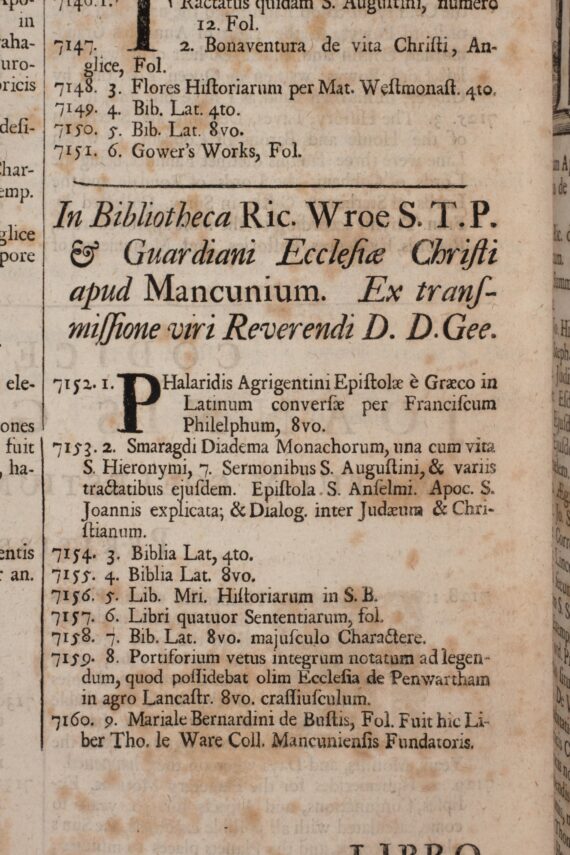
Figure 3: The Mariale in Edward Bernard’s Catalogi Librorum Manuscriptorum Angliae et Hiberniae (Chetham’s Library, Dd.8.13, Tom. II, Vol. I, p. 222).
How and why the Mariale eventually left the possession of the college’s wardens is unknown, but it had certainly done so by the early nineteenth century, when it acquired the bookplate of Le Gendre Pierce Starkie (1796–1819) of the Starkie family of Huntroyde, Lancashire. It then remained in this family’s possession for some time, ultimately passing to Guy Piers Le Gendre Starkie (1909–85) before appearing as lot 136 in the sale of his books by Sotheby & Co. on 12 December 1962. A series of letters in the Bodleian Library from Chetham’s Librarian Hilda Lofthouse to the distinguished palaeographer Neil Ker around the time of this sale (Oxford, Bodleian Library, MS. 21050/21) attest to an unsuccessful campaign to keep the Mariale in Manchester. The letters relating to the sale occur in the middle of a longer correspondence, of which only half survives, although it is possible to fill in the gaps.
Lofthouse’s first letter on the subject, dated 22 November 1962, reveals that Ker had written to alert her to the upcoming sale of the Mariale and another local manuscript. This was probably a breviary (a manuscript containing the texts for the Divine Office) that appeared as lot 137 in the auction catalogue, which also had a Lancashire provenance and had similarly passed through Wroe’s hands; this identification is supported by the fact that a copy of the Sotheby’s catalogue held at the John Rylands Library in Manchester contains a loose sheet of paper with the heading ‘with Messrs. Sotheby & Co’s compliments’, which bears a typewritten note that reads ‘may we draw your attention to lot 137’. Sotheby’s catalogue did not make the connection between the Mariale and the college, instead misidentifying Thomas de la Warre and making no mention of Laurence Vaux’s wardenship. It was to Ker’s intervention that Lofthouse probably owed her knowledge of the Mariale. She agreed with Ker that the manuscripts ‘really ought to be here or across the road at the Cathedral’, stated that she had written to the chairman of the Library Committee of Chetham’s Library to urge them to find the money for the manuscripts’ purchase, and wondered whether she could remind the owner of his family’s Lancashire connections.
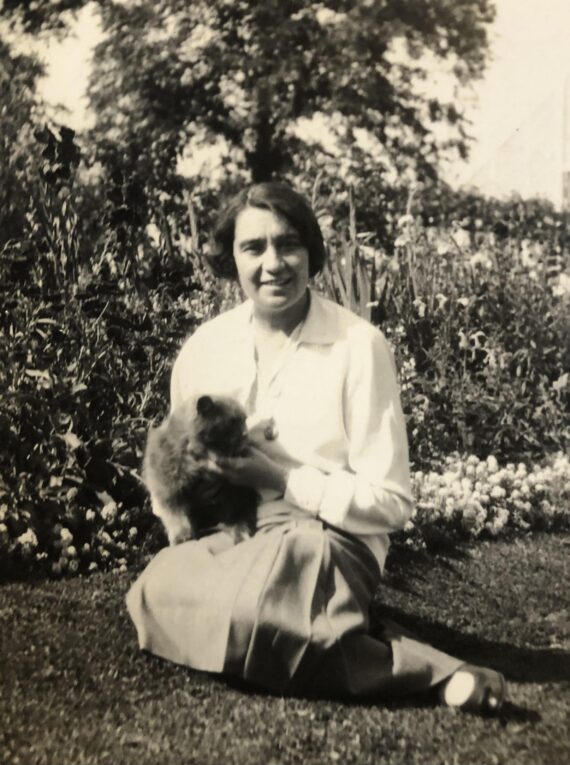
Figure 4: Photograph of Hilda Lofthouse and her cat.
In the second letter, dated 27 November, Lofthouse expressed her gratitude to Ker for his (now-missing) offer to contribute to the fund that was then being assembled to purchase the manuscripts and to intercede with the Friends of the National Libraries—whose support the library has recently benefitted from—to similarly contribute. She hoped that Ker could ‘soften their hearts’, since Chetham’s Library was not a national library (a distinction since erased by their name change to the Friends of the Nation’s Libraries). Lofthouse had since heard back from the Library Committee, who were entirely in favour of acquiring the manuscripts; the chairman, Professor Ernest Rupp, was going to write to Starkie urging a private sale, and if that proved unsuccessful then the library would bid in the ensuing auction. Lastly, she noted the advice of Ker and Professor Ernest Jacob (a medievalist, one of the library’s feoffees and president of the Chetham Society) to concentrate on the Mariale if it went to auction, although she drily remarked that ‘we could manage to find space for both’.
By the time of the next letter, dated 3 December, Ker had written to the Friends of the National Libraries on the library’s behalf, and Rupp had received a reply from Starkie. Although we do not have this reply, it was presumably negative, since the sale proceeded as planned on 12 December 1962. There, the Mariale was purchased for £680 (roughly £12,500 today) by Maggs Bros Ltd for the Huntington Library in San Marino, California. In her fourth letter, dated 16 January 1963, Lofthouse was still holding out hope that the Mariale would remain in Manchester; the library had been asked if it wished to object to its export, and since Manchester University Library was prepared to meet the auction price, the objection had been registered with Theodore Skeat, Keeper of Manuscripts and Egerton Librarian at the British Museum. Lofthouse nevertheless regretted ‘that it should have to happen in this way, and that either we or Bodley could not have had infinite cash to buy up anything which we wanted’.
In the fifth and final letter relating to the sale, dated 30 January, Lofthouse informed Ker that the university had backed out of the purchase and ‘decided not to appeal against the export of the Mariale’, and lamented that ‘the Huntington will, presumably, get it’. Skeat did not expect that Chetham’s Library’s own appeal would amount to anything, and he was sadly proven right: the Mariale slipped through the library’s fingers, and resides to this day at the Huntington Library (a few pages have been digitised and may be viewed online). Half a world away from its former home, it now stands as a distant testament to the efforts of the numerous individuals who sought to preserve Manchester’s medieval patrimony.